Glass Balustrade Building Regulations UK: What You Need to Know
If you're planning a glass balustrade for your home, one of the first questions that comes up is whether it needs to comply with building regulations. The short answer: yes, almost always. The good news is that the rules are straightforward once you know what applies.
This guide covers the key UK building regulations for glass balustrades in domestic properties, including height requirements, glass specifications, loading standards, and when you'll need building control involved. All of Dio-Met's balustrade systems are designed and manufactured in our Sheffield factory to meet or exceed these standards.
Please note: this guide is provided for general information only and should not be treated as professional, structural, or legal advice. Building regulations can vary depending on your specific project, location, and local authority interpretation. Always consult a qualified structural engineer and/or your local building control department before making decisions based on this information. Dio-Met Fabrications Ltd accepts no liability for any actions taken or not taken based on the content of this page.
When Do You Need a Balustrade?
Under Approved Document K of the Building Regulations (England and Wales), guarding is required wherever there's a change in floor level of more than 600mm. That covers staircases, landings, mezzanines, balconies, roof terraces, and raised decking.
If you're replacing an existing balustrade with a new glass system, the same rules apply. The replacement needs to meet current standards, not the ones that were in place when the original was installed.
Glass balustrade height regulations
The minimum height depends on where the balustrade is installed.
Internal stairs and landings: 900mm measured from the pitch line (the imaginary line running along the front edge of each step) to the top of the handrail or barrier.
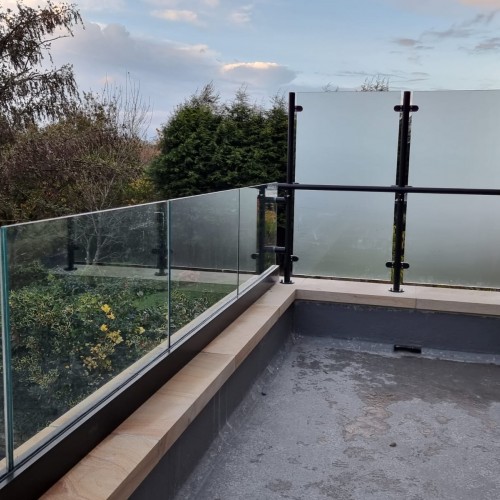
Balconies, terraces, and any external guarding: 1,100mm from finished floor level.
These are minimums. There's nothing stopping you going higher if the design calls for it, and for commercial or public buildings the requirements increase further.
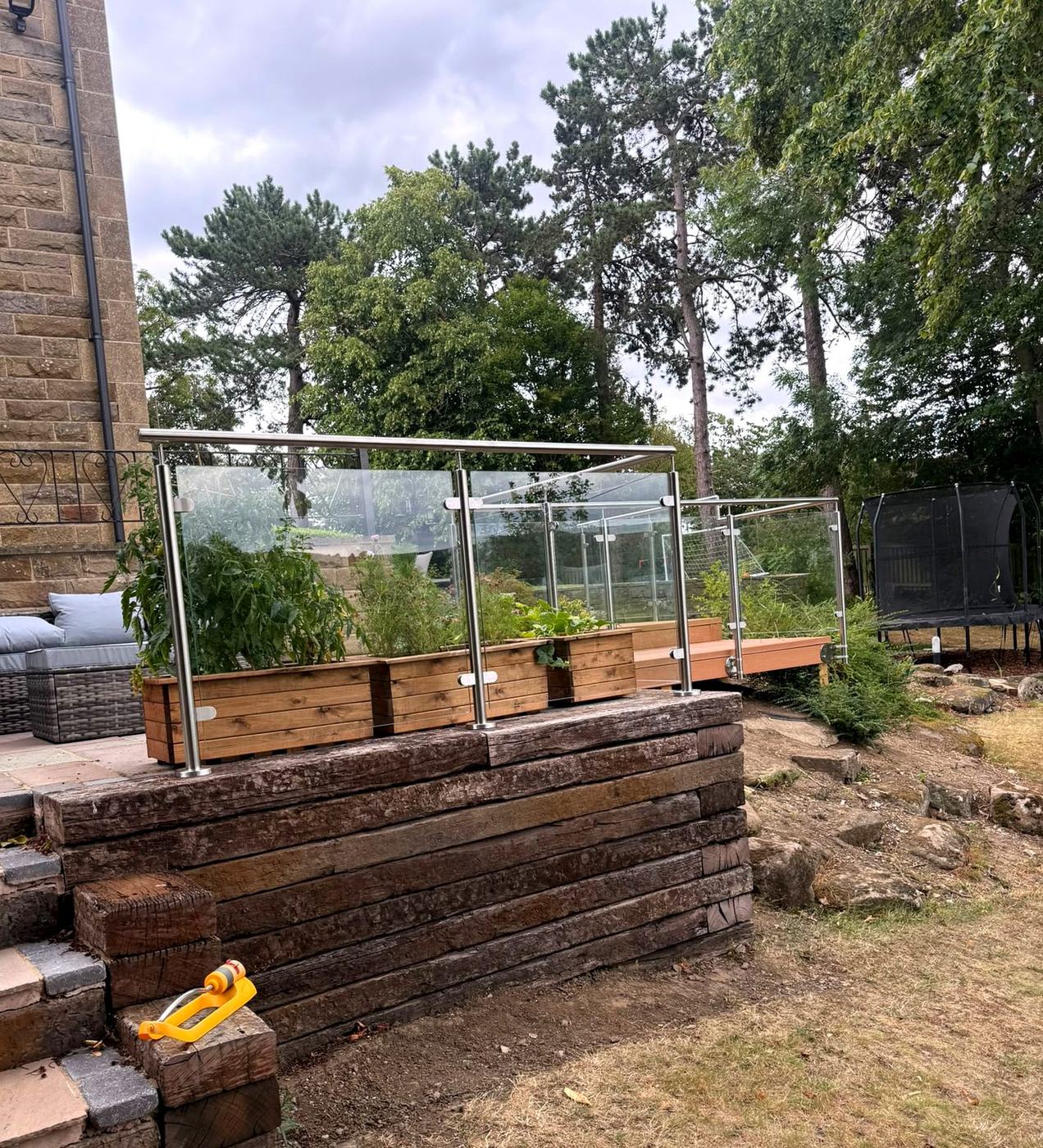
A single run often has to do both. On our framed glass balustrade to stone entrance steps in Grenoside the level guarding across the terrace and the raking guarding down the flight meet at the head of the steps, so the change from one measuring rule to the other has to be set out at survey rather than left to the fitters.
A note on Juliet balconies: the same 1,100mm height applies. If you're fitting a glass Juliet balcony to French doors on a first floor, the barrier must be at least 1,100mm from the internal finished floor level.
Glass balustrade specifications: toughened and laminated glass
Not any glass will do. Balustrade glass must be safety glass tested to BS EN 12600, the impact performance test. There is no single classification that covers every balustrade: what you need depends on whether the glass is the only thing guarding the edge, which comes down to the handrail. More on that just below.
In practice, this means you'll be using one of two types:
Toughened glass (to BS EN 12150) is heat-treated to be around four to five times stronger than standard annealed glass. When it does break, it shatters into small, relatively harmless granules rather than sharp shards.
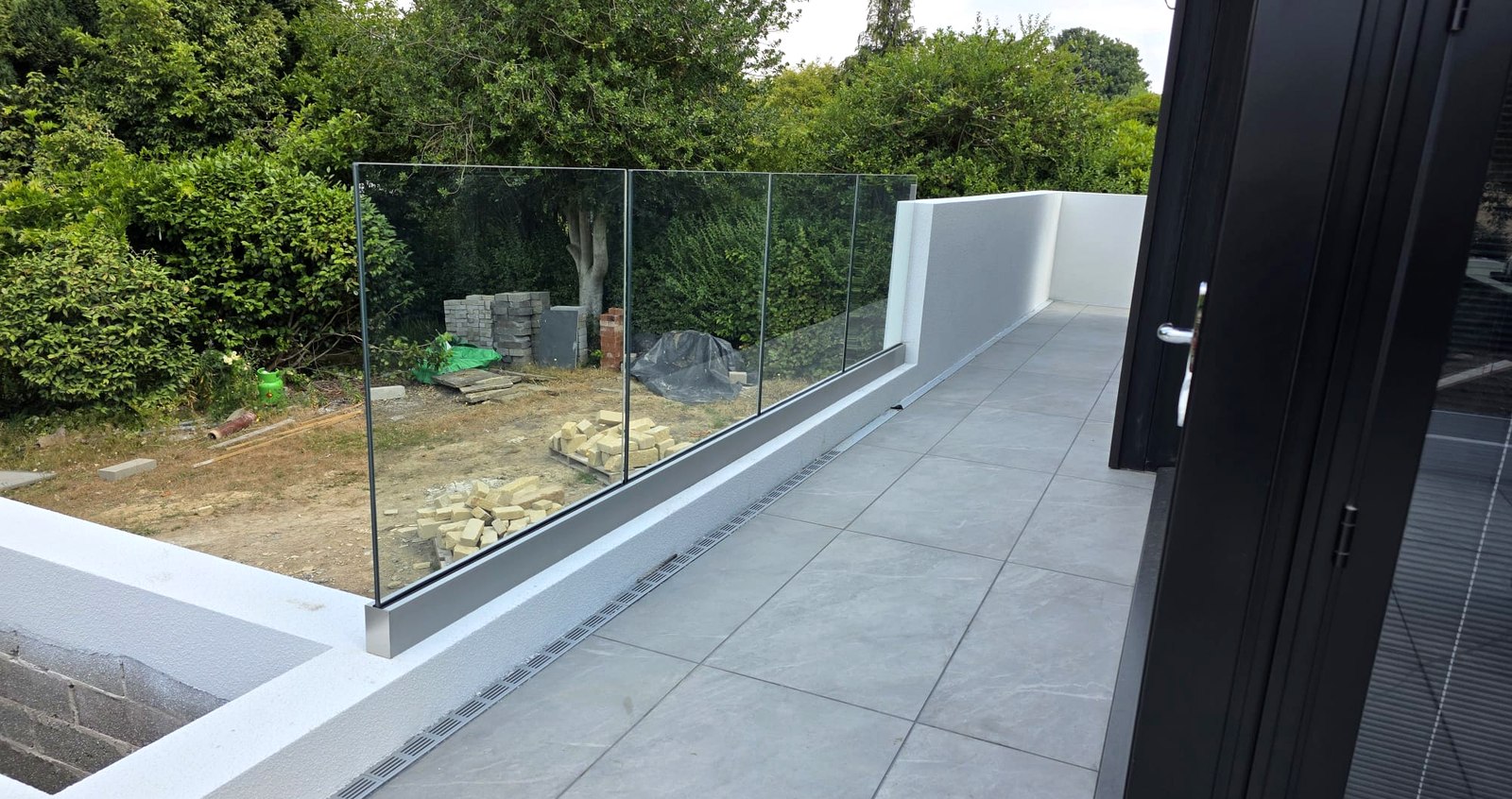
Laminated glass (to BS EN 14449) consists of two or more layers of glass bonded together with an interlayer (usually PVB). If it breaks, the interlayer holds the fragments in place. Laminated glass is required wherever a balustrade has no handrail, because the glass itself is acting as the barrier. On staircases, a handrail is always required by building regulations, but it doesn't have to be on the glass side: a wall-mounted handrail on the opposite side satisfies the requirement, meaning the glass panels can be frameless without a top rail.
For frameless glass balustrades where the glass is structural (doing the work of holding loads without relying on a metal frame), laminated glass is the standard choice.
Typical minimum thicknesses for domestic balustrades:
- Post-supported systems (where glass is infill between metal posts): 10mm or 12mm toughened glass is usually sufficient
- Frameless structural systems used internally: 13.5mm laminated toughened glass
- Frameless structural systems used externally (balconies, terraces): 17.5mm or 21.5mm laminated toughened glass, depending on the span and loading
All glass supplied by Dio-Met comes with the relevant BS EN certification. If you're sourcing glass separately for a supply-only balustrade kit, make sure your supplier can provide certificates confirming compliance.
Do glass balustrades need safety glazing?
Yes, but not under the rule most people mean when they ask. Approved Document K has two separate sets of glazing rules and they catch different things, so it is worth being clear which one applies to a balustrade.
Section 5 covers glazing you might walk into or fall against, in what it calls critical locations: glazing in a wall or partition up to 800mm above floor level, and in a door or the 300mm strip beside it up to 1500mm. Glass in those positions has to be BS EN 12600 Class 3, or Class C under the older BS 6206, with door panes over 900mm wide allowed to drop to Class 2 or Class B.
A balustrade is not one of those locations. It is a barrier, judged on the falling protection rules and the BS 6180 loadings covered below, which is a more demanding specification anyway. So if someone tells you your balustrade needs to be Class 3 safety glazing, they have reached for the wrong table. Where section 5 does apply on our jobs is the glazing around a balustrade rather than the balustrade itself: a glazed screen forming part of a wall, or the door out onto a balcony.
If there is any doubt about which rule applies to your building, ask your building control officer before the glass is ordered. We can make a balustrade to whatever specification is required, and often do, but the decision on what a particular building needs is theirs to make and not ours to assert.
Does the glass have to be stamped or marked?
Approved Document K does not require it. In practice safety glass almost always carries a permanent mark in the corner of the pane, and building control inspectors look for it, because it is the quickest way to show which standard and class the glass was made to. Every pane we supply is marked and the specification is on the paperwork, so a query on site can usually be settled without taking anything apart.
Balustrade loading requirements and BS 6180
The minimum loading a domestic balustrade must withstand depends on its location. These are horizontal line loads applied to the top of the barrier, set out in BS 6180:2011 and referenced by Approved Document K.
Internal balustrades (stairs, landings, mezzanines): 0.36 kN/m
External balustrades (balconies, terraces, raised decking): 0.74 kN/m
To put that in plain terms: the balustrade needs to handle someone leaning against it, a child pushing on it, or a reasonable accidental impact without failing. External balustrades have a higher requirement because the consequences of failure at height are more severe.
For areas where crowds might gather (commercial properties, communal areas in flats, public buildings), the required loading increases significantly, up to 3.0 kN/m or more depending on the use. If your project falls into this category, get in touch and we can advise on the right specification.
Every Dio-Met balustrade system is load-tested to confirm it meets the relevant requirements.
UKCA Marking and Structural Steelwork (BS EN 1090)
If your balustrade includes structural steel components (posts, frames, base plates, or any load-bearing metalwork), there's an additional requirement that many suppliers overlook: the steelwork must be manufactured by a company certified to BS EN 1090-2 and carry the UKCA mark.
BS EN 1090 is the European (and now UK-adopted) standard for the fabrication and assembly of structural steel and aluminium. It covers everything from the welding procedures and materials used, through to quality control during manufacturing. UKCA marking is the UK equivalent of CE marking and is the legal requirement for structural steel products placed on the UK market.
This matters because a balustrade is a safety-critical structure. If the steelwork hasn't been manufactured under a certified quality management system, building control may reject it, and there could be liability issues down the line.
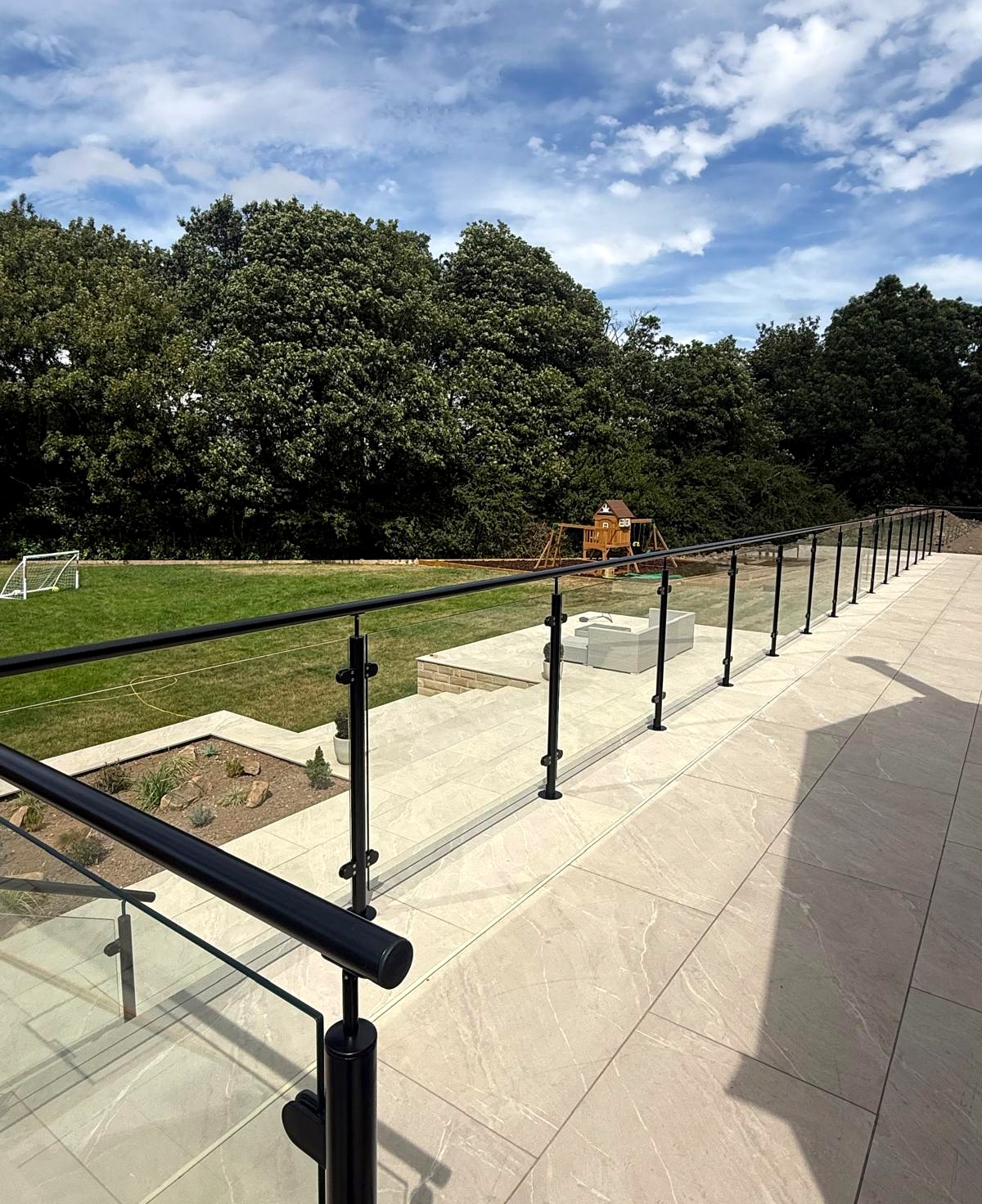
Dio-Met is fully certified to BS EN 1090-2 and all our structural steelwork carries the UKCA mark. This applies to our balustrade posts and frames, balcony structures, staircase steelwork, and glass floor hatch frames. We can provide Declaration of Performance certificates for any steelwork we manufacture.
What to check if you're buying elsewhere: ask your supplier whether their steelwork is manufactured under BS EN 1090 certification and whether it comes with UKCA marking. If they can't confirm both, that's a red flag.
The 100mm sphere rule for balustrade gaps
Approved Document K requires that no opening in a balustrade should allow a 100mm sphere to pass through. This is a child safety measure, roughly the size of a small child's head.
For most glass balustrade systems this isn't an issue because the glass panels are solid. But it does affect the gaps between panels, between the glass and posts, and between the bottom of the glass and the floor. If your system has any openings, they all need to be under 100mm.
Do you need planning permission for a glass balustrade?
In most cases, no. Replacing or installing a glass balustrade on an existing structure (a staircase, landing, or existing balcony) is generally permitted development and doesn't require planning permission.
However, planning permission may be needed if:
- You're building a new balcony or terrace (the structure itself, not just the balustrade on it)
- Your property is listed
- You're in a conservation area
- The installation significantly changes the external appearance of the building
If in doubt, a quick call to your local planning authority will clarify things. It's always better to check before you start.
Do glass balustrades need building control approval?
Yes, in most situations. Any balustrade installation that forms part of building works subject to Building Regulations will need inspection and approval by building control, either your local authority's building control department or a private approved inspector.
In most cases, building control will want to see a UKCA Declaration of Performance certificate for any structural steelwork. This confirms that the manufacturer is certified to BS EN 1090-2 and that the product meets the required standards. Some local authorities may also request project-specific structural calculations, though this is increasingly rare.
It's always worth checking with your local building control office early on to understand exactly what they'll need for your specific project.
Dio-Met supplies UKCA Declaration of Performance certificates as standard with all our structural steelwork. If your building control officer requires additional documentation such as project-specific structural calculations, we can provide these on request.
Which Dio-Met Systems Meet Building Regulations?
Every glass balustrade system we manufacture at our Sheffield factory is designed to comply with Approved Document K and BS 6180 for domestic applications, unless its description says otherwise or a client specifically instructs otherwise.
Our range includes:
- Post-and-glass systems (System 1, System 2, and others) using stainless steel or powdercoated steel posts with toughened glass infill panels
- Frameless structural glass (System 4, System 7) using thicker laminated or toughened glass without visible posts
- Parapet/cavity wall systems for new builds and roof terraces, specifically designed for building regulation compliance on raised parapets
A caveat on compliance, and on our photographs
Compliance is what we design to, but it is not always what a client wants built. Occasionally someone asks us to supply something that would not pass building control. Infill left out so a balustrade reads as cleaner, a top rail dropped from a design that needs one, or a height set below what the drop requires.
Where that happens the client is making an informed decision on their own knowledge and at their own risk, and we tell them so at the time. It does mean that some of the finished work in our photographs, on this site and elsewhere online, was built to a client's instruction rather than to Approved Document K. Please do not treat a photograph as a specification.
If your project has to satisfy building control, say so at enquiry stage. We will design to it, and tell you where something you have seen elsewhere would not comply.
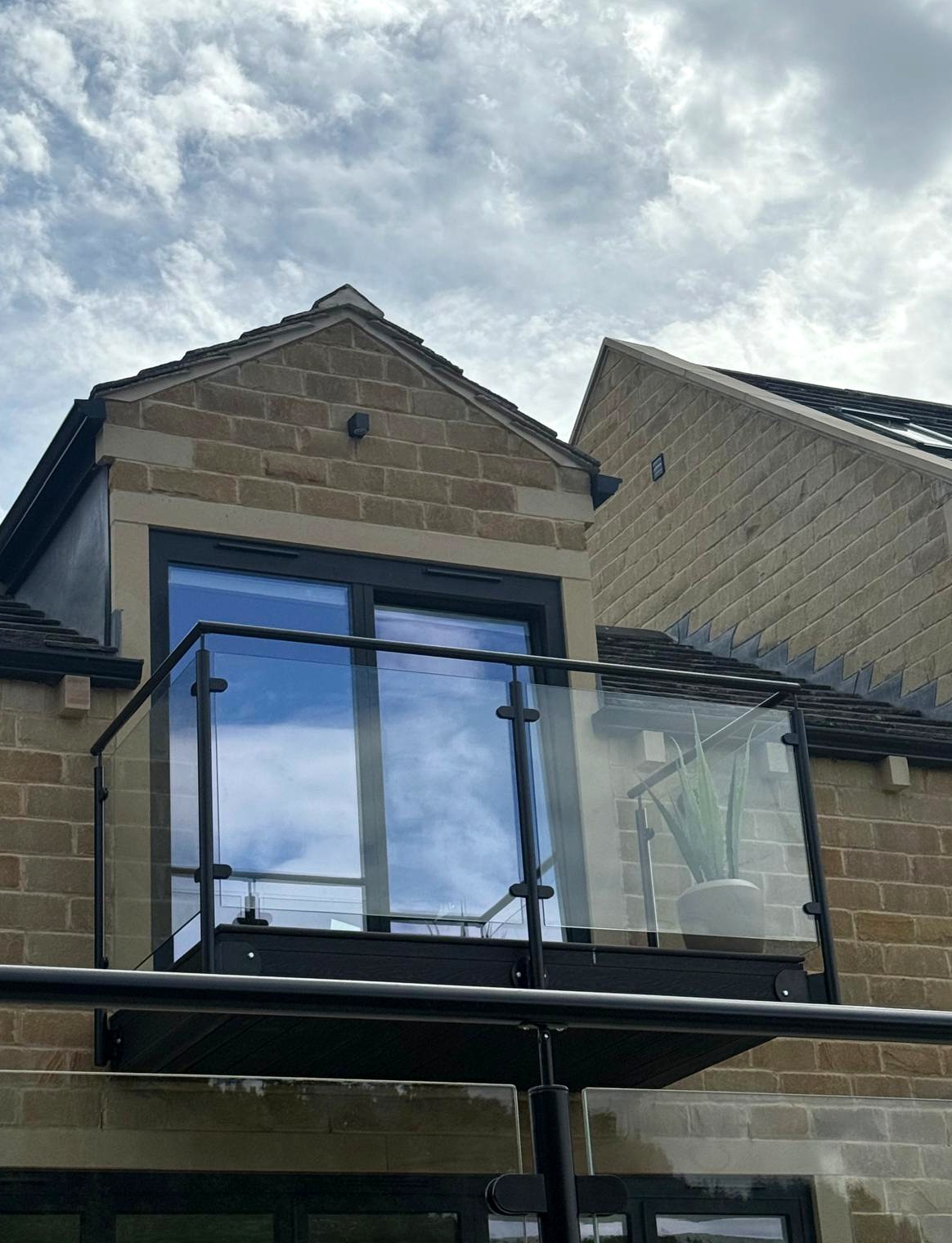
If you're not sure which system is right for your project, get in touch and we'll help you work it out or check out our glass balustrade buying guide
Frequently Asked Questions
What is the minimum height for a glass balustrade in the UK?
900mm for internal staircases (measured from the pitch line) and 1,100mm for balconies, landings, terraces, and any external guarding (measured from finished floor level). These are set out in Approved Document K of the Building Regulations.
Does a glass balustrade need building control approval?
In most cases, yes. Building control will generally want to see a UKCA Declaration of Performance certificate for the structural steelwork, and some may request additional documentation. Requirements can vary between local authorities, so it's always worth checking early. Dio-Met supplies UKCA Declarations of Performance as standard.
What type of glass is required for a balustrade?
Safety glass tested to BS EN 12600. Which type depends on the handrail. Where a handrail is fitted, toughened glass (BS EN 12150) is acceptable, because the rail still guards the edge if a pane breaks. Where there is no handrail on the glass, it has to be laminated (BS EN 14449), typically classified 1B1, because the glass is the whole barrier and has to stay in place after impact. For post-supported systems, 10-12mm toughened glass is typical. For frameless systems, 13.5mm laminated internally or 17.5mm/21.5mm laminated externally.
Do I need planning permission to install a glass balustrade?
Usually not. Replacing or adding a balustrade to an existing structure is normally permitted development. You may need planning permission if you're building a new balcony, your property is listed, or you're in a conservation area. Check with your local planning authority if unsure.
Does a glass balustrade need UKCA marking?
The glass itself doesn't require UKCA marking, but any structural steelwork (posts, frames, base plates) does. The steelwork must be manufactured by a company certified to BS EN 1090-2 and carry the UKCA mark. Dio-Met is fully certified and all our structural steelwork is UKCA marked. If you're sourcing from another supplier, ask them to confirm their BS EN 1090 certification.
Can Dio-Met supply the documentation needed for building control?
Yes. We supply UKCA Declaration of Performance certificates as standard with all structural steelwork. If your building control officer requires additional documentation such as project-specific structural calculations, we can provide these on request.
Balustrades we have built to these rules
Worth seeing the systems in place rather than just described. All surveyed, made in Sheffield and installed by our own fitters.
- System 1 stainless and glass across stepped levels, Totley, Sheffield
- System 4 frameless base channel to a raised patio, Barnsley
- System 10 galvanised and powder coated, patio and balcony, Sheffield
- Frameless infinity glass balustrade, Ranmoor, Sheffield
- Parapet wall glass balcony balustrade, Norton, Sheffield
- All bespoke projects
Related Products
- Metal & Glass Balustrades: our full range of framed and frameless systems
- Frameless Glass Balustrades: structural glass systems without visible posts
- Glass Juliet Balconies: minimalist balconies for first-floor French doors
- Walkout Balconies: full walkout balcony systems in steel and glass
- View all our bespoke projects
Need Advice on Your Project?
Not sure which system meets regulations for your specific situation? We've been manufacturing glass balustrades in our Sheffield factory for over 30 years and we deal with building control queries every week. Call us on 0114 243 9009 or email sales@diometonline.co.uk, or request a quote online.
Disclaimer
The information on this page is provided by Dio-Met Fabrications Ltd for general guidance purposes only. It does not constitute professional, structural, engineering, or legal advice. While we make every effort to keep this information accurate and up to date, building regulations, British Standards, and their interpretation by local authorities can change and may vary by project and location. Dio-Met Fabrications Ltd makes no representations or warranties of any kind, express or implied, about the completeness, accuracy, or reliability of the information provided. You should always seek advice from a qualified structural engineer, architect, or your local building control authority before proceeding with any installation. Dio-Met Fabrications Ltd accepts no liability for any loss, damage, or consequence arising from reliance on the content of this page. This guide relates to England and Wales only; regulations in Scotland and Northern Ireland may differ.
Tags: lass balustrade building regulations, balustrade height requirements UK, BS 6180, Approved Document K, glass balustrade specifications, balustrade regulations domestic, glass barrier building regs, balustrade loading requirements