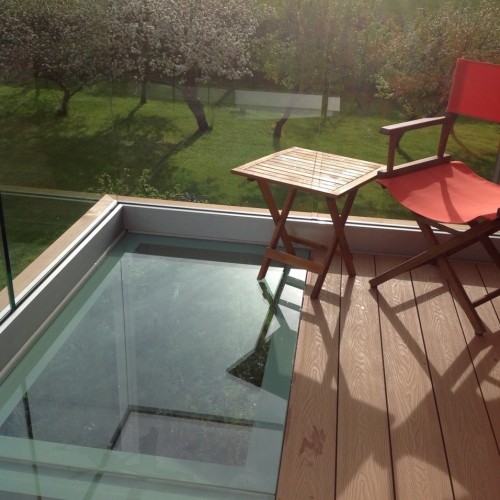
Balcony & Juliet Balcony Building Regulations UK: What You Need to Know
If you're planning a walkout balcony or juliet balcony, building regulations will apply to your project. The requirements for balconies are actually more involved than many people expect, covering everything from barrier heights and structural loading through to planning permission and fire safety.
This guide covers the key UK building regulations for both walkout balconies and juliet balconies in domestic properties. There is some crossover with our glass balustrade building regulations guide, particularly around barrier heights, glass specifications, and loading. Where the two overlap, we've kept things brief here and linked across. Where balconies have their own specific requirements, particularly around structural design, planning permission, and fire safety, we've covered those in full.
All of Dio-Met's balcony and juliet balcony systems are designed and manufactured in our Sheffield factory to meet or exceed these standards.
Please note: this guide is provided for general information only and should not be treated as professional, structural, or legal advice. Building regulations can vary depending on your specific project, location, and local authority interpretation. Always consult a qualified structural engineer and/or your local building control department before making decisions based on this information. Dio-Met Fabrications Ltd accepts no liability for any actions taken or not taken based on the content of this page.
Walkout Balcony vs Juliet Balcony: What's the Difference?
Before getting into the regulations, it's worth being clear about the distinction, because the rules are quite different for each.
A walkout balcony is a platform that projects from the building. You open a door and step out onto it. It's a usable external space that must support the weight of people, furniture, and whatever else ends up out there. Structurally, it needs to be designed as a floor, not just a barrier.
A juliet balcony has no platform at all. It's a protective barrier fitted across an opening (usually full-height French doors or a floor-to-ceiling window) to allow the doors to open safely without anyone being able to fall out. You don't step onto anything. There's no external floor to stand on.
This distinction matters because walkout balconies need structural design, planning permission, and significantly higher loading calculations. Juliet balconies are simpler in almost every respect, but they still need to comply with barrier height, glass specification, and building control requirements.
Already Have a Balcony and Just Need a Balustrade?
It's worth mentioning that some people use the word "balcony" when they actually mean the balustrade (the glass or metal barrier around the edge). If you already have a balcony structure, roof terrace, or raised area and you just need a balustrade fitted to it, the regulations you need are covered in our glass balustrade building regulations guide rather than this one. That guide covers barrier heights, glass specifications, loading, and building control requirements for balustrades as standalone products.
This guide is for situations where you're building a new walkout balcony (the structure itself) or fitting a new juliet balcony to an opening.
Balcony handrail and railing height regulations
The minimum barrier height for both types is set out in Approved Document K of the Building Regulations (England and Wales).
Walkout balconies: the barrier (balustrade, railing, or glass panel) must be at least 1,100mm from the finished floor level of the balcony itself.
Juliet balconies: the barrier must be at least 1,100mm from the internal finished floor level. Because there's no external platform, the measurement is taken from the floor inside the room.
These are minimums. You can go higher if the design calls for it, and in practice some juliet balcony designs sit slightly above 1,100mm to give a comfortable margin.
The 100mm sphere rule also applies to both types. No gap in the barrier should allow a 100mm sphere to pass through. This is a child safety measure. For glass balconies and juliets, the solid glass panels take care of this, but pay attention to gaps between panels, between glass and posts, and at the base of the barrier.
For more detail on barrier heights in different locations (stairs, internal landings, external guarding), see our glass balustrade building regulations guide.
If you are still deciding which Juliet balcony to buy rather than what the rules are, our Juliet balcony buying guide compares glass, metal, curved step-out and wide span designs, with sizing, fixings and prices.
Balcony and Juliet balcony planning permission
This is where walkout balconies and juliet balconies diverge significantly.
Juliet balcony planning permission
A juliet balcony does not usually require planning permission. Because there's no external platform and no usable outdoor space, it's generally treated as permitted development. You're essentially fitting a safety barrier to a window or door opening, which doesn't change the building's footprint or create overlooking issues.
Exceptions apply if your property is listed, in a conservation area, or subject to an Article 4 direction that restricts permitted development rights. In all cases, check with your local planning authority before ordering.
Walkout balcony planning permission
A walkout balcony almost always requires planning permission. This is because it creates new external usable space, it projects from the building envelope, and it can affect the privacy of neighbouring properties.
The local planning authority will typically consider the balcony's size and projection from the building, its height above ground, any overlooking of neighbouring gardens or windows, the visual impact on the streetscape, and whether it's in keeping with the character of the area.
If your property is in a conservation area or is a listed building, expect additional scrutiny and potentially more restrictive conditions.
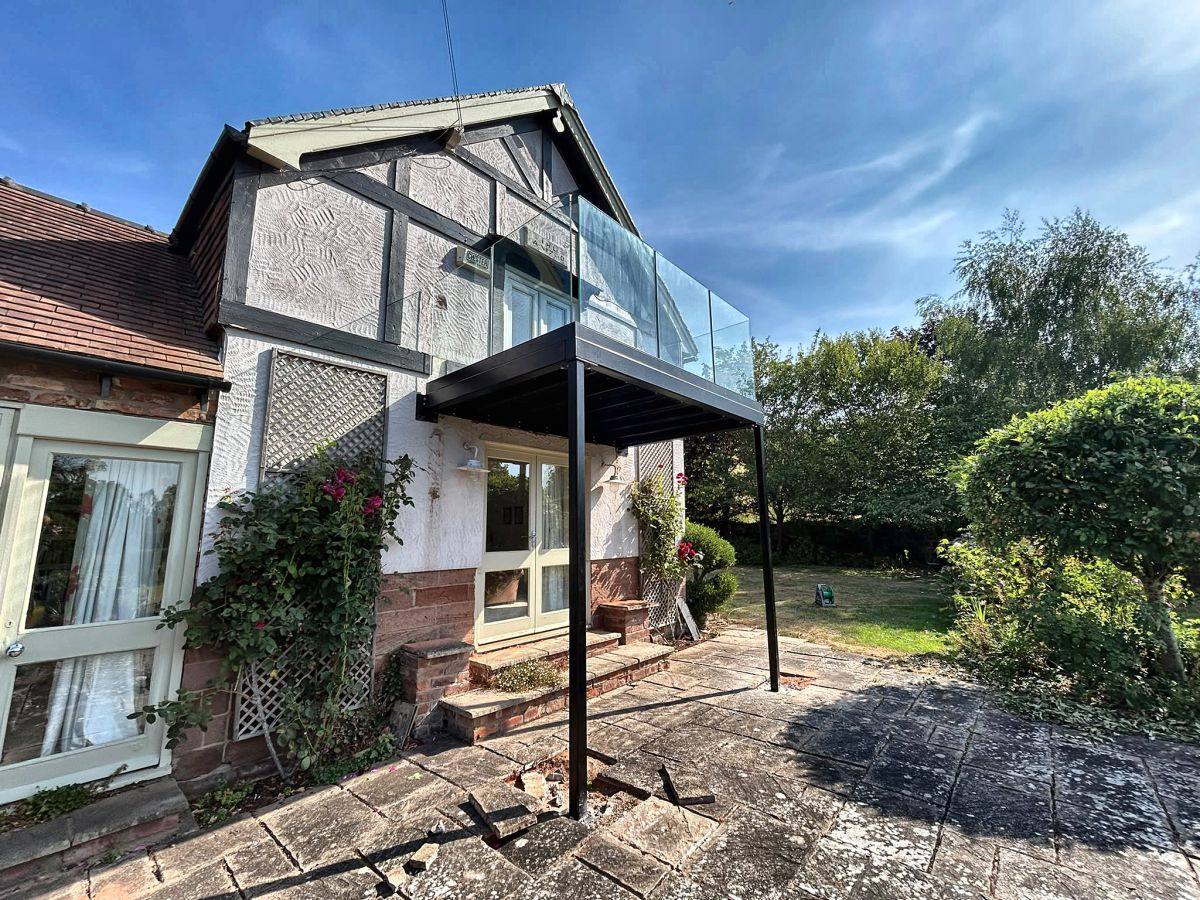
Our advice: apply for planning permission before ordering your balcony. We've seen projects delayed because planning was applied for too late. It's not unusual for the process to take 8 to 12 weeks, and conditions may be attached that affect the design, materials, or position of the balcony. A walk-out balcony we built in Great Missenden ran in the right order: survey and drawing first, then planning approval, then the balcony was made.
Drawings for a balcony planning application
People often assume the balcony drawing is the planning application. It is not, and finding that out after you have paid for something is the wrong time.
We survey the property and produce a general arrangement drawing of the balcony itself, to scale. It shows the size and projection, the height above ground level, the steel sections, the joist arrangement, the guarding height, the balustrade specification, the finish, and how the whole thing is fixed back to the building and down to its footings. That is the part a planning officer cannot get from anywhere else, because until somebody has measured your house nobody knows what the balcony actually is.
What a householder application normally asks for is broader than that. A typical list is a site location plan at around 1:1250 showing where the property sits, a block or site plan at 1:200 or 1:500 showing the property and its boundaries, and existing and proposed elevations at 1:100 or 1:50 for every face of the house that is affected, not just the one the balcony is on. Floor plans are often wanted too, and on a sloping site you may be asked for sections or level drawings showing how the proposal sits against existing ground levels.
Our drawing covers the balcony. It does not cover the location plan, the block plan, or full elevations of the rest of the house.
What individual planning departments will actually accept varies, and it varies more than people expect. Some are perfectly happy with our balcony drawing alongside a marked up existing elevation and a location plan you can buy online. Others want the whole set drawn up properly, in which case an architect or a planning drawing service is doing that work and our drawing becomes one input to it rather than the submission.
So the useful order is: ring your planning department first and ask what they want for a rear balcony on a house like yours. It is a short phone call and it is free. Then commission whatever they have told you they need. Doing it the other way round is how people end up paying twice.
Our drawings are charged as a separate piece of work, and if the balcony then goes ahead with us that charge comes off the order. It means you are not asking us to design something for nothing before you know whether you are allowed to build it, and you are not paying for the design twice if you are.
Juliet balcony construction and structural requirements
Juliet balcony structural requirements
A juliet balcony is non-loadbearing in the traditional sense. It doesn't need to support the weight of people standing on it because nobody stands on it. However, it does need to resist the horizontal loads set out in BS 6180:2011 for barriers, specifically the force of someone leaning against it or falling into it.
For a domestic juliet balcony, the minimum horizontal line load is 0.74 kN/m applied to the top of the barrier. This is the same as any external domestic balustrade.
The fixings into the building structure (typically the wall or the window reveals) need to transfer this load safely. This is why it matters what you're fixing into. Solid masonry, reinforced concrete, or steel are straightforward. Timber frames, thin block, or insulated render systems need more thought and potentially specialist fixings or a bolt-through design.
Walkout balcony structural requirements
Walkout balconies are a different proposition entirely. The balcony platform is a structural element that must be designed to carry:
Floor loading (BS EN 1991-1-1 / UK National Annex):
- Minimum uniformly distributed load: 2.5 kN/m² for a residential balcony (some engineers design to 4.0 kN/m² depending on expected use)
- Concentrated load: 2.0 kN applied over a 50mm square area
Balustrade loading (BS 6180:2011):
- Horizontal line load at the top of the barrier: 0.74 kN/m for domestic external balustrades
The connection between the balcony and the building is critical. This is where most of the engineering effort goes, particularly for cantilevered designs where the balcony projects without visible support from below. The connection must transfer both the vertical loads (weight of the balcony, people, furniture, snow, etc.) and the bending moment created by the cantilever.
For a cantilever walkout balcony, you will almost certainly need a structural engineer to produce project-specific calculations. Building control may want to see these before approving the work.
All Dio-Met walkout balcony structures are manufactured to BS EN 1090-2 and carry the UKCA mark. We can provide structural calculations for our systems and work with your structural engineer if one is already appointed.
Balcony glass specifications
The glass requirements for balcony and juliet balcony balustrades are the same as for any glass balustrade. The key points are:
All glass must be safety glass meeting BS EN 12600 with a minimum classification of 1B1 (the highest impact resistance category).
Toughened glass (BS EN 12150) is suitable where the glass is contained within a frame or between posts and a handrail is present. Typical thickness for post-supported systems is 10mm or 12mm.
Laminated glass (BS EN 14449) is required wherever the glass is the sole means of protection (no handrail on the glass), wherever the glass is structural (frameless systems), and is recommended for any external application at height. Typical thicknesses for external balcony balustrades range from 17.5mm to 21.5mm laminated toughened, depending on the span and loading.
For a full explanation of glass types, thicknesses, and when laminated glass is required, see our glass balustrade building regulations guide.
Balcony fire safety regulations
Fire safety regulations under Approved Document B can apply to balconies, particularly in certain building types.
Residential Houses
For a typical domestic property (a house, not a flat), fire safety requirements for balconies are minimal. The main consideration is that the balcony materials don't contribute to external fire spread. Steel and glass are both non-combustible, so Dio-Met balcony systems don't create an issue here.
If the balcony is accessed via a door, that door doesn't need to be fire-rated in a standard domestic situation unless it's part of an escape route.
Flats and Multi-Storey Residential
For buildings containing flats, particularly those over 11m in height, the requirements are more stringent. Balcony materials in buildings over 18m must be entirely non-combustible (classified A1 or A2-s1,d0 under BS EN 13501-1). This effectively rules out timber decking on high-rise balconies.
Steel and glass meet the non-combustible requirement, which is one of the reasons steel-framed balcony systems have become the default specification for new-build flats.
If a balcony forms part of an escape route (which is uncommon in domestic properties but can apply to some flat conversions), additional requirements around fire-rated doors and protected routes will apply.
Thermal Efficiency (Part L)
If you're installing a new balcony door or replacing an existing one, the door must meet the thermal performance requirements of Approved Document L. For replacement doors, the maximum U-value is 1.6 W/(m²·K), or a minimum energy rating of C.
This doesn't apply to the balcony structure itself, but it's worth being aware of when planning the full project.
Do balconies need building control approval?
Building control approval for a Juliet balcony
A juliet balcony installation will normally need building control approval if it forms part of wider building work that's subject to the Building Regulations (for example, a loft conversion with new French doors, or an extension with a first-floor opening).
If you're simply replacing an existing juliet balcony with a new one on an otherwise unchanged opening, building control may not need to be involved, but it's always worth checking. Requirements vary between local authorities.
Building control will typically want to see that the barrier height meets the 1,100mm minimum, the glass specification meets BS EN 12600, and the balcony has no gaps over 100mm.
Building control approval for a walkout balcony
Walkout balconies almost always require building control approval. This is a structural alteration to the building, and building control may want to see structural calculations, the connection design to the existing building, the balustrade specification (height, loading, glass type), UKCA Declaration of Performance certificates for any structural steelwork (BS EN 1090-2), and the drainage arrangement if applicable.
Expect inspections at key stages: before the connection to the building is concealed, during installation, and on completion.
Dio-Met supplies UKCA Declaration of Performance certificates as standard with all our structural steelwork. If your building control officer requires project-specific structural calculations, we can provide these on request.
Balcony drainage and overflow requirements
One detail that gets overlooked on walkout balconies is drainage. Rainwater needs to go somewhere, and if the balcony slopes back towards the building rather than away from it, you'll get water pooling against the door threshold.
Building control may require a minimum fall of 1:80 on the balcony surface, directing water away from the building. Some designs incorporate a small drainage channel or scupper at the outer edge. Many balcony designs with decking planks simply allow drainage through these boards.
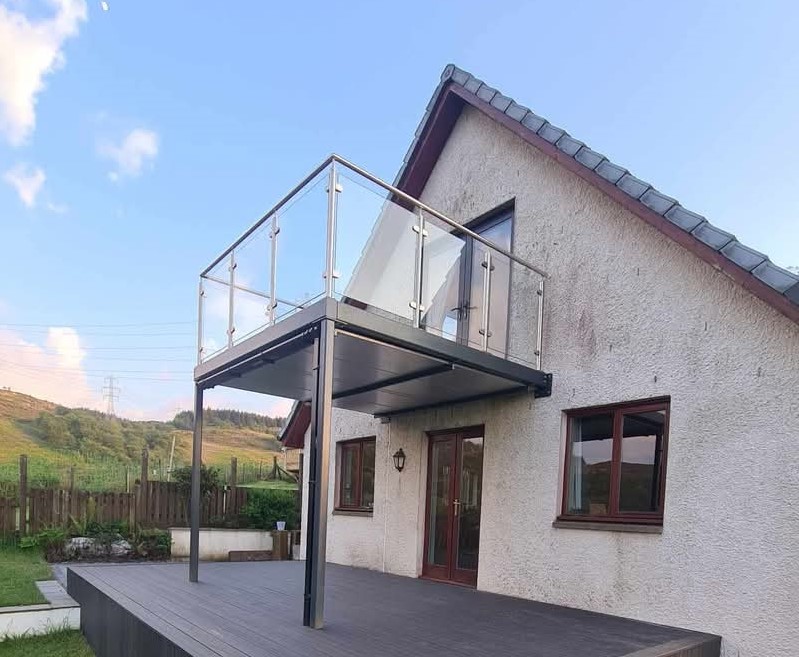
For balconies above other occupied spaces (such as a balcony over a ground-floor room), waterproofing of the balcony deck becomes important. Dio-Met offers steel drip tray and guttering systems that sit beneath the balcony deck, effectively forming a waterproof canopy over the space below. This keeps the area underneath dry and usable, which is a common requirement when a balcony sits above a patio, doorway, or ground-floor extension.
Balcony privacy screen regulations
If your walkout balcony overlooks neighbouring properties, planning permission will often come with a condition requiring privacy screens. This is one of the most common planning conditions attached to balcony approvals, and it catches people out because it affects the balustrade design and budget.
What Planning Typically Requires
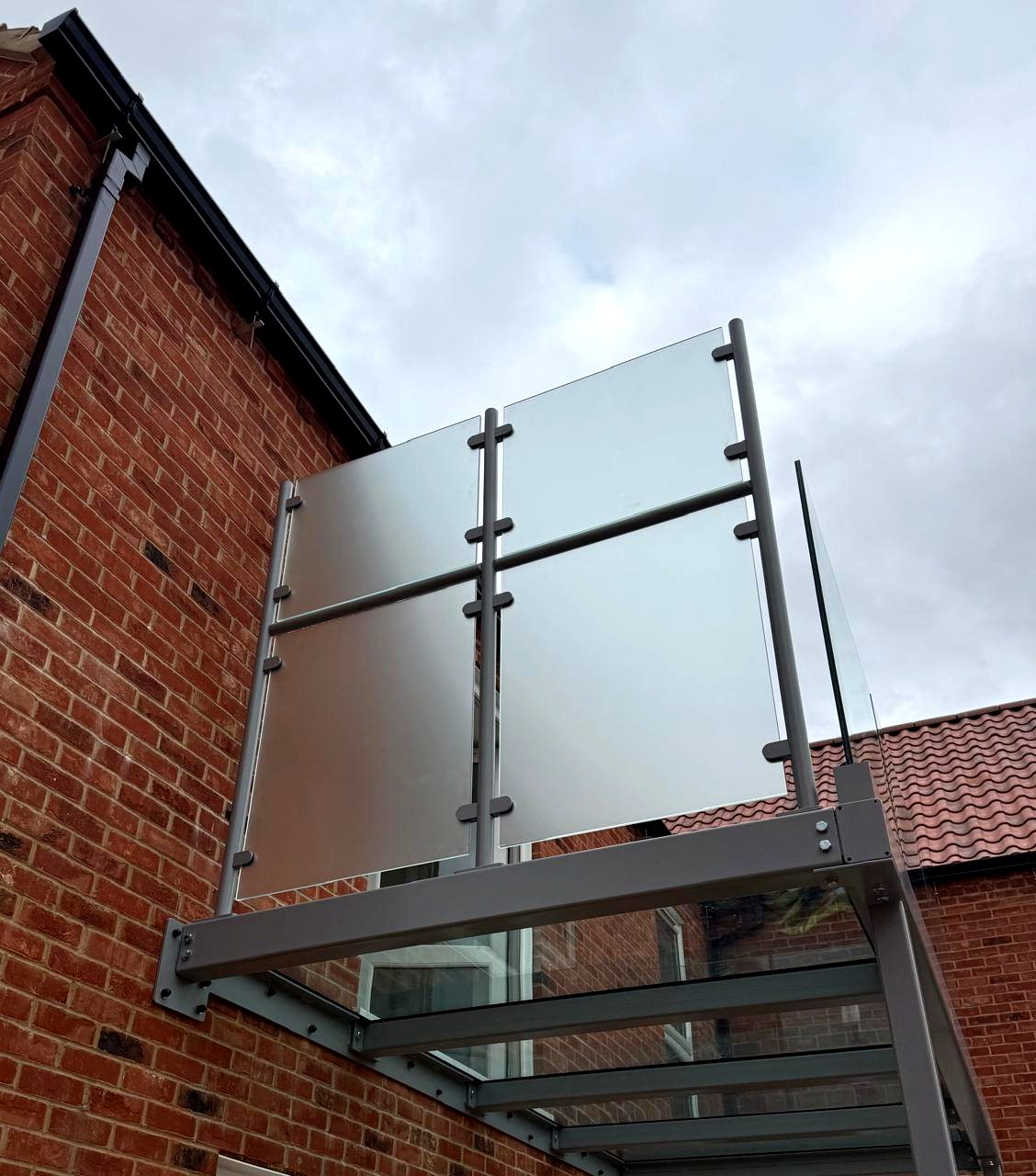
Privacy screens are usually required on one or both sides of the balcony (the sides facing neighbours), and the typical specification imposed by planning is 1,800mm high frosted or obscured glass. The exact wording varies between local authorities, but the intent is always the same: prevent direct overlooking of neighbouring gardens and windows.
Design Considerations
At 1,800mm, you're well above the standard 1,100mm barrier height, which has some important implications for the design:
Framed systems are the practical choice. Frameless structural glass balustrades become impractical at 1,800mm. The glass would need to be excessively thick and heavy to resist wind loads at that height without structural posts. A framed system with steel posts and glass infill panels is the standard approach for privacy screens.
Glass specification: Privacy screen glass can be either laminated toughened glass (where the glass is the sole means of protection above handrail height) or toughened glass with an offset handrail maintained at the standard 1,100mm height. The offset handrail option means the glass above 1,100mm acts as a screen rather than a barrier, which can simplify the glass specification. Your building control officer will advise on which approach they prefer.
Frosted or obscured glass: The planning condition will specify the type of obscure glazing. Frosted (acid-etched or sandblasted) glass is the most common choice. It lets light through while blocking the view. Some authorities specify a minimum obscurity level (such as Pilkington Level 3 or above).
Wind loading: At 1,800mm, wind loads on the screen are significant, especially on exposed or elevated sites. The posts and fixings need to be designed accordingly. This is another reason why framed systems with properly engineered steel posts are the right approach.
Getting It Right
If you're applying for planning permission for a walkout balcony and your property overlooks neighbours, assume privacy screens will be a condition. It's better to factor them into the design from the start rather than retrofitting them after planning comes back with conditions you weren't expecting.
Dio-Met manufactures bespoke privacy screen systems in steel and glass to match the balcony balustrade. We can work from your planning conditions to produce a screen that meets the exact specification required.
When can balcony building regulations be relaxed?
Sometimes a fully compliant installation isn't practical within the available space or the constraints of the existing building. In those situations, building control can offer dispensations or relaxations on a case-by-case basis.
For example, if a juliet balcony can't quite achieve 1,100mm because of the existing window head height, or if a walkout balcony can't achieve the full loading requirement due to the existing building structure, building control may accept an alternative approach if it can be shown that the design is safe and reasonable for the specific situation.
This isn't a loophole, and it isn't guaranteed. It's a formal process that requires a written application to your local authority. But it's worth knowing it exists before you abandon a project that seems non-compliant at first glance.
Balcony Access: Stairs and Spirals
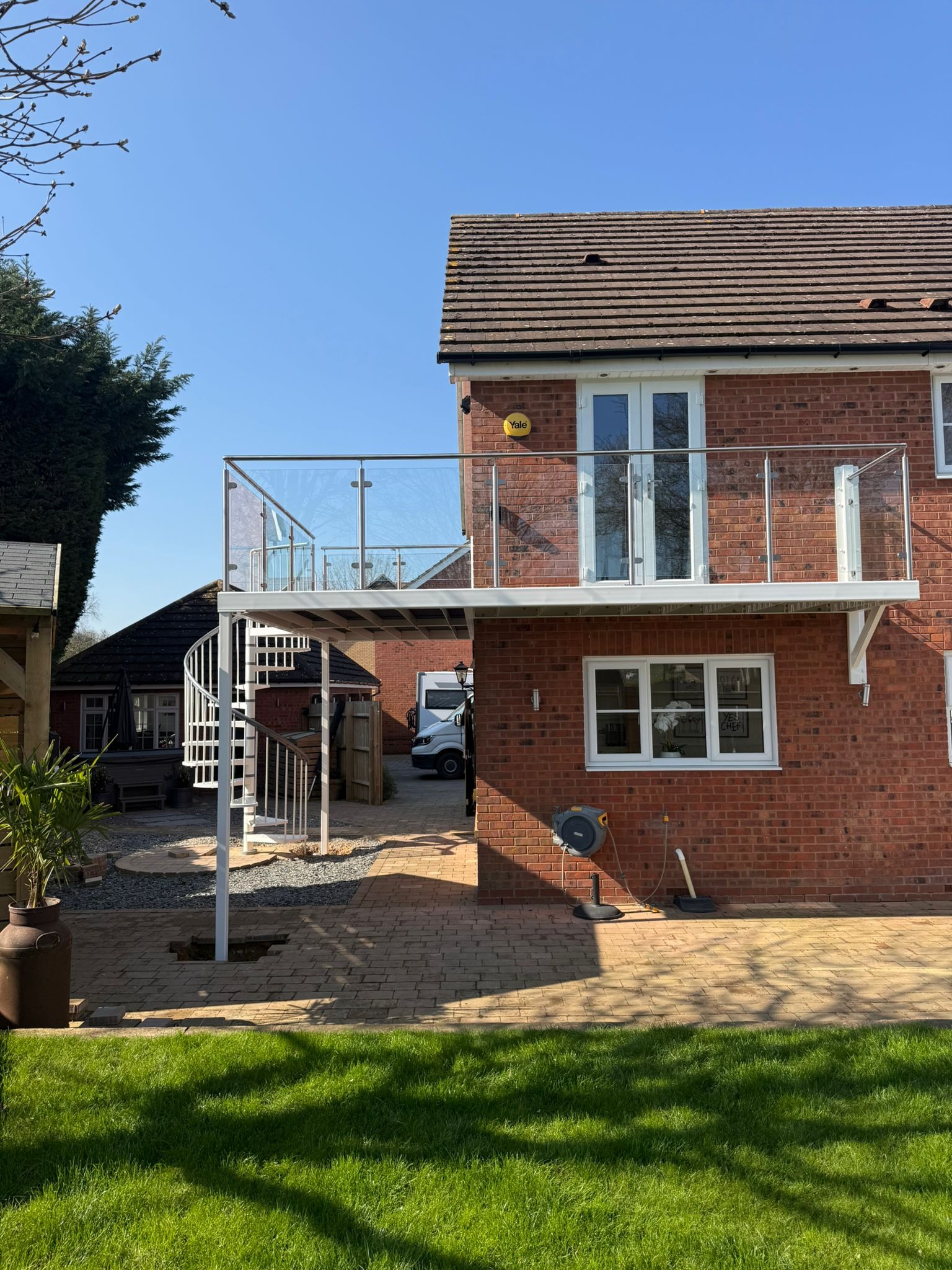
A walkout balcony on a first floor or above usually needs an access route, and for many projects that means an external staircase or spiral staircase. The staircase itself is subject to its own set of building regulations covering pitch, rise, going, handrail heights, and headroom.
If you're planning a balcony that includes external stair access, our staircase building regulations guide covers the requirements in detail. Dio-Met designs and manufactures both straight-flight and spiral staircases in steel, so we can supply the complete system (balcony, balustrade, and access stair) as a coordinated package from our Sheffield factory.
Walkout Balcony Construction: Steel vs Timber
Steel joists and NHBC Chapter 7.1
All Dio-Met walkout balconies are built using steel joists as standard. This is worth highlighting because many balcony suppliers still use timber joists for the structural frame, which creates problems over time.
Steel joists are the NHBC preferred option for balcony construction. Balcony decks are covered by Chapter 7.1 of the NHBC Standards, so on any plot signed off under an NHBC warranty, steel is the path of least resistance. There are good reasons for that:
Fire safety: Steel is non-combustible. In the wake of post-Grenfell guidance, non-combustible construction is increasingly expected for external structures, particularly on multi-storey residential buildings. Using steel joists means the entire structural frame of the balcony meets the non-combustible requirement without question.
Strength: Steel has a far higher strength-to-weight ratio than timber. This allows longer spans, thinner sections, and more design flexibility. For cantilevered balconies in particular, steel is the only practical choice because the connection loads are more predictable and easier to engineer.
Lower maintenance: Timber joists in an external, exposed location are vulnerable to moisture ingress, rot, and insect damage, even when treated. Steel joists with appropriate coatings (galvanised or powder coated) will outlast timber significantly with minimal maintenance. We galvanise or powder coat all our balcony steelwork as standard.
If you're comparing quotes from different suppliers, check what the structural frame is made from. It's one of the biggest differences in long-term performance and it's not always obvious from a product listing.
Composite Decking
Dio-Met supplies composite decking only on our walkout balcony systems. We don't offer timber decking for balconies, and the reasons mirror the argument for steel joists: durability, low maintenance, and fire performance.
Composite decking won't rot, warp, splinter, or need annual treatment. It maintains its appearance for years with nothing more than occasional cleaning. From a fire safety perspective, most quality composite decking products achieve a Class Bfl-s1 or better fire rating, which is significantly better than untreated timber.
Glass Floor Panels
For balconies that sit above a living space, patio, or entrance, light to the area below can be a concern. Dio-Met offers structural glass floor panels as an alternative to solid decking on part or all of the balcony surface. These allow natural light to pass through to the space underneath while still providing a safe, loadbearing walking surface.
Glass floor panels for balconies are manufactured to the same structural glass standards as our glass floor systems and are laminated for safety. They're a practical option where the balcony would otherwise cast the room below into shadow.
Adding a balcony to a house that never had one? This guide covers the regulations. For the practical side of a retrofit, including how the balcony is supported, replacing or modernising an old one, costs and lead times, see our guide to retrofitting a balcony to an existing house.
Which Dio-Met Systems Are Suitable?
Juliet balconies: we manufacture a range of glass juliet balcony systems in stainless steel and mild steel with various finishes. All meet the 1,100mm minimum height and are supplied with the correct glass specification. Our juliet balconies are supplied as complete units ready to fix to the building.
Walkout balconies: we design and fabricate bespoke walkout balcony structures with steel joist frames, composite decking, and glass or metal balustrades. Every walkout balcony is designed to the specific project requirements and manufactured to BS EN 1090-2 with UKCA marking. We can supply structural calculations and work with your architect or structural engineer. Options include glass floor panels for light transmission and steel drip tray/guttering systems for waterproof coverage of the area below.
Access stairs and spirals: if your balcony needs external stair access, we manufacture straight-flight and spiral staircases in steel to match the balcony system. See our metal staircases range.
For all of the above, we supply nationwide from our Sheffield factory.
Frequently Asked Questions
Do I need planning permission for a juliet balcony?
Usually not. A juliet balcony has no external platform and is generally treated as permitted development. Exceptions apply for listed buildings, conservation areas, and properties with restricted permitted development rights. Check with your local planning authority if you're unsure.
Do I need planning permission for a walkout balcony?
Almost always, yes. A walkout balcony creates new external usable space and typically requires a planning application. Apply early because the process can take 8 to 12 weeks, and conditions may affect the design.
What is the minimum barrier height for a balcony?
1,100mm from the finished floor level for both walkout balconies and juliet balconies. For walkout balconies this is measured from the balcony floor. For juliet balconies it's measured from the internal floor level. This is set out in Approved Document K.
What type of glass is used for balcony balustrades?
Safety glass meeting BS EN 12600 Class 1B1. For post-supported systems, 10mm or 12mm toughened glass is typical. For frameless or structural systems, laminated toughened glass from 17.5mm to 21.5mm is standard, depending on the span and exposure. External frameless glass balcony applications generally use laminated glass because of the height and the consequences of failure.
Do I need a structural engineer for a balcony?
For a walkout balcony, yes, in most cases. The balcony platform is a structural element that needs to be designed to carry floor loads, and the connection to the building needs engineering- this is covered on Dio-Met standard balconies but any non-standard project will need individual calculations to support it. Building control may expect to see structural calculations but the standard accepted route is a final UKCA certificate which Dio-Met supply as standard. For a juliet balcony, a structural engineer isn't usually needed, but the fixings must be suitable for the wall type and building control may ask for confirmation of this.
Can Dio-Met supply balconies outside Sheffield?
Yes. We manufacture in Sheffield and deliver / install nationwide. All our systems are designed for simple site assembly, so installation can be carried out by your own contractor or builder.
Balconies we have built to these rules
The regulations make more sense next to real jobs. Each of these was surveyed, made in our Sheffield factory, installed by our own fitters and marked to BS EN 1090-2.
- Post-supported walkout balcony with frameless glass, Malpas, Cheshire
- Walkout balcony with a glass floor and 1800mm privacy screen, Rutland
- Replacement balcony and staircase, Bourne End, Buckinghamshire
- Louvred steel privacy screen on an exposed site, Cumbria
- Waterproof balcony with drainage trays and guttering, Perthshire
- Large structural walkout balcony, Oban, Scotland
- All bespoke projects
- Obscure glass to the full perimeter, powder coated to match the windows, St Neots
Related Products
- Glass Juliet Balconies: our range of glass juliet balcony systems
- Walkout Balconies & Juliets: full walkout balcony systems in steel and glass
- Metal & Glass Balustrades: framed and frameless balustrade systems
- Glass Balustrade Building Regulations Guide: our companion guide covering balustrade-specific regulations
- View all our bespoke projects
Need Advice on Your Project?
Whether it's a juliet balcony for a loft conversion or a full walkout balcony for a new build, we deal with these projects and their regulations every week. Call us on 0114 243 9009 or email sales@diometonline.co.uk, or request a quote online.
Disclaimer
The information on this page is provided by Dio-Met Fabrications Ltd for general guidance purposes only. It does not constitute professional, structural, engineering, or legal advice. While we make every effort to keep this information accurate and up to date, building regulations, British Standards, and their interpretation by local authorities can change and may vary by project and location.
Dio-Met Fabrications Ltd makes no representations or warranties of any kind, express or implied, about the completeness, accuracy, or reliability of the information provided. You should always seek advice from a qualified structural engineer, architect, or your local building control authority before proceeding with any installation.
Dio-Met Fabrications Ltd accepts no liability for any loss, damage, or consequence arising from reliance on the content of this page.
This guide relates to England and Wales only; regulations in Scotland and Northern Ireland may differ.
Tags: balcony building regulations UK, juliet balcony regulations, balcony height requirements, Approved Document K balconies, walkout balcony planning permission, juliet balcony glass specification, balcony structural loading, BS 6180 balconies, balcony building control