How to Choose a Glass Balustrade System
Choosing a glass balustrade isn't as straightforward as picking one off a shelf. The right system depends on where it's going, what it's fixing to, what finish suits the property, whether you're fitting it yourself or having it professionally installed, and whether it needs to comply with building regulations (it almost certainly does).
This guide is designed to help you work through those decisions. It covers the key differences between framed and frameless systems, the finish options available, fixing methods, when you need a handrail, and what to look out for when comparing suppliers. If you want the technical detail on building regulations, glass specifications, and loading requirements, our glass balustrade building regulations guide covers all of that.
All of Dio-Met's balustrade steelwork is fabricated in our Sheffield factory. Our glass is sourced to the correct specification for each system. We supply nationwide, with both supply-only and professionally installed options available.
Frameless glass balustrade vs post-and-rail: which is right?
This is usually the first decision, and it's not purely aesthetic. There are practical reasons why one type suits certain situations better than the other.
Framed Glass Balustrades
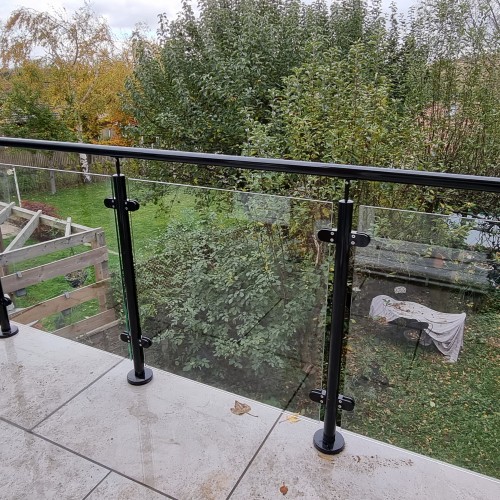
A framed system uses steel or stainless steel posts with glass panels clamped or seated between them, and usually a handrail running along the top. The posts do the structural work, and the glass is essentially infill.
Framed systems are the more versatile option. They can be fixed to almost any surface (timber decking, concrete, paving, steel structures), they work on stairs as well as flat runs, and the posts can be surface-mounted with base plates or side-fixed to a wall or fascia. They're also generally easier to install, which makes them a good choice for DIY or supply-only projects.
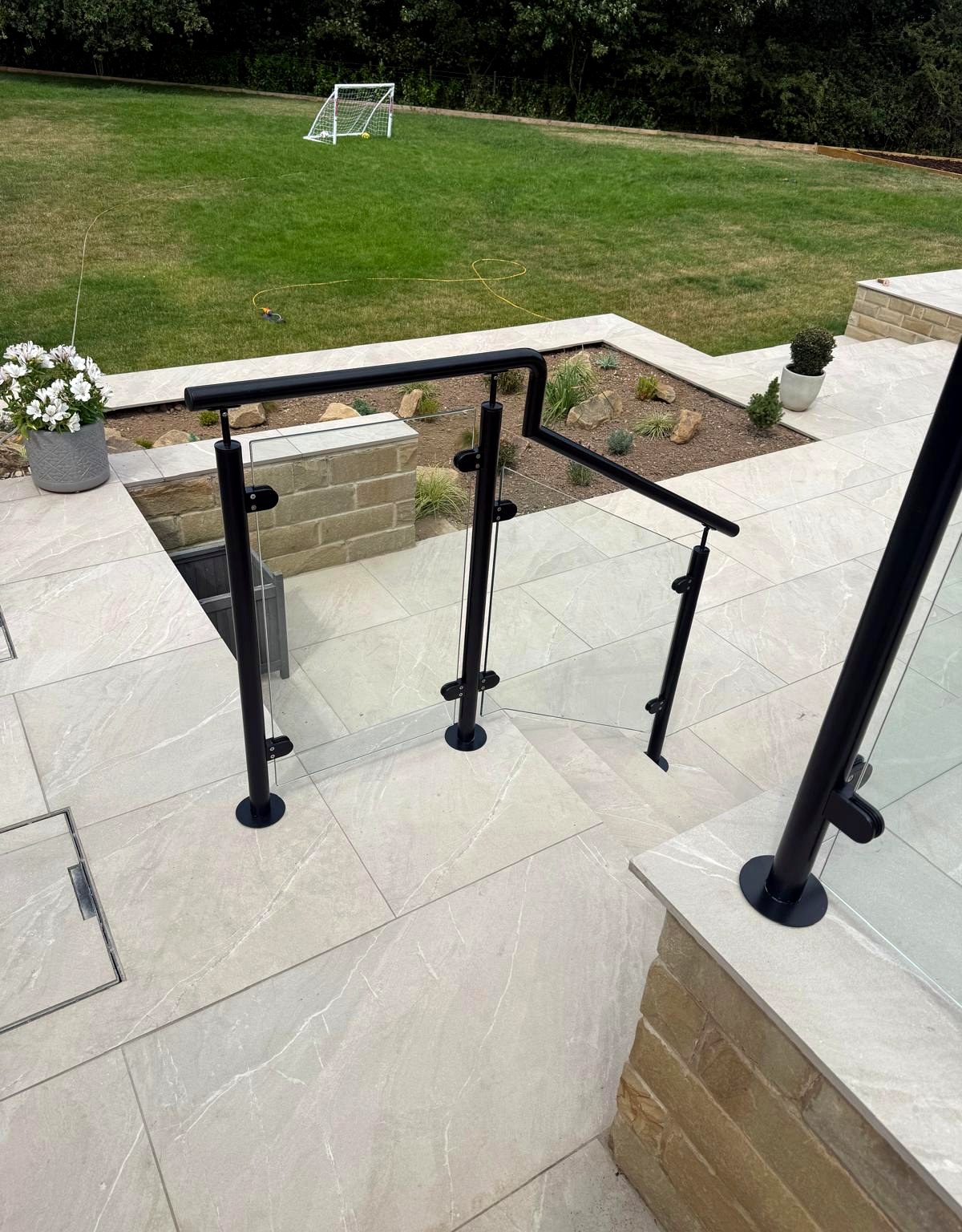
Dio-Met's framed systems include System 1 (stainless steel with handrail), System 8 (powder coated posts with stainless handrail), System 9 (galvanised steel), and System 10 (powder coated), among others.
Frameless Glass Balustrades
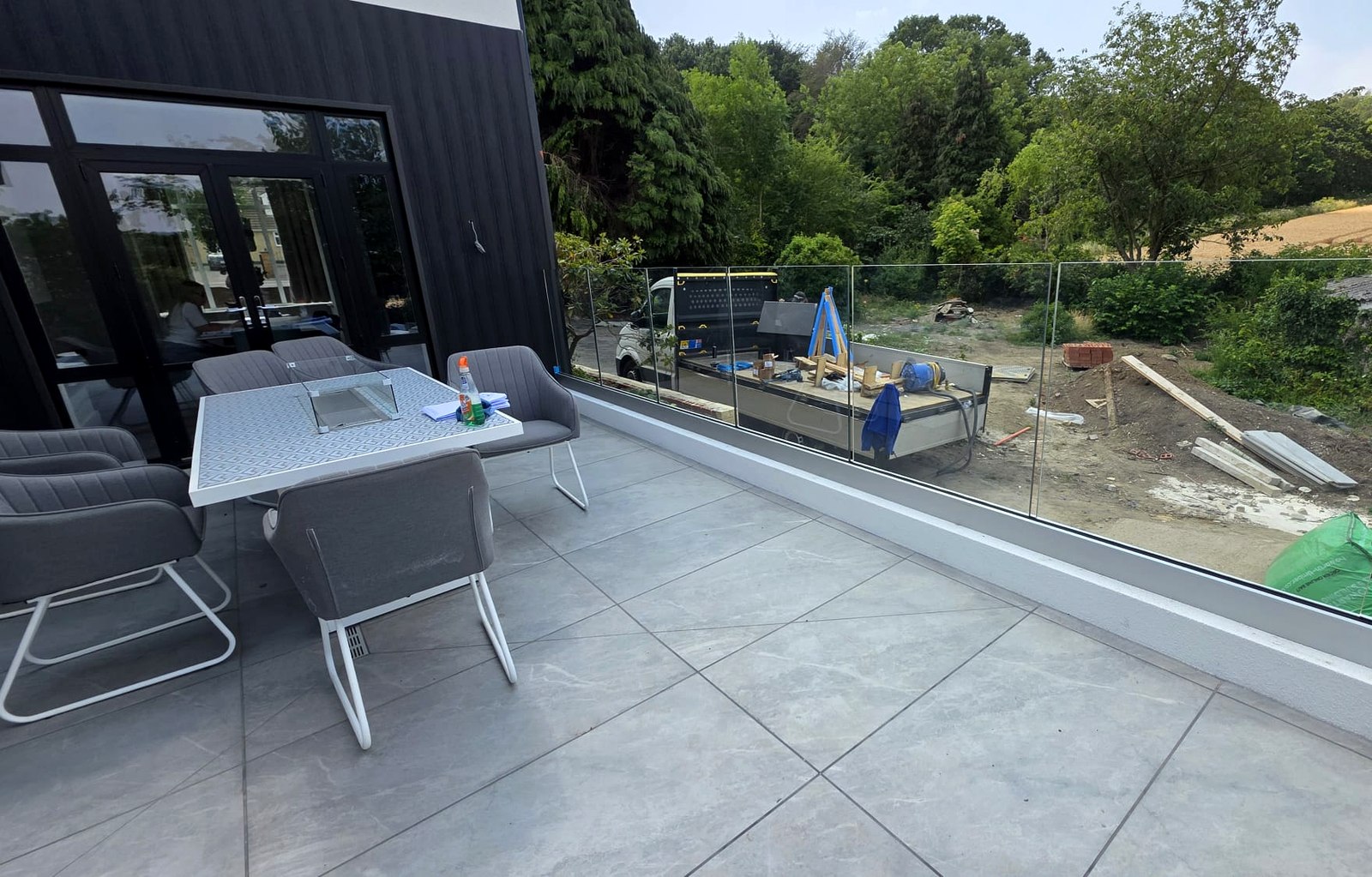
Frameless systems have no visible posts. The glass panels are structural, meaning the glass itself provides the barrier rather than relying on a metal frame. The result is a cleaner, more minimal look with uninterrupted views.
However, frameless isn't always suitable, and it's important to understand why before you commit to it.
Channel-fixed frameless systems (like our System 4) require a flat, solid surface to mount the channel to. The channel is a U-shaped aluminium or steel track that the glass sits into, and it needs a level, structurally sound base. If your surface is uneven, sloped in unexpected ways, or not solid enough to take the fixings, a channel system won't work without significant preparation.
Side-fixed frameless systems (like our System 7) are bolted through the glass into a wall or fascia. These look great, but they need a solid fixing area with enough depth to take the bolts. Be very careful with cavity walls and parapets. If the wall is a thin skin of blockwork with a cavity behind, there may not be enough solid material to achieve a safe fixing. This is one of the most common problems we see on site visits. Our parapet cavity wall glass balustrade is specifically designed for this situation, with a tested solution that bolts through and clamps the wall rather than relying on the depth of a single skin.
Frameless systems also use thicker, heavier glass (typically 15mm or 17.5mm laminated toughened) because the glass is structural. This means higher material costs and more weight to handle during installation.
The Quick Decision
If you want maximum flexibility, easier installation, and a wider choice of finishes, go framed. If you want the cleanest possible look and your fixing surface can support it, go frameless. If you're fixing to a parapet or cavity wall, talk to us first.
Choosing a balustrade finish
The finish affects the look, the durability, the maintenance, and the cost. Here's what's available and when each makes sense.
Stainless Steel
Stainless steel is the default choice for balustrades in many situations. It looks clean and modern, needs relatively low maintenance, and there are two main surface finishes to choose from.
Satin (brushed) finish is the most common. It has a subtle, non-reflective texture that hides fingerprints and minor scratches well. This is what most of our stainless steel systems are supplied in. The brushed grain can collect salt and contaminants in coastal areas, so satin-finished stainless steel near the coast requires more frequent cleaning.
Mirror polished finish is available on selected systems (see System 1 Mirror Polish). The smooth, grain-free surface is more resistant to salt and contaminant build-up, which makes it the better choice for coastal properties if budget allows. It does show fingerprints more readily and is more prone to visible scratching, so it's a trade-off. For internal applications, mirror polish is purely an aesthetic choice for contemporary properties where the balustrade is a design feature.
Stainless Steel Grade: 304 vs 316
This matters. G304 stainless steel should only be used internally. For any external balustrade, you need G316 (marine grade) stainless steel.
Stainless steel depends on a thin chromium oxide layer on its surface for corrosion resistance. The underlying metal is not corrosion-resistant on its own. That passive layer can be damaged by airborne particles, iron contamination, and particularly chlorides. Coastal areas are one of the harshest environments, with high levels of airborne salt, high winds, and plenty of seagull gifts that will begin to eat away at the surface and tarnish the finish if not regularly maintained.
G316 stainless has a higher molybdenum content that gives it significantly better resistance to chloride attack. It's more expensive than G304, but for external applications it's not optional.
One thing to remember: stainless steel is stainless, not stainfree. Even G316 marine grade stainless steel needs regular cleaning in coastal and external environments. The good news is that basic soapy water is usually enough. Clean it as often as you clean your windows and doors, and it will look fantastic for years. Neglect it and you'll get tea-staining and surface corrosion that's harder and more expensive to deal with later.
If you're using stainless steel externally, let us know your location when you enquire and we'll make sure the correct grade is specified.
Galvanised Steel
Galvanised steel is hot-dip coated in zinc, which provides excellent corrosion protection at a lower cost than stainless steel. It has an industrial, utilitarian appearance that suits some properties and doesn't suit others.
Our System 9 is a galvanised steel and glass balustrade. It's a practical, cost-effective option for external applications where appearance is secondary to durability and budget.
Powder Coated Steel
Powder coating gives you colour options. The steelwork is galvanised first for corrosion protection, then powder coated in the RAL colour of your choice. Anthracite grey (RAL 7016) is by far the most popular, but we can coat in any standard RAL colour.
Powder coating suits situations where you want the balustrade to match the window frames, the building exterior, or a specific design scheme. It's durable, weather-resistant, and gives a consistent factory-applied finish.
Our powder coated systems include System 5 (with iroko wooden handrail), System 8, and System 10.
Which Finish for Which Situation?
Internal staircases and landings: G304 stainless steel (satin or mirror) or powder coated to match the interior scheme.
External balconies and terraces: G316 stainless steel (satin or mirror) for a metal finish, or galvanised and powder coated for colour matching. G304 is not suitable externally.
Decking and patio areas: G316 stainless, galvanised, or powder coated all work. Powder coated is popular because it can match the house.
Coastal properties: G316 stainless steel (mirror polished for lower maintenance) or galvanised and powder coated. Whichever you choose, commit to regular cleaning.
Commercial and public areas: stainless steel (satin) is the standard choice for durability and low maintenance.
Supply-only glass balustrade kits vs professional installation
Dio-Met supplies balustrade systems both as supply-only kits for self-installation and as professionally installed packages. The right choice depends on your confidence, the complexity of the installation, and what you're fixing to.
Supply-Only (DIY)
All our DIY kits are designed to make installation as straightforward as possible for a competent person. Posts are supplied fully assembled (glass clamps already fitted, base plates welded on), and handrails are pre-drilled and tapped so they bolt directly to the post tops. You're not assembling the system from loose components; you're fixing pre-built units in position and connecting the handrail sections.
For a standard deck or patio installation with base-plate-mounted posts, the process is: position the posts, mark and drill the fixing holes, bolt the posts down, drop in the glass panels, tighten the clamps, and connect the handrails. A competent DIYer with a drill and a spirit level can do it.
Base plate fixing is the simplest method. The post sits on top of the surface (decking, paving, concrete) and is bolted down through holes in the base plate. This is the standard approach for most DIY installations and works on timber decking, concrete, paving slabs, and composite decking.
We supply all our DIY systems with full fixing instructions and deliver nationwide. If you get stuck, call us.
Professional Installation
Professional installation is recommended (and sometimes necessary) for:
Core-drilled installations: where the posts are set into holes drilled into the floor or coping stone rather than surface-mounted with base plates. Core drilling gives a cleaner finish with no visible base plate, but it requires specialist equipment and experience. This is the standard method for high-end residential and commercial projects.
Frameless systems: channel-fixed and side-fixed frameless balustrades need precise installation. The glass is heavy (a single panel of 15mm laminated glass can weigh 40kg or more), the tolerances are tight, and getting it wrong is expensive. We'd always recommend professional installation for frameless.
Stairs: staircase balustrades involve angled cuts, raking handrails, and transitions between raking and level sections. It's achievable as a DIY job on simple straight flights, but anything with turns, winders, or multiple levels is better left to a professional.
Structural fixings into masonry or concrete: if the installation requires chemical anchors, resin fixings, or fixing into unusual substrates, a professional installer will have the right tools and experience.
Balustrade certifications and UKCA marking: check before you buy
This is one of the most important things to verify when choosing a glass balustrade supplier, and it's one of the most commonly overlooked.
Any structural steelwork in a glass balustrade system (posts, frames, base plates, brackets) must be manufactured by a company certified to BS EN 1090-2 and carry the UKCA mark. This is a legal requirement for structural steel products placed on the UK market. A balustrade is a safety-critical structure, and the steelwork must be fabricated under a certified quality management system.
This isn't optional, and it isn't a nice-to-have. It's the law. Building control can reject an installation if the steelwork doesn't carry UKCA marking, and there are liability implications if something goes wrong with non-certified steelwork.
The reason we emphasise this is that many balustrade suppliers do not hold BS EN 1090 certification. Some import steelwork that hasn't been manufactured under the standard. Others fabricate in-house but haven't gone through the certification process. Either way, the result is the same: the product doesn't comply.
Dio-Met is fully certified to BS EN 1090-2 and all our structural steelwork carries the UKCA mark. We supply UKCA Declaration of Performance certificates as standard with every order.
When comparing quotes, ask the supplier directly: "Is your steelwork manufactured under BS EN 1090 certification, and does it come with UKCA marking?" If they can't confirm both, find a supplier who can. Our glass balustrade building regulations guide covers this in more detail.
Does a glass balustrade need a handrail?
The short answer: on a staircase, yes, always. On a balcony or landing, it depends.
Under Approved Document K, a staircase must have a continuous handrail. It doesn't have to be on the balustrade side (a wall-mounted handrail on the opposite side satisfies the requirement), but there must be one somewhere. If the balustrade is the only side with a handrail option, then yes, your system needs a handrail.
On a balcony, terrace, or landing, a handrail isn't strictly required by building regulations provided the barrier meets the height and loading requirements. However, many people prefer a handrail for practical reasons: something to hold onto, somewhere to rest a drink, and it protects the top edge of the glass from impact damage.
From a glass specification perspective, a handrail also makes a difference. If the glass has no handrail, it's acting as the sole means of protection above the barrier height, which means laminated glass is required. With a handrail, the glass is infill between posts and the specification can be simpler (toughened glass is usually sufficient). This affects cost.
If you're unsure whether your installation needs a handrail, our building regulations guide has the full detail, or just ask us.
Glass balustrade privacy screens
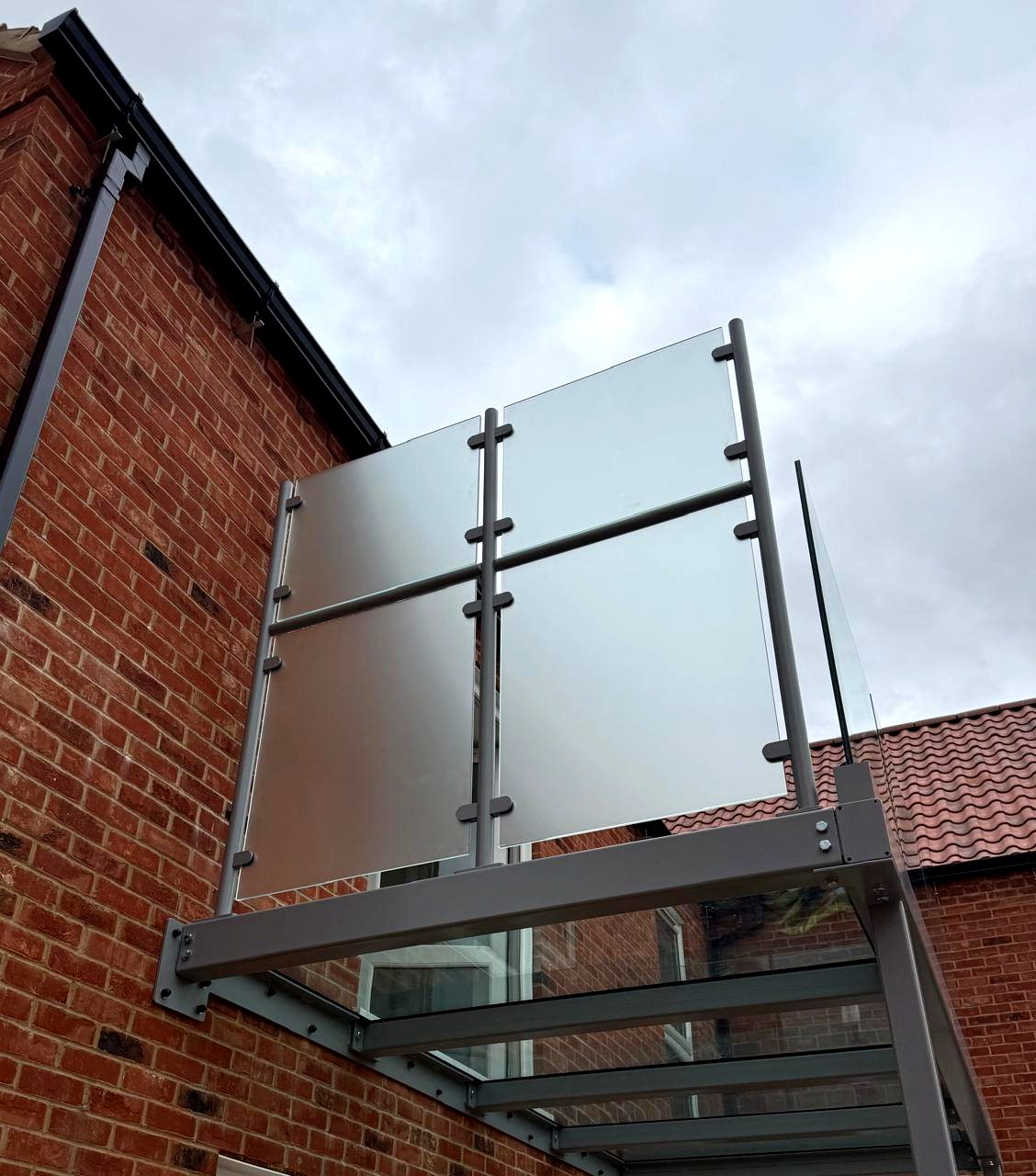
If your balustrade is on a balcony that overlooks neighbouring properties, you may need privacy screens. This is one of the most common planning conditions attached to balcony approvals, and it catches people out because it affects the design and budget.
Privacy screens are typically required at 1,800mm high in frosted or obscured glass on the sides facing neighbours. At that height, you're well above the standard 1,100mm barrier, which has implications for the post design, glass specification, and wind loading.
Our balcony building regulations guide covers privacy screen requirements in detail. The key advice: if you're applying for planning permission for a balcony and you have neighbours, factor privacy screens into the design from day one. Retrofitting them after planning comes back with conditions is always more expensive and more disruptive than getting it right first time.
Dio-Met fabricates bespoke privacy screen systems in steel and glass to match the balcony balustrade. We can work from your planning conditions to produce screens that meet the exact specification required.
What surface are you fixing a glass balustrade to?
The fixing surface matters more than most people realise. Here's a quick rundown:
Timber decking: base-plate-mounted framed systems work well. Use stainless steel or galvanised coach bolts through the decking boards into the joists beneath. Make sure you're fixing into the joists, not just into the boards.
Concrete or paving: base-plate systems with concrete anchor bolts. Straightforward for both DIY and professional installation.
Steel structure: posts can be bolted or welded to existing steelwork. This is common on balconies with steel frames.
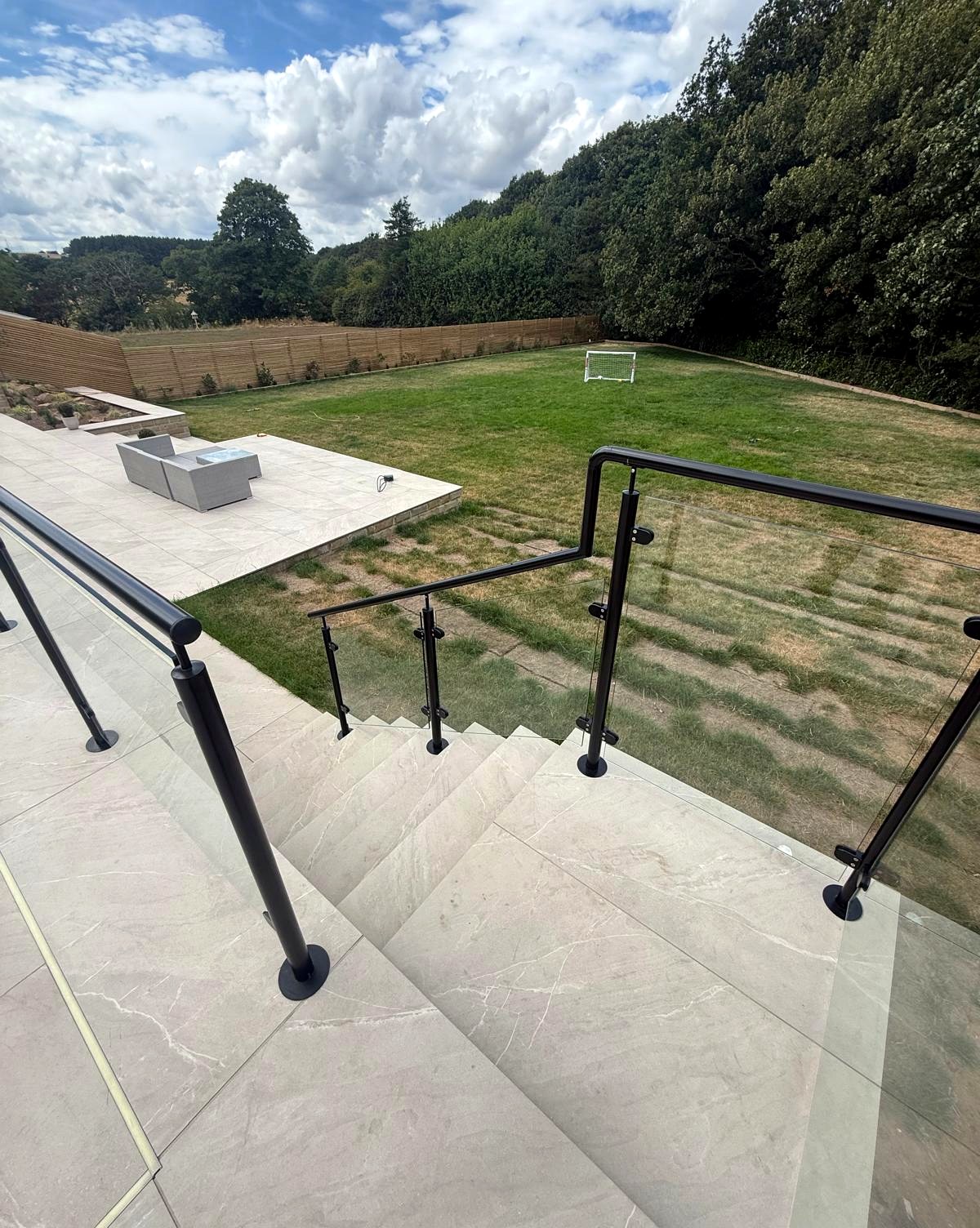
Parapet walls and cavity walls: this is where it gets complicated. If the wall is solid masonry or concrete, side-fixed systems work well. If there's a cavity, the inner or outer skin alone may not be strong enough to take the load. Our parapet cavity wall glass balustrade is designed specifically for this.
Composite decking: base-plate fixing works, but you'll need to fix through the composite boards into a solid substrate beneath (timber or steel subframe). Composite boards alone don't have enough pull-out strength for balustrade fixings.
If you're not sure what you're fixing to, or you know it's going to be awkward, send us some photos and measurements. We'll advise on the best system and fixing method for your specific situation.
Frequently Asked Questions
What's the difference between framed and frameless glass balustrades?
Framed systems use steel posts with glass panels clamped between them. The posts are structural and the glass is infill. Frameless systems have no visible posts; the glass itself is structural. Framed is more versatile and easier to install. Frameless gives a cleaner look but needs specific fixing conditions and professional installation.
Can I install a glass balustrade myself?
Yes, if you choose a framed, base-plate-mounted system. Our DIY kits come with fully assembled posts and pre-drilled handrails, making installation straightforward for a competent person with basic tools. Frameless systems, staircase installations, and core-drilled fixings are better suited to professional installation.
Do I need UKCA-marked steelwork for a balustrade?
Yes. Any structural steelwork (posts, frames, base plates) must be manufactured under BS EN 1090-2 certification and carry the UKCA mark. This is a legal requirement. Ask your supplier to confirm this before you buy. Dio-Met supplies UKCA Declaration of Performance certificates as standard.
Which finish is best for a coastal property?
G316 (marine grade) stainless steel is the correct grade for any external application, and it's essential near the coast. Mirror polished G316 offers the best resistance to salt build-up due to its smooth, grain-free surface. Galvanised and powder coated steel is also an excellent option for coastal properties. G304 stainless steel should only be used internally.
Do I need a handrail on my glass balustrade?
On a staircase, yes, a continuous handrail is required by building regulations (though it can be on the wall side). On a balcony or landing, a handrail isn't strictly required if the barrier meets height and loading requirements, but it's often preferable for practical and safety reasons.
Can you supply balustrades outside Sheffield?
Yes. All our steelwork is fabricated in our Sheffield factory and we deliver supply-only kits nationwide. For professional installation, availability depends on location, so get in touch to discuss.
See the systems in place
Specifications read better next to a finished job. All of these were surveyed, made in our Sheffield factory and installed by our own fitters.
- System 1 stainless and glass, top-fixed and side-fixed across stepped levels, Totley
- System 4 frameless base channel to a raised patio, Barnsley
- System 10 galvanised and powder coated, core-drilled patio and side-fixed balcony, Sheffield
- System 5 with iroko timber handrails, Timperley, Manchester
- Frameless infinity glass balustrade, Ranmoor, Sheffield
- Parapet wall glass balcony balustrade, Norton, Sheffield
- Art-glass privacy screens made to a client design, Walkley, Sheffield
- All bespoke projects
Related Products
- Metal & Glass Balustrades: our full range of framed and frameless systems
- Frameless Glass Balustrades: structural glass systems without visible posts
- Parapet Cavity Wall Glass Balustrade: designed for cavity walls and thin parapets
- Balustrade & Handrail Fittings: clamps, connectors, and components
- Glass Balustrade Building Regulations Guide: the technical regulations companion guide
- Balcony Building Regulations Guide: for balcony-specific regulations including privacy screens
- View all our bespoke projects
Need Help Choosing?
If you're not sure which system, finish, or fixing method is right for your project, get in touch. We've been fabricating glass balustrade systems in Sheffield for over 30 years, and we deal with these questions every day. Call us on 0114 243 9009 or email sales@diometonline.co.uk, or request a quote online.
Tags: glass balustrade buying guide, framed vs frameless balustrade, glass balustrade DIY, stainless steel balustrade, powder coated balustrade, glass balustrade installation, UKCA balustrade, balustrade fixing methods, glass balustrade supply only, glass balustrade UK