Stainless Steel Arch Pergola, Water Rills and Wall Panels — RHS Tatton Park Show Garden
Most of what we make is bolted to a house and expected to last thirty years. This one had to be perfect for five days.
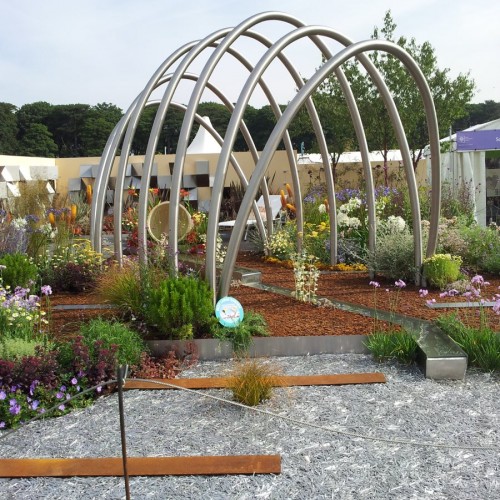
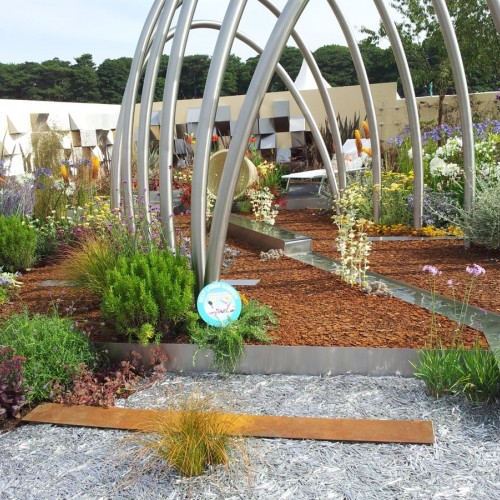
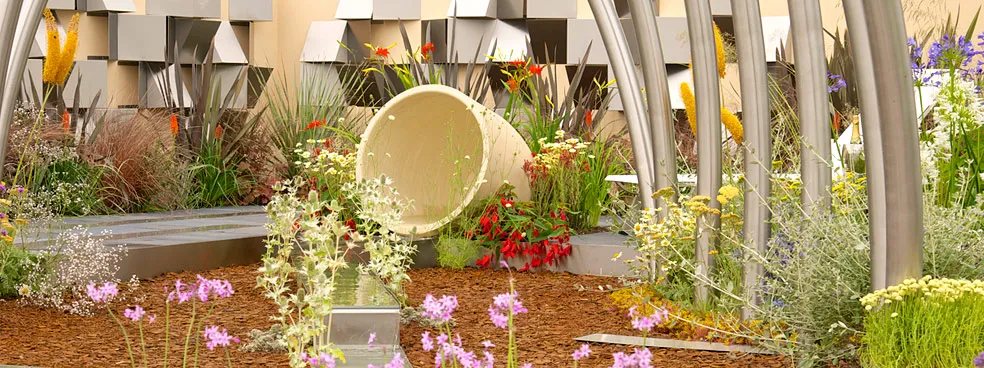
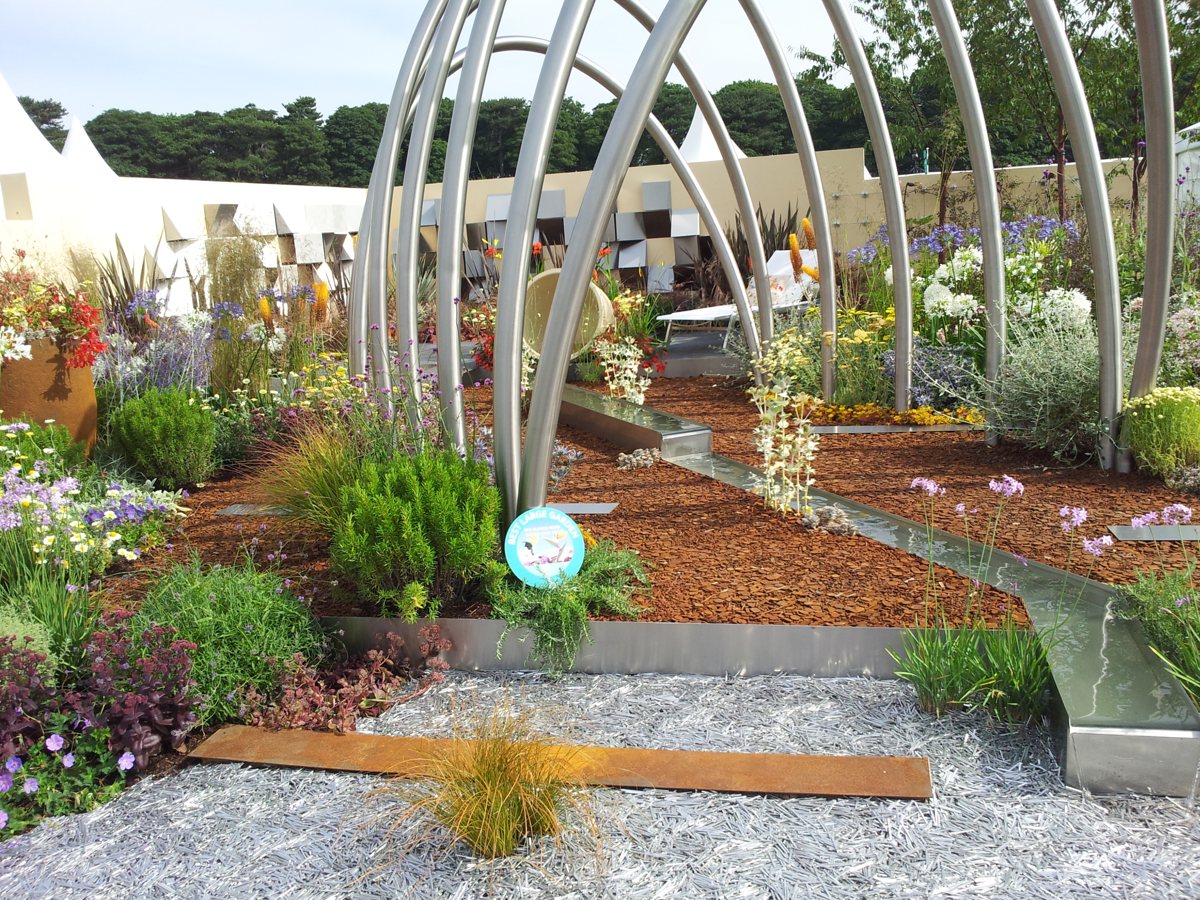
We built the metalwork for the Stainless Century Garden, designed by Phil Hirst for the RHS Flower Show at Tatton Park: a run of leaning stainless arches three metres tall, a water rill running the length of the plot, stainless edging to every bed, and a wall of folded stainless panels. It was made from raw tube and sheet in our Sheffield workshop, trial built on the shop floor, taken apart, polished by hand, and put back together on site. It won a Gold Medal and Best Large Garden.
Project Overview
- Client type: Show garden, built for competition
- Designer: Phil Hirst
- Venue: RHS Flower Show, Tatton Park, Cheshire
- Garden: The Stainless Century Garden
- Our scope: Design development, fabrication, satin polishing, trial build, delivery and site assembly
- Feature arch: Rolled stainless tube arches, three metres to the highest crown, each set at its own angle, echoing the ribs of the Sheffield Winter Garden
- Water feature: Fabricated stainless rill in linked sections with stepped weirs
- Bed edging: Folded stainless strip, mitred at the corners
- Wall panels: Folded stainless plates, fixed proud of a rendered wall
- Finish: Satin polished throughout, by hand, after trial build
- Result: Gold Medal and Best Large Garden
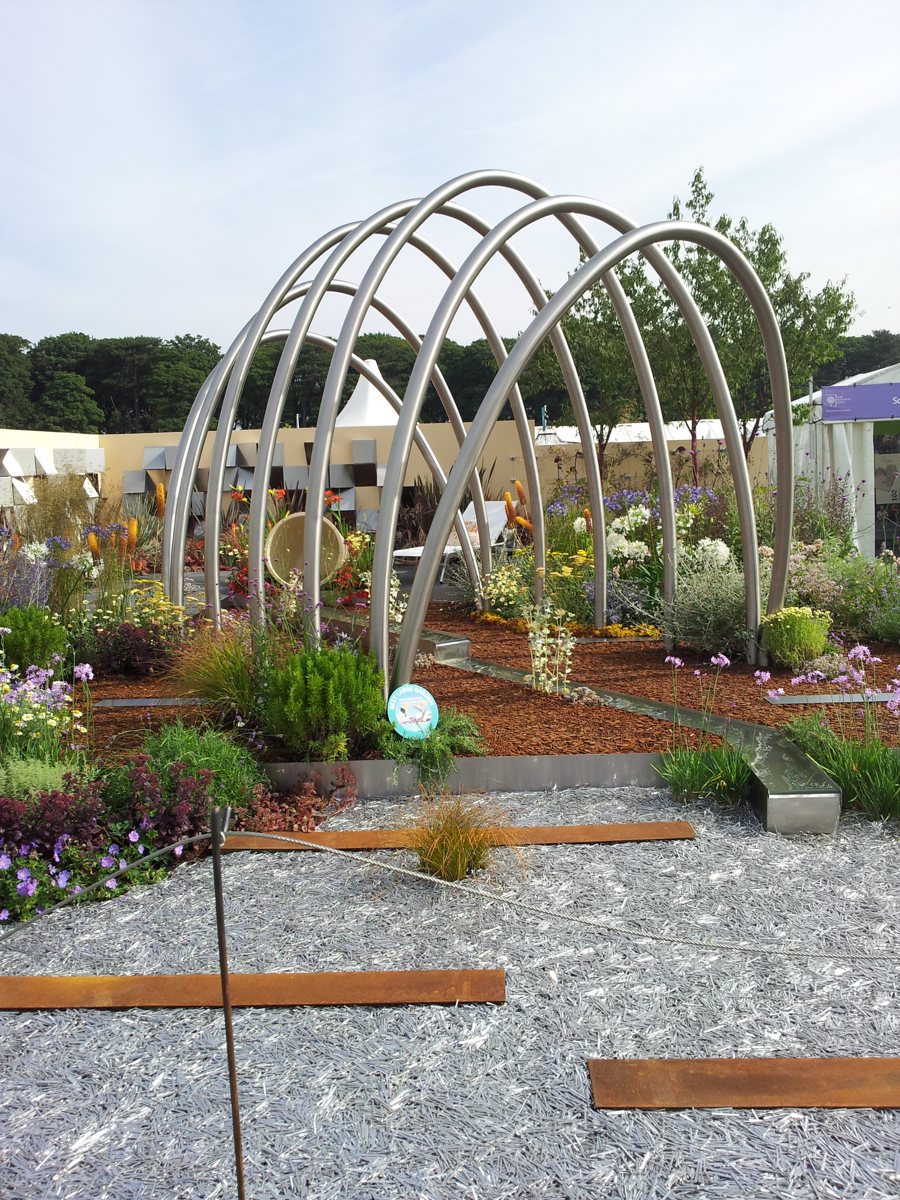
The arches lean. That is the whole trick.
A row of identical arches standing parallel is a tunnel, and a tunnel is a dull thing to walk through. These do not stand parallel. Each arch is set at its own angle, leaning a little further than the one before it, so the crowns describe a curve through the air and the whole run appears to twist as you move past it.
That is easy to draw and unpleasant to build. Once the arches stop being parallel, nothing repeats. Every foot lands in a different place, every arch meets its neighbours at a different angle, and there is no such thing as a typical joint to work out once and copy. The geometry has to be resolved for the whole assembly at the same time, because moving one arch moves the crossing points of the two next to it.
The form is not arbitrary either. It takes its cue from the Sheffield Winter Garden, the great arched glasshouse that sits between the Peace Gardens and the Millennium Galleries, where a run of tall parabolic ribs makes the whole roof. Ours are stainless rather than laminated timber and a fraction of the size, but the family resemblance is deliberate: a Sheffield landmark, restated in the material Sheffield is known for, for a garden about that material.
The feet were the part that mattered most visually. There are no base plates sitting on the surface, no bolt heads, no collars. Each arch drops straight into the ground and the planting comes up to meet it, so the arches read as if they have grown out of the bed rather than been delivered on a lorry. Everything that made that possible is below the finished level and nobody at the show ever saw it, which is the correct outcome.
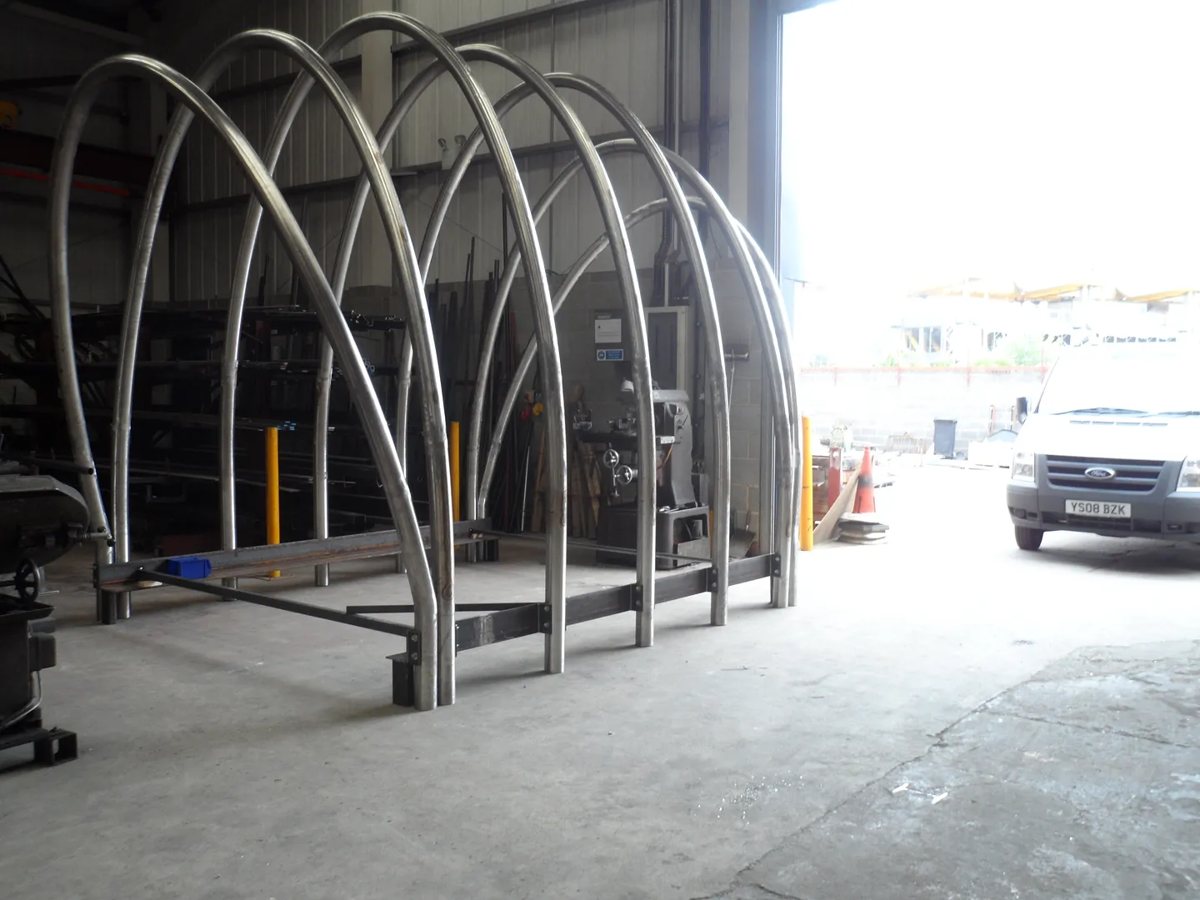
Built once in the workshop before it was ever built on site
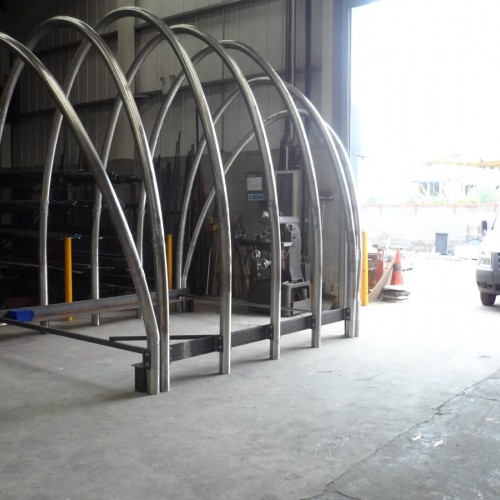
The photograph above is the whole arch assembly standing on our shop floor, still in mill finish, bolted to a temporary steel frame that exists only to hold the feet at the right spacing and angle. It was built there so that it would never have to be solved at Tatton.
Show build slots are short and shared. You arrive at a field with a plot marked out, a queue of other contractors, and a fixed number of days before judging. There is no workshop, no second chance at a rolled section, and a problem that would take an afternoon to fix at home can cost you the medal. So the arch was assembled complete in Sheffield, checked, marked, dismantled, finished, and delivered as a kit of parts that had already been proved to fit.
The temporary base frame did a second job. It let us set the whole thing up on flat concrete and see the geometry as an object rather than as lines on a drawing, at the point where changing an angle still cost nothing. On a shape with no repeating parts, that is worth more than any amount of checking on paper.
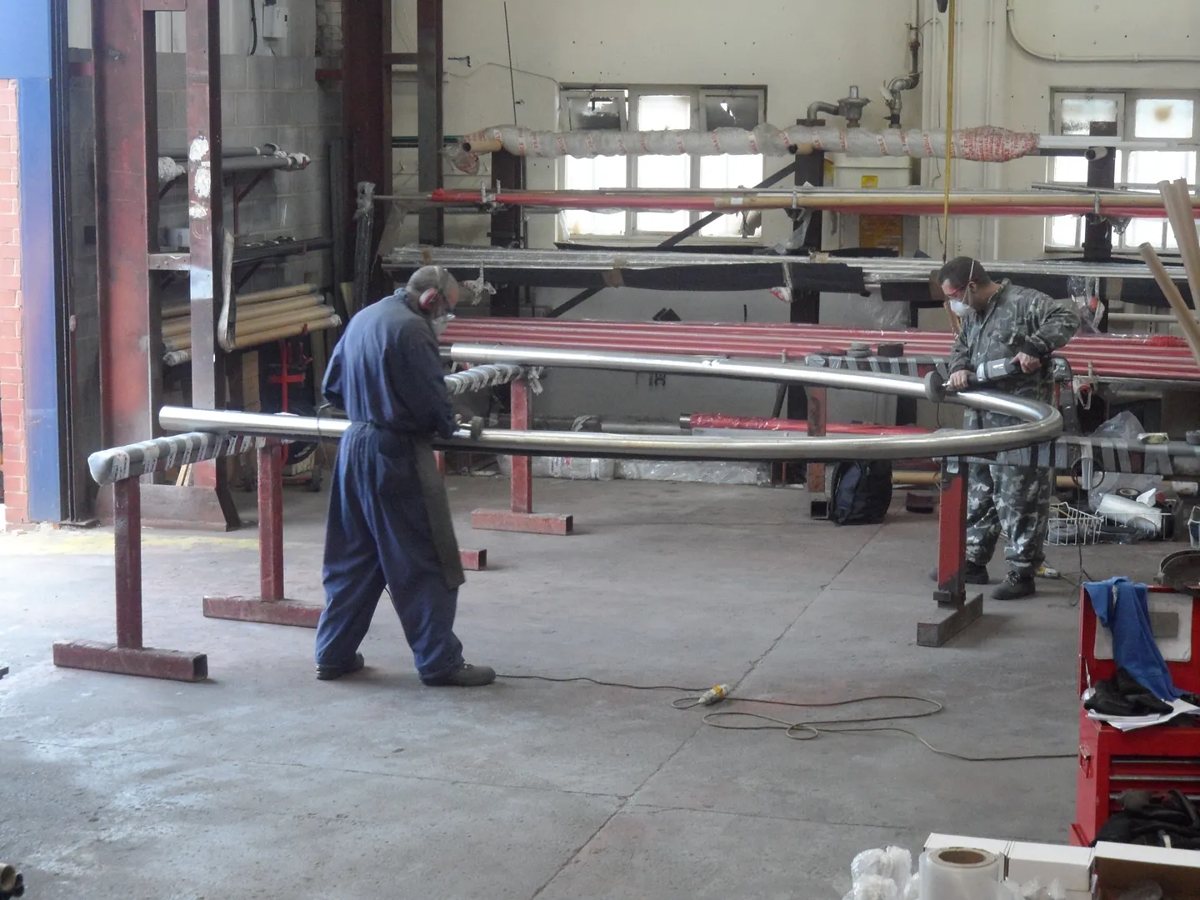
Polished by hand, one section at a time
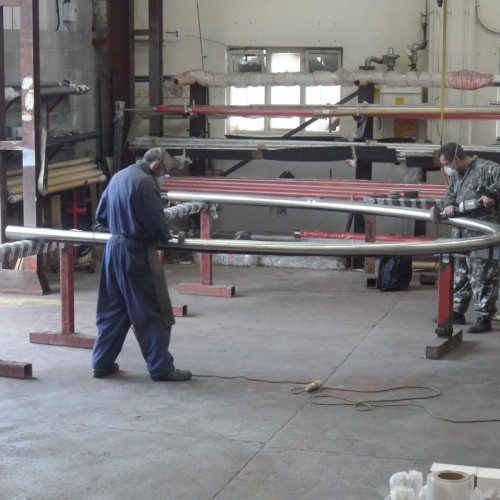
This is the part of the job that took the longest and the part nobody at the show would have thought about. Stainless does not arrive shiny. It arrives with mill marks, drawing lines, handling scuffs and the discolouration that comes off rolling and welding, and the only way to a consistent satin finish across a piece this size is two people, an abrasive, and a long time.
Two things make it harder than it sounds. The first is that every section is curved, so the operator is working around a radius while keeping the grain running in one direction. Break the direction and you get a bright patch that catches the light differently and your eye finds it instantly. The second is that the arches sit next to each other and cross, so any variation between one section and the next is on display side by side rather than hidden on opposite sides of a building.
It also has to happen after the trial build, not before. Handling polished stainless through an assembly, a dismantle, a delivery and a site build is how you arrive with a beautiful finish covered in marks. Build it raw, prove it, take it apart, then finish it, then wrap it.
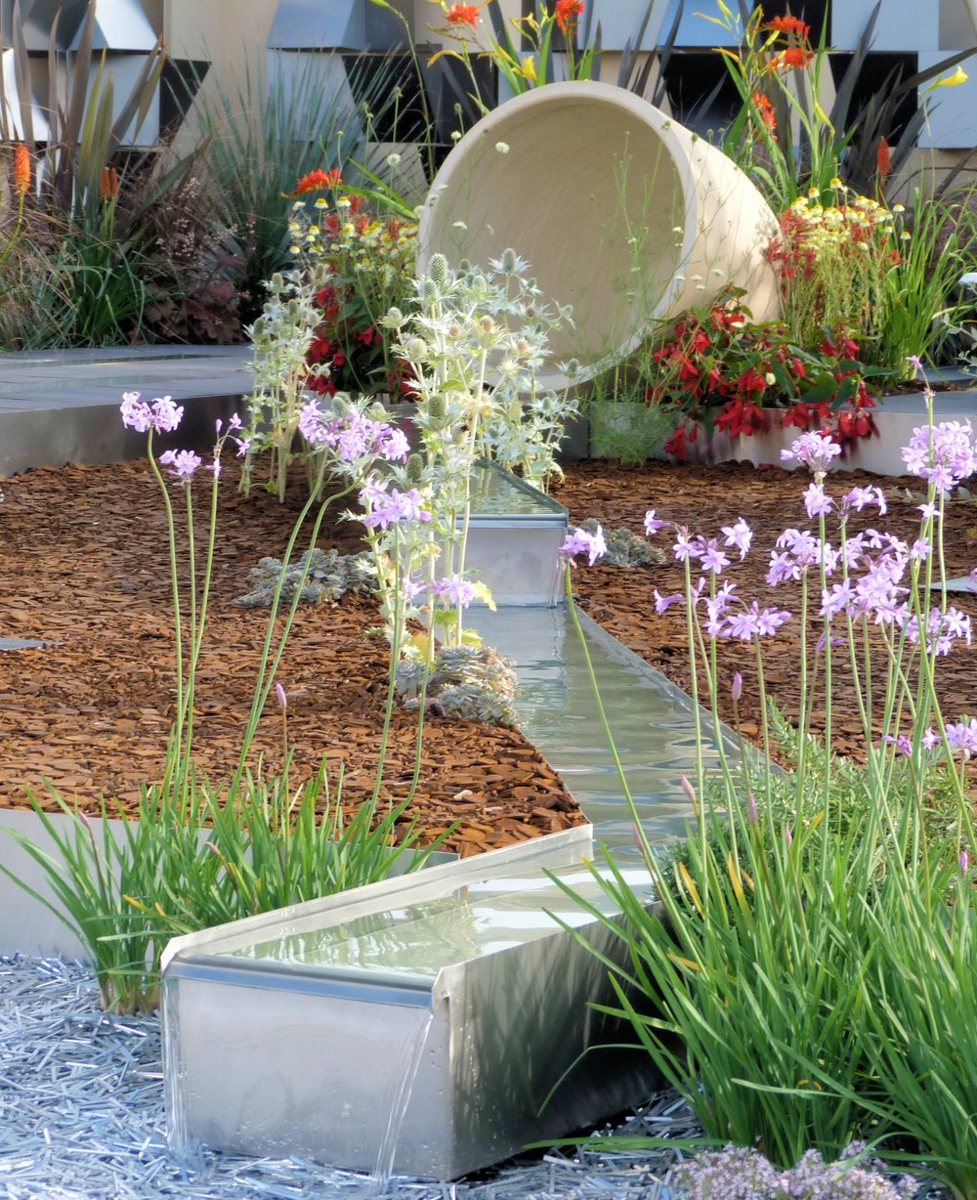
A rill is a fabrication problem pretending to be a water feature
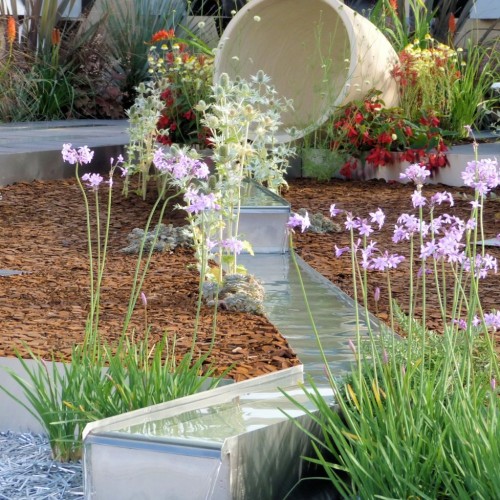
The rill runs the length of the garden as a shallow stainless channel, stepping down through the beds in linked sections with a small weir at each change of level. It looks simple and it is the least forgiving thing on the plot.
Water shows you everything. A channel that is a couple of millimetres out of level does not look slightly out of level, it looks like one end is empty and the other is overflowing, because the water surface is dead flat and your eye reads the metal against it. So the sections had to be made straight and true, and set out on site with a level rather than by eye.
The weirs are the detail worth looking at. The lip is folded rather than welded and applied, so the water leaves a single clean edge and falls as a sheet instead of dribbling off a joint. Get that edge right and the water does the work. Get it wrong and you can hear it as well as see it.
The same folded stainless runs round the beds as edging, which is what gives the planting its hard line against the bark and the gravel. It is a small detail repeated a great many times, and it is most of what makes the garden look built rather than laid out.
Wall panels: flat sheet made to catch the light
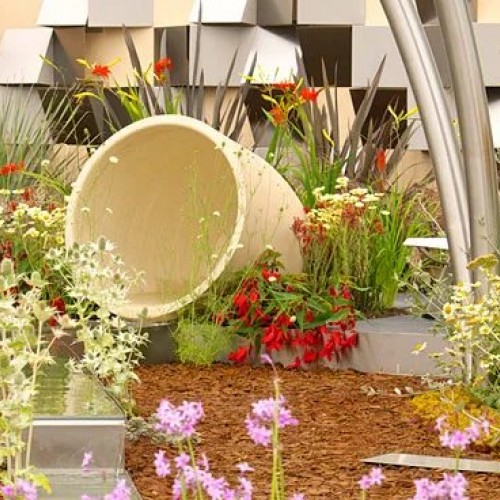
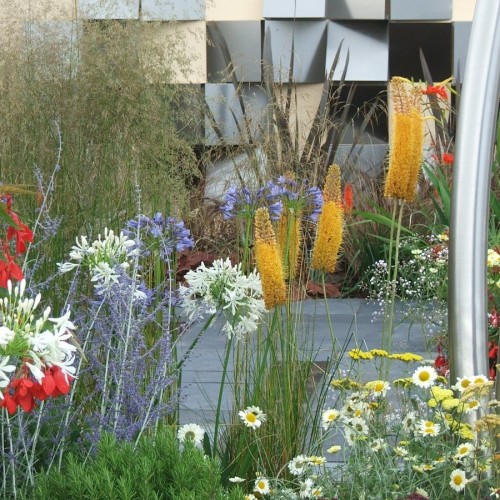
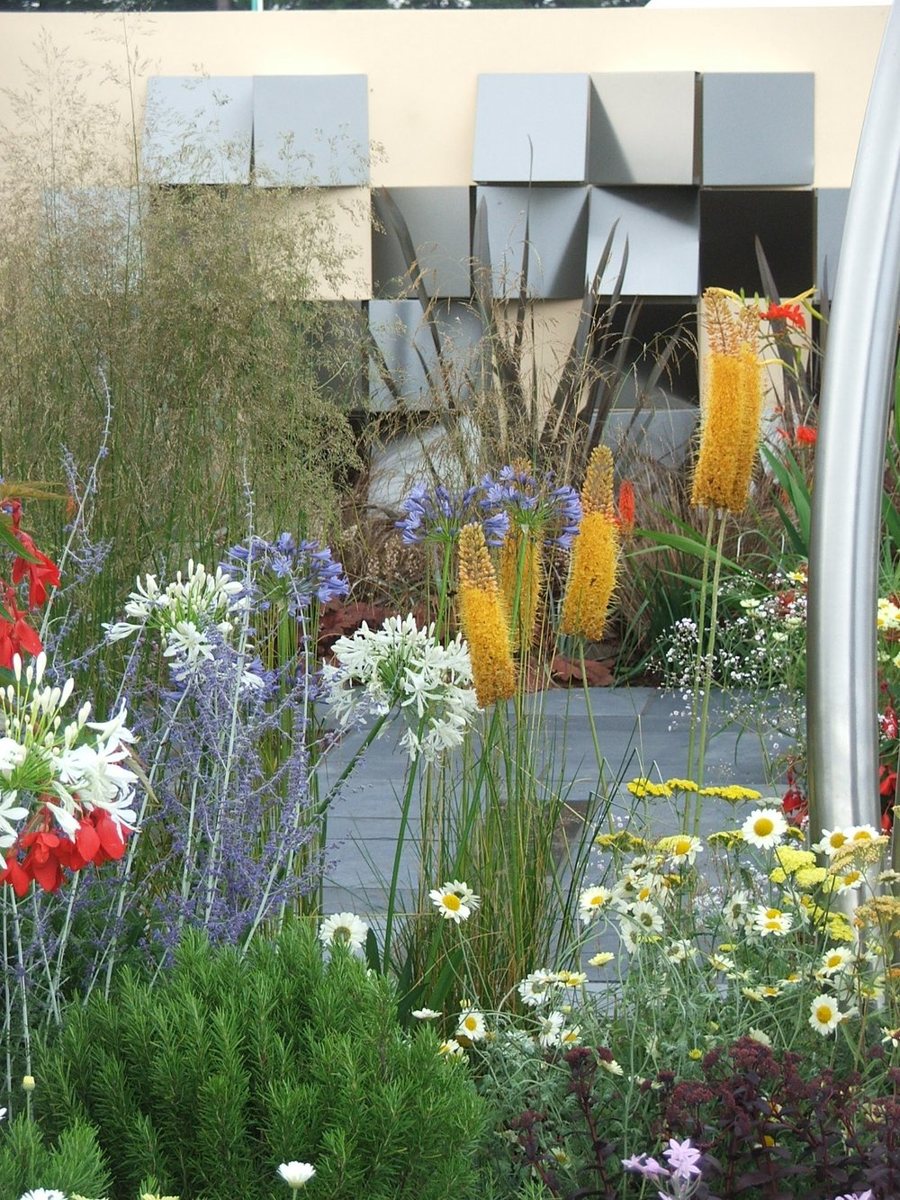
The back wall carries a loose grid of stainless panels, each one a flat plate folded so that part of it stands proud and part of it lies back. They are fixed off the render rather than flat against it, so they throw a shadow and read as objects rather than as cladding.
The reason they work is that they are not all the same. Because each fold sits at a slightly different angle, the panels catch the sky differently across the width of the wall, and the pattern changes as the light moves through the day and as you walk past. A flat mirrored wall would have given you one bright rectangle and a lot of reflected sky. Folded and satin finished, you get a slow, shifting texture instead.
Stainless steel, in Sheffield, for a garden about stainless steel
The garden was built to mark the centenary of Harry Brearley’s invention of stainless steel in Sheffield. That is the whole concept, and it is why the material had to carry the design rather than sit inside it. There is no timber in the structure and no painted finish anywhere. Everything you can see is stainless, in one finish, doing a different job each time.
We are a Sheffield fabricator working in stainless every week of the year, about two miles from where Brearley did the work. Being asked to make the centrepiece for a garden celebrating that is the closest thing to a home fixture we are ever likely to get, and it is the reason the polishing was done in house by our own people rather than sent out.
What a show garden teaches you about ordinary work
A show garden is judged at a distance of about a metre by people who look at metalwork for a living, in flat daylight, with no furniture in front of it and nothing to distract from a bad weld. There is nowhere to hide, and the deadline does not move.
Two habits came out of that and stayed. The first is trial building anything with non repeating geometry before it is finished, because the cost of finding a problem in the workshop is an hour and the cost of finding it on site is a day. The second is finishing last and wrapping immediately, for the simple reason that a polished surface only has to be handled carelessly once.
Neither is exotic and both cost time up front. They are the reason a garden gate, a balcony or a staircase from us arrives without a bag of shims and an apology.
Frequently asked questions
Do you make one off sculptural metalwork, or only standard products?
Both, and the one off work is where we started. If it can be drawn and it can be made from steel, stainless or aluminium, we will price it. Sculptural and feature pieces come to us through garden designers, architects and landscapers more often than directly from homeowners.
Can arches like these be made for a private garden?
Yes, and it is a more common request than you would think. The structure itself is not exotic: rolled tube, set out accurately, fixed properly below ground. What drives the cost is the number of different shapes. A run of identical arches is a fraction of the price of a run where every one is different, so if budget matters, repeat the geometry and spend the money on the finish instead. Our bespoke metal pergola page is the starting point for anything in this family.
Why stainless steel rather than painted or galvanised steel outdoors?
Stainless costs more at the outset and then largely stops costing anything. There is no repainting, no touching up chips, and no rust bleed down whatever it is standing on. For a feature that is meant to be the focal point of a garden for twenty years, that usually wins. Galvanised and powder coated steel remain the sensible answer for larger structures where the budget is the constraint.
Will a satin polished finish stay looking like that outside?
It weathers rather than degrades. Satin is far more forgiving than a mirror polish because the directional grain hides water spotting and fingerprints instead of showing them, which is exactly why it was chosen here. It will want an occasional wash with warm water and a soft cloth, worked along the grain, and no more than that.
Do you work with garden designers and landscape architects?
Regularly, and it is our favourite way to work. Send a sketch, a concept drawing or a photograph of something you have seen. We will tell you honestly what will and will not work in metal, produce fabrication drawings for approval, and make it. Call 0114 243 9009 or email sales@diometonline.co.uk.
Explore more
Related products
Similar projects
- Bespoke steel garden pergola built around a tree, Sheffield
- Our original write up, with more workshop photographs
- View all our bespoke projects
Thinking about something similar?
Send us the concept, however rough. A sketch on the back of a drawing, a photograph of something that is nearly right, or a designer’s visual we can work from. We will tell you what it takes to make it, put a drawing in front of you before anything is cut, and make it here in Sheffield. Email sales@diometonline.co.uk or call 0114 243 9009.
Tags: under stairs glass doors, under stairs wine store, raked glass, wine racking, Delamere, Cheshire