Galvanised Dock Access Stairs and Crossover Platforms — Markham Vale, Derbyshire
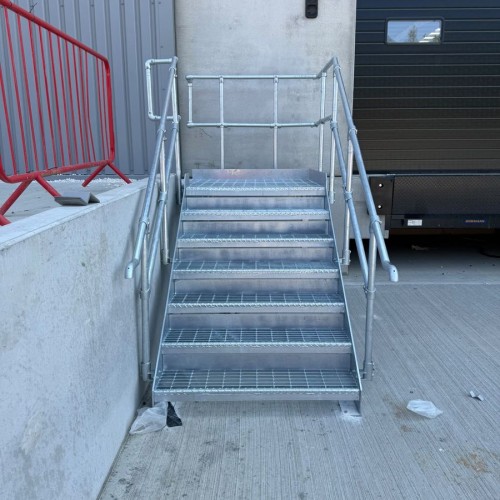
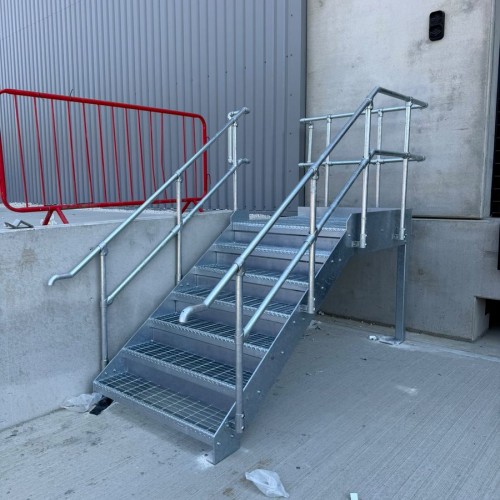
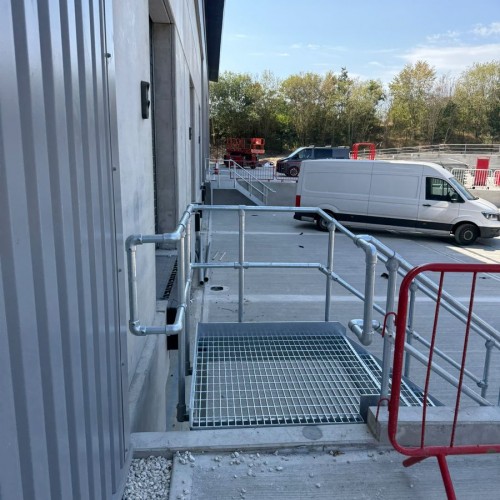
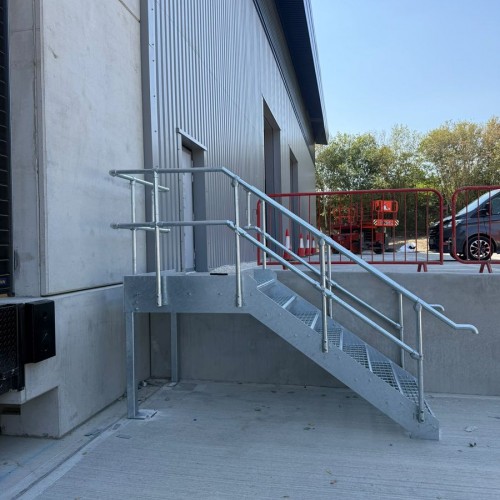
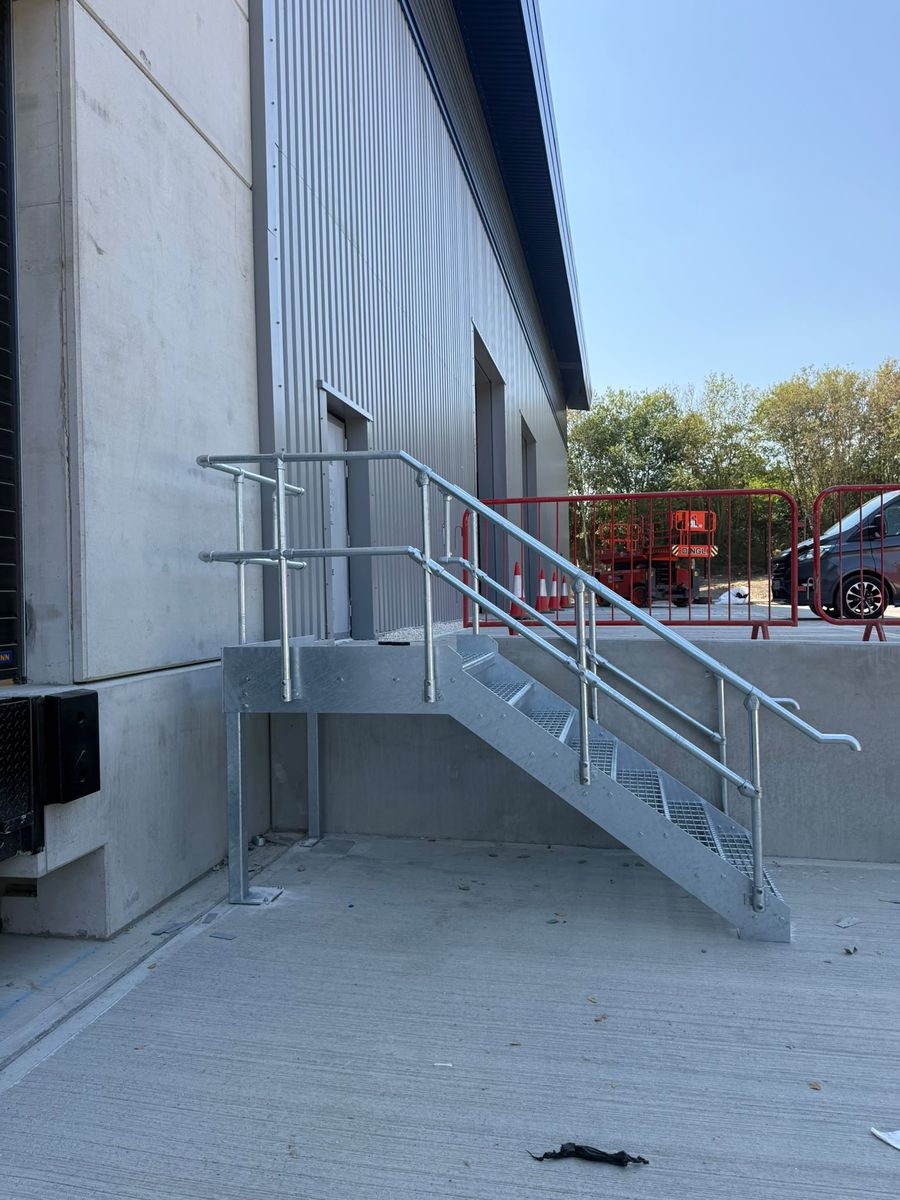
New industrial units for Henry Boot at Markham Vale needed safe access to the loading doors. Dio-Met surveyed, made and installed the galvanised access stairs and open mesh crossover platforms that serve them, with key clamp handrails throughout. It is our second job on the estate for the same client, after the fire escape staircases.
Project Overview
- Client: Henry Boot
- Location: Markham Vale, Derbyshire (M1 J29A)
- Application: Loading dock access stairs and crossover platforms on a new industrial and distribution scheme
- Treads: Open mesh grating with serrated leading edges
- Handrails: Key clamp tube, top and mid rail, both sides, with returned ends
- Structure: Folded plate stringers on bolted baseplates, landings on legs where the dock face required it
- Finish: Hot dip galvanised to BS EN ISO 1461
- Scope: Survey, supply and install, by our own team
- Standard: UKCA marked, fabricated to BS EN 1090-2
Why key clamp on a job like this
Key clamp handrails look plain next to a polished stainless system, and on an industrial site that is exactly the point. They are worth choosing for three practical reasons rather than for how they look.
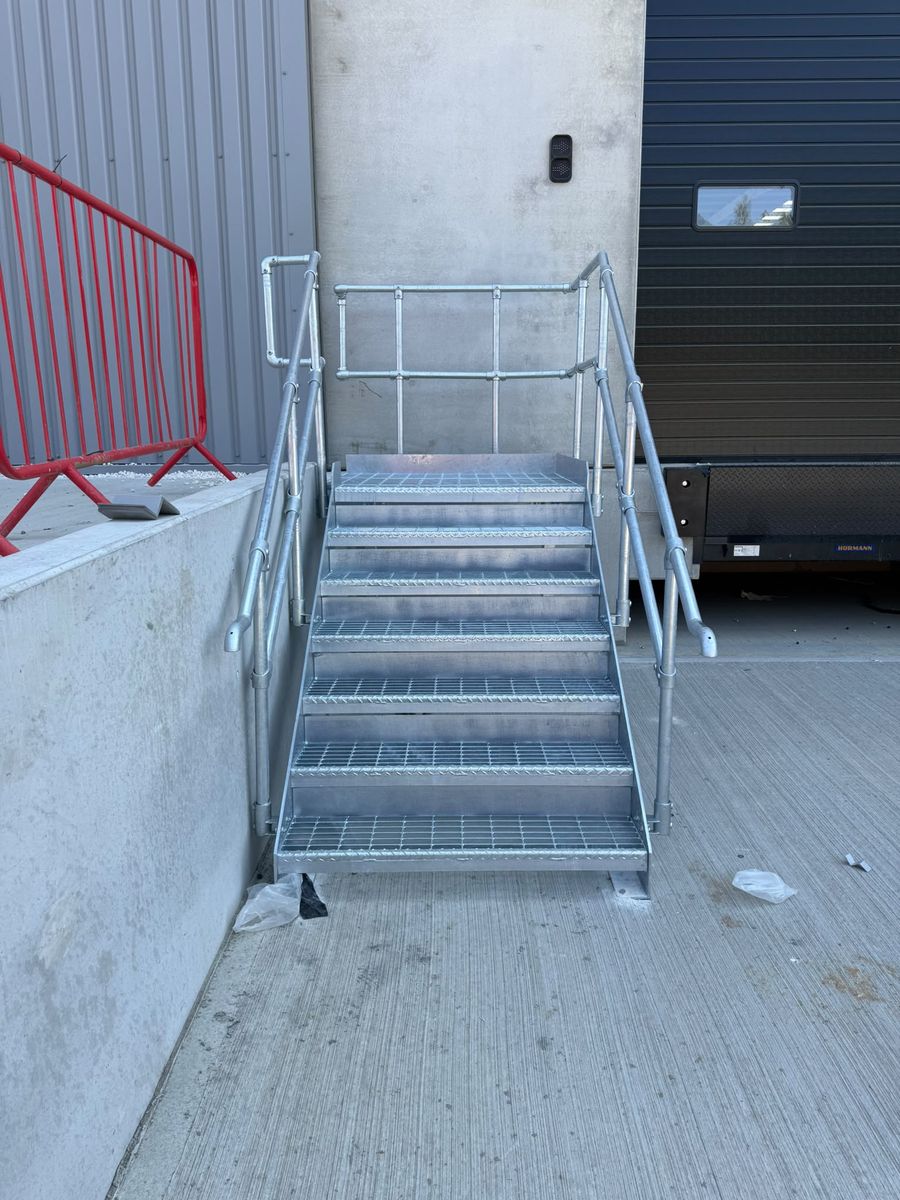
No hot works on site. Key clamp fittings are mechanical. They slip over the tube and clamp with a grub screw, so a handrail goes together with an Allen key and nothing else. On a live construction site, welding means a hot works permit, a fire watch and a cooling-off period, and near composite cladding and insulation it is often simply not wanted. Taking welding out of the site programme takes a whole conversation out of it too.
It absorbs the tolerances. Concrete rarely lands exactly where the drawing said. A welded assembly is fixed the moment it leaves the factory, while a clamp joint can be rotated, slid and set to what is actually in front of you. On a dock frontage with several openings and a slab that falls away for drainage, that adjustability is the difference between a tidy fit and a set of packers.
It can be altered later. Industrial buildings get re-fitted, re-let and re-purposed. A key clamp rail can be taken apart and rebuilt around a new opening years from now, by anybody with a spanner, without a fabricator and a generator.
Open mesh treads, and why not chequer plate
The treads are open mesh grating with a serrated leading edge. Outside, that beats a solid tread every time: water falls straight through instead of sitting on the step, so there is nothing to freeze overnight and nothing to skid on after rain. Grit and mud drop through as well rather than building up into the polished patch you get in the middle of a well-used solid step.
The serrations on the front edge do the work where a foot actually lands. Solid chequer plate has its place, and we used it here for the threshold plates where the stair meets a doorway, but on an open external flight in daily use, mesh is the right answer.
What we made
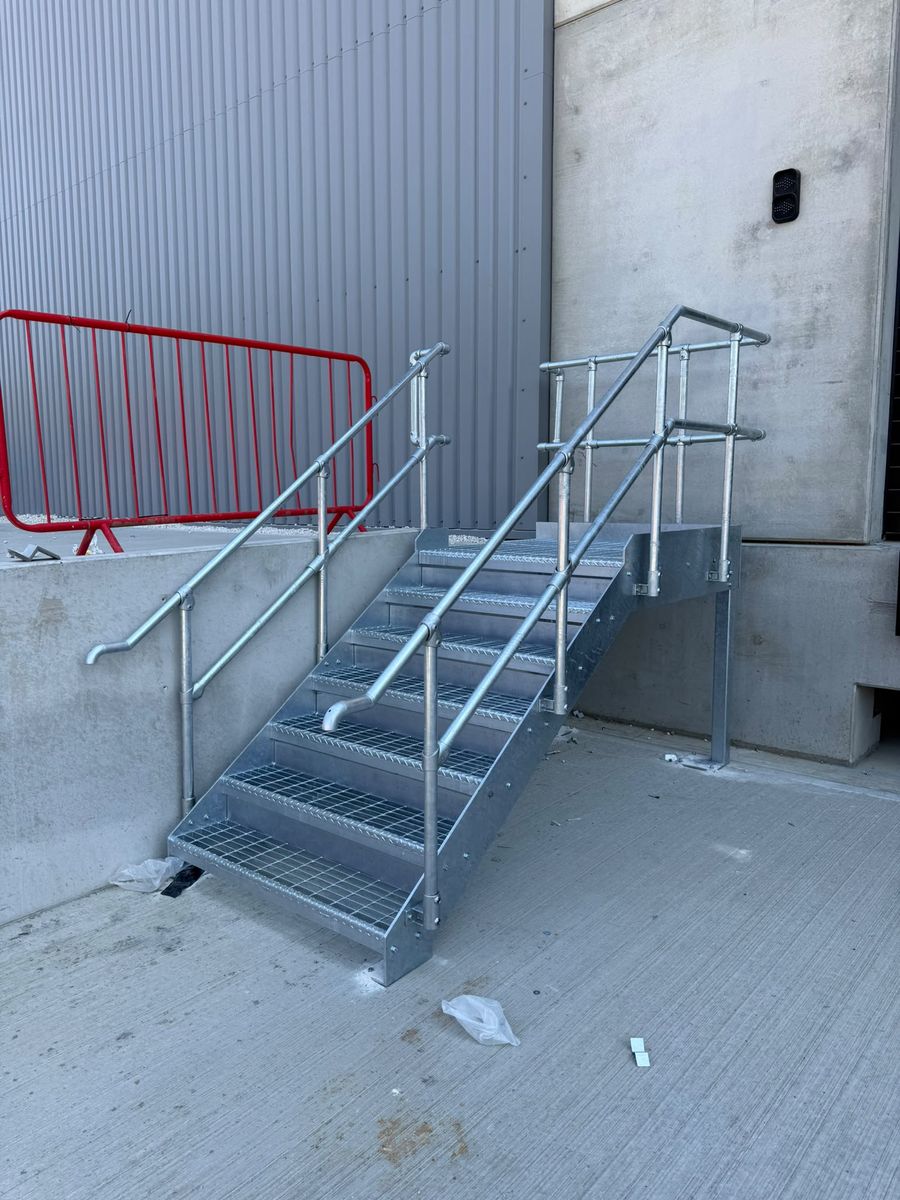
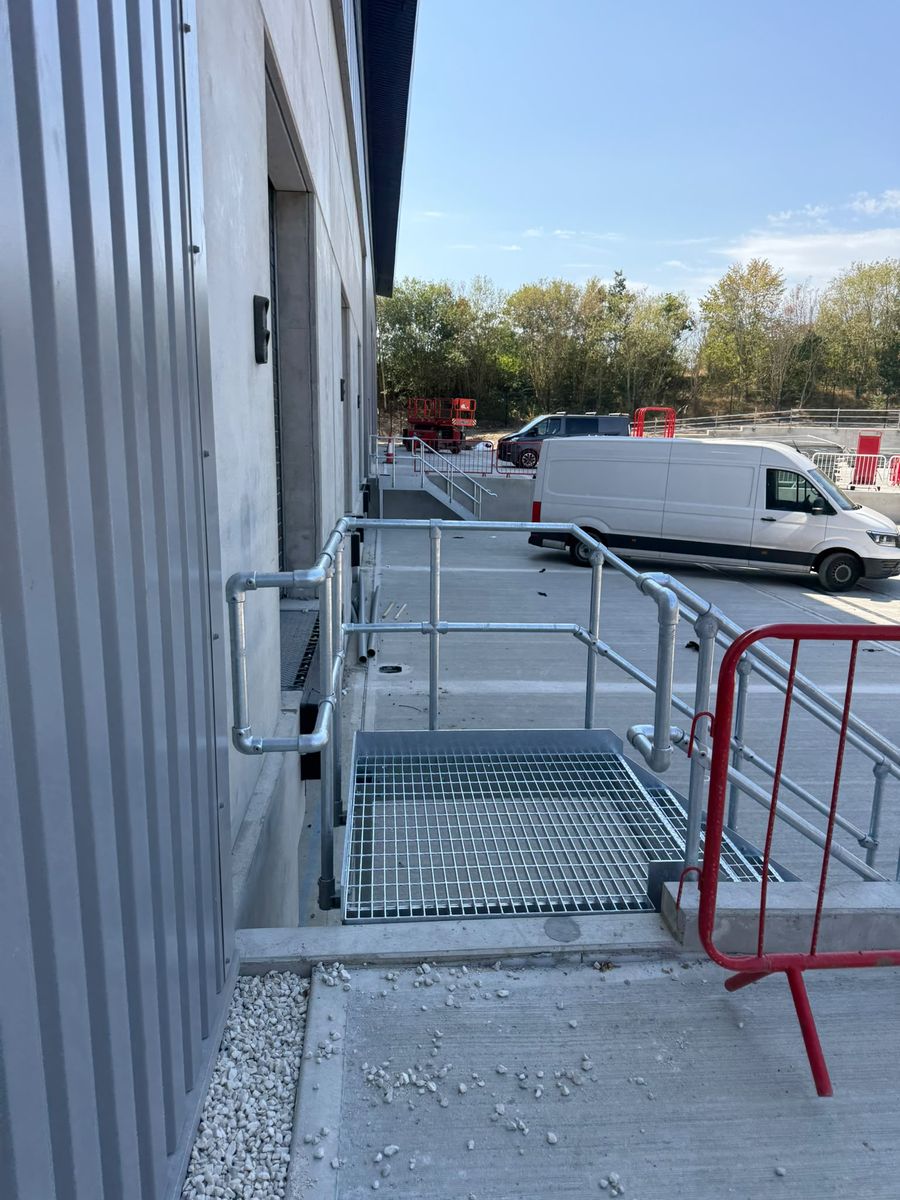
The stairs are the visible part, but a dock frontage needs more than steps. Alongside the flights we made open mesh crossover platforms at the dock positions, so anybody working at a door has a proper surface underfoot rather than the gap between the slab and the leveller, each with its own key clamp guarding. Where a stair or platform meets a personnel door we made chequer plate threshold plates to bridge the step and finish the junction cleanly.
Everything is bolted down. Folded plate stringers sit on baseplates fixed into the slab, and where the dock face left no ground to bear on, the landing carries on its own legs against the wall. Nothing was left resting on the concrete edge, which is the part of a dock that takes the most punishment.
Galvanised, not painted
The whole lot is hot dip galvanised to BS EN ISO 1461 and left at that, with no paint over the top. On a house we would usually galvanise and then powder coat, because appearance matters. On a loading dock it does not, and the paint would only be something to chip.
A dock is the hardest working part of an industrial building. It is outside, it is wet, it gets hit by pallet trucks and cages, and it is walked every day in work boots. Galvanising takes the knocks as bare metal, and where it does get scraped, the zinc around the scratch keeps protecting the steel underneath instead of letting rust creep away under a coating.
The steelwork is UKCA marked and fabricated to BS EN 1090-2, with a Declaration of Performance issued with it. On a commercial job the principal contractor will ask for that paperwork, and it should arrive without being chased.
Access stairs are not fire escape stairs
These are workplace access stairs, and that is a different job from the fire escape staircases we made for the same client on the same estate. An escape stair is designed around getting people out of a building in a hurry and is judged against the fire strategy. An access stair is walked every day, in both directions, often by somebody carrying something.
The requirements overlap but they are not the same, and on a commercial building the specification comes from the client's design team rather than from us. We build to what we are given, and we will say if something looks wrong, but confirming what a particular building has to comply with belongs to the design team and the building control body. It is not a check we take off anyone's hands.
If you want the background reading, our staircase building regulations guide covers the domestic and non-domestic split, and the staircase classification guide explains where Part M takes precedence over Part K on buildings other than dwellings.
Expert insight
"On a live site the fastest steel is the steel that does not need a hot works permit. Key clamp gets a compliant handrail up in an afternoon with an Allen key, it takes up whatever the concrete has actually done rather than what the drawing said, and in ten years somebody can move a section without ringing a fabricator. It is not the prettiest system we make. It is very often the right one."
Frequently asked questions
What is a key clamp handrail?
A handrail built from galvanised tube joined with cast fittings that clamp onto it, rather than being welded. Elbows, tees, corners and wall flanges all pull up on grub screws, so the rail assembles on site with hand tools. It is the standard for industrial handrails, ramps, plant access and roof edge protection, and we hold the tube and clamp fittings as stock items.
Can you fit stairs and handrails on a live construction site?
Yes, and key clamp is usually the reason it goes smoothly. No welding means no hot works permit, no fire watch and no restriction on working next to cladding or insulation. We work to the principal contractor's induction and permit system like any other trade.
Why open mesh treads rather than solid ones?
Outside, mesh drains. Water, grit and mud fall through instead of sitting on the step, so there is nothing to freeze in winter and nothing to build up into a slippery patch. The serrated front edge gives grip where a foot lands. On internal stairs or where things get dropped through, solid or chequer plate treads make more sense.
Do you supply commercial and industrial clients as well as homeowners?
Yes. A good part of our work is contractors, developers and facilities teams: fire escapes, access stairs, walkways, plant platforms, ramp handrails and guarding. Have a look at the fire escape staircases on this same estate and the galvanised fire escape stairs at Eurocell in Alfreton.
How far do you travel?
Nationwide, with our own installers rather than subcontracted fitters. Markham Vale is half an hour down the M1 from our Sheffield factory, which helps, but we survey, make and install the length of the country.
Explore more
Related products
- Tube and clamp fittings, the key clamp system used here
- Metal staircases and fire escape stairs
- Custom metal handrails on posts
- All metal handrails
- Railings and gates
Similar projects
- Industrial Fire Escape Staircases, Markham Vale, the earlier phase for the same client
- Galvanised Fire Escape Staircase, Eurocell Head Office, Alfreton
- View all our bespoke projects
Helpful guides
Got an access problem on site?
Call us on 0114 243 9009 or email sales@diometonline.co.uk. Send a photograph and a height and we will tell you what we can make and how quickly.
Stock tube and clamp fittings are priced on the site if you are building something yourself. Stairs, platforms and installed handrail systems are priced per job, so those need a call.
Tags: loading dock stairs, dock access steps, key clamp handrail, galvanised access stairs, open mesh tread stairs, industrial stairs Derbyshire, crossover platform, warehouse access stairs, tube and clamp handrail, commercial steelwork Sheffield