Staircase Building Regulations UK: What You Need to Know
Whether you're adding a new steel staircase to your home, replacing a tired external access stair, or fitting a spiral to a loft conversion, building regulations will apply. The rules cover everything from step dimensions and headroom to handrail heights and structural certification.
This guide covers the key UK building regulations for domestic staircases, with a focus on metal and steel staircases. It also touches on external stairs and fire escape requirements where relevant. All of Dio-Met's staircases are designed and manufactured in our Sheffield factory to comply with the relevant standards.
Please note: this guide is provided for general information only and should not be treated as professional, structural, or legal advice. Building regulations can vary depending on your specific project, location, and local authority interpretation. Always consult a qualified structural engineer and/or your local building control department before making decisions based on this information. Dio-Met Fabrications Ltd accepts no liability for any actions taken or not taken based on the content of this page.
Standard staircase dimensions UK: rise, going and pitch
These are the fundamental dimensions that determine whether a staircase is safe and comfortable to use. Approved Document K sets out the following requirements for domestic stairs:
Maximum rise (step height): 220mm per step
Minimum going (tread depth): 220mm per step
Maximum pitch angle: 42 degrees
There's also a comfort formula: twice the rise plus the going (2R + G) should fall between 550mm and 700mm. This ensures the staircase has a natural, comfortable rhythm when you walk up or down it.
All risers in a single flight must be the same height, and all goings must be the same depth. Inconsistent steps are a trip hazard and building control will reject them.
Number of steps and landing requirements
A single flight of domestic stairs can have a maximum of 16 risers before a landing is required. There's no minimum number, but in practice most flights have between 12 and 16 steps.
Landings must be at least as wide as the staircase and at least as long as the narrowest width of the flight. The landing provides a rest point and a safe place to change direction.
Staircase width regulations
There's no absolute minimum width for domestic stairs in the Building Regulations, but in practice a main staircase serving habitable rooms should be at least 800mm clear width. Between 800mm and 1,000mm is typical for most homes.
Width matters for handrail requirements too. Staircases under 1,000mm wide need a handrail on at least one side. Staircases 1,000mm or wider need handrails on both sides.
For bespoke steel staircases, the width is part of the design from the start. If you're working with a specific opening or limited space, get in touch and we can advise on what's achievable within the regulations.
Staircase headroom regulations
The minimum headroom above a staircase is 2,000mm (2 metres), measured vertically from the pitch line to any obstruction above. This applies throughout the full length of the flight and at landings, not just at the top and bottom.
For loft conversions where space is tight, building control may accept a reduced headroom of 1,900mm at the centre of the stair, reducing to 1,800mm at the sides. This needs to be agreed with your building control officer before you proceed.
Staircase handrail and guarding regulations
Every staircase needs a handrail. The requirements depend on the width of the stair and whether there's a risk of falling.
Handrail height: between 900mm and 1,000mm measured from the pitch line to the top of the handrail.
Stairs under 1,000mm wide: handrail required on at least one side.
Stairs 1,000mm or wider: handrails required on both sides.
Where there's an open side (no wall), a balustrade or guarding is also required to prevent falls. The guarding must be at least 900mm high on internal stairs. For open-riser stairs, no opening should allow a 100mm sphere to pass through (the same child safety rule that applies to glass balustrades).
For staircases with glass balustrade panels, see our glass balustrade building regulations guide for the specific glass requirements.
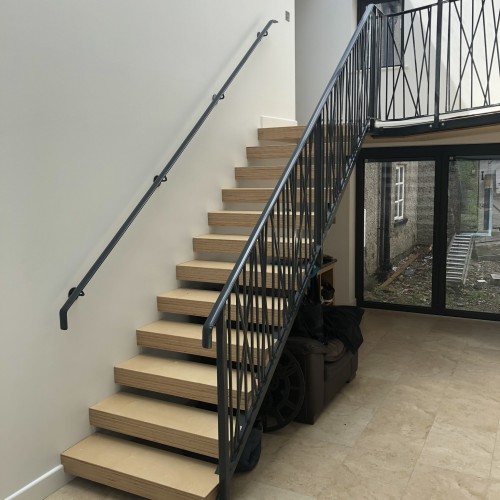
Open riser stairs and building regulations
Open riser (open tread) staircases are permitted under building regulations, but with conditions:
- No opening in the staircase should allow a 100mm sphere to pass through. This typically means the gap between treads must be less than 100mm
- The treads usually need to overlap each other by at least 16mm when viewed from the side, to prevent a foot slipping through. At Dio-Met, we design our open riser treads with a 25mm overlap as standard, comfortably exceeding the minimum
Many of Dio-Met's steel staircases are designed as open riser, which gives a lighter, more contemporary look while meeting all safety requirements.
There is more than one way to close the gap. The usual answer is a row of slim stainless infill bars across each riser, which is what our spine staircases use. On the ash tread staircases we made for a new house in Chorlton, Manchester the pressed steel tread tray is folded down behind each tread instead, so the structure closes the riser itself and no bars are needed at all.
Do spiral staircases meet building regulations?
Spiral staircases are governed by BS 5395 (Code of practice for the design of stairs) as well as Approved Document K. They're classified into categories based on their intended use:
Category A (small private stair): for access to a single room, such as a loft or mezzanine. Minimum clear width 600mm.
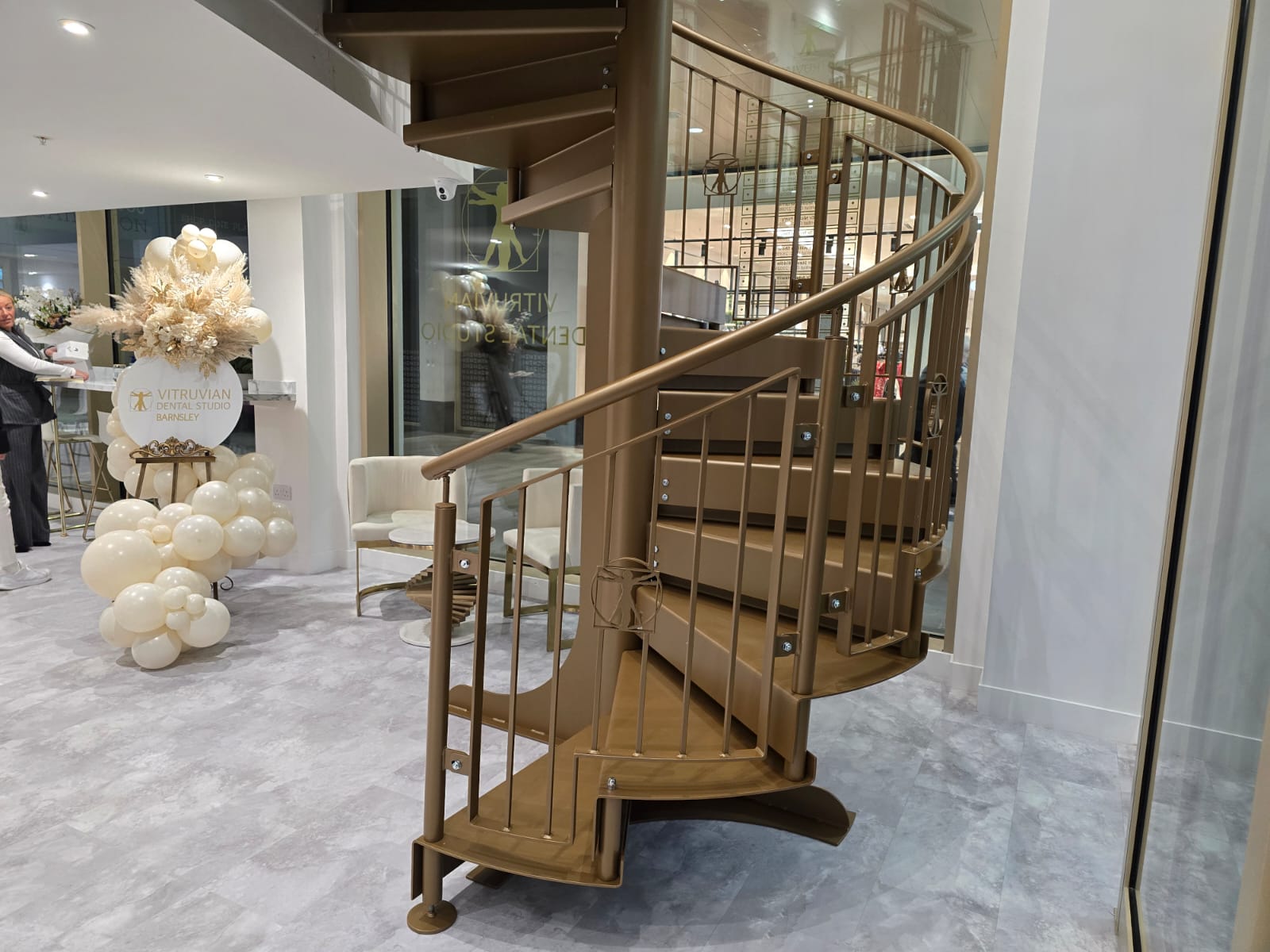
Category B (private stair): the main staircase in a home or the primary means of access between floors. Minimum clear width 800mm.
The minimum going is measured at the centre line of the tread for spirals, not at the narrow end. For a Category B spiral serving as a primary staircase, a diameter of around 1,800mm is typically needed to achieve the required going at the centre.
Where space is limited, Approved Document K gives some flexibility, and the final decision is at the discretion of your building control officer. If you're considering a spiral staircase for a tight space, it's worth involving building control early in the process.
Dio-Met manufactures bespoke steel spiral staircases to suit specific dimensions and building regulation requirements.
UKCA Marking and Structural Steelwork (BS EN 1090)
A steel staircase is structural steelwork. Under the Construction Products Regulation, any structural steelwork placed on the UK market must be manufactured by a company certified to BS EN 1090-2 and carry the UKCA mark.
This is a legal requirement, not optional. It applies to all load-bearing steel components: stringers, treads, landings, support brackets, and any associated steelwork. If the staircase carries weight (which all staircases do), it needs to be UKCA marked.
BS EN 1090-2 covers the entire manufacturing process, from welding procedures and material traceability through to quality control and final inspection. UKCA marking confirms that the manufacturer operates under a certified Factory Production Control system and that the product meets the required structural standards.
Building control will typically require a UKCA Declaration of Performance certificate for any steel staircase. Without it, sign-off may be refused.
Dio-Met is fully certified to BS EN 1090-2 and all our structural steelwork carries the UKCA mark. We supply Declaration of Performance certificates as standard with every staircase we manufacture.
What to check if you're buying elsewhere: ask your supplier whether their steelwork is manufactured under BS EN 1090 certification and whether it carries the UKCA mark. This is particularly important for staircases bought online or from overseas suppliers, where certification may not be in place. If they can't confirm both, building control may reject the installation.
External steps and staircase building regulations
External staircases follow the same basic dimensional rules as internal stairs (rise, going, headroom, handrails), with some additional requirements outdoors. Before any of that though, work out which document you are actually under, because it is where most of the confusion starts.
Part K or Part M: which one applies to your steps?
- Approved Document M applies when the steps form part of the approach to the building, meaning the route from the street, the drive or a parking space to an entrance. Part M is about access, so its steps are shallower and its rules are tighter.
- Approved Document K applies to everything else. A staircase down to the garden, up to a raised deck or balcony, a fire escape, or any stair inside the house. Part K is about protection from falling.
In practice most external steelwork sits under Part K. Steps serving a front entrance are the exception rather than the rule, but they are the ones people most often get wrong, so they are worth taking first.
Guarding height: external balustrades and guarding must be at least 1,100mm high (compared to 900mm for internal stairs), because any fall from an external staircase is likely to be more severe.
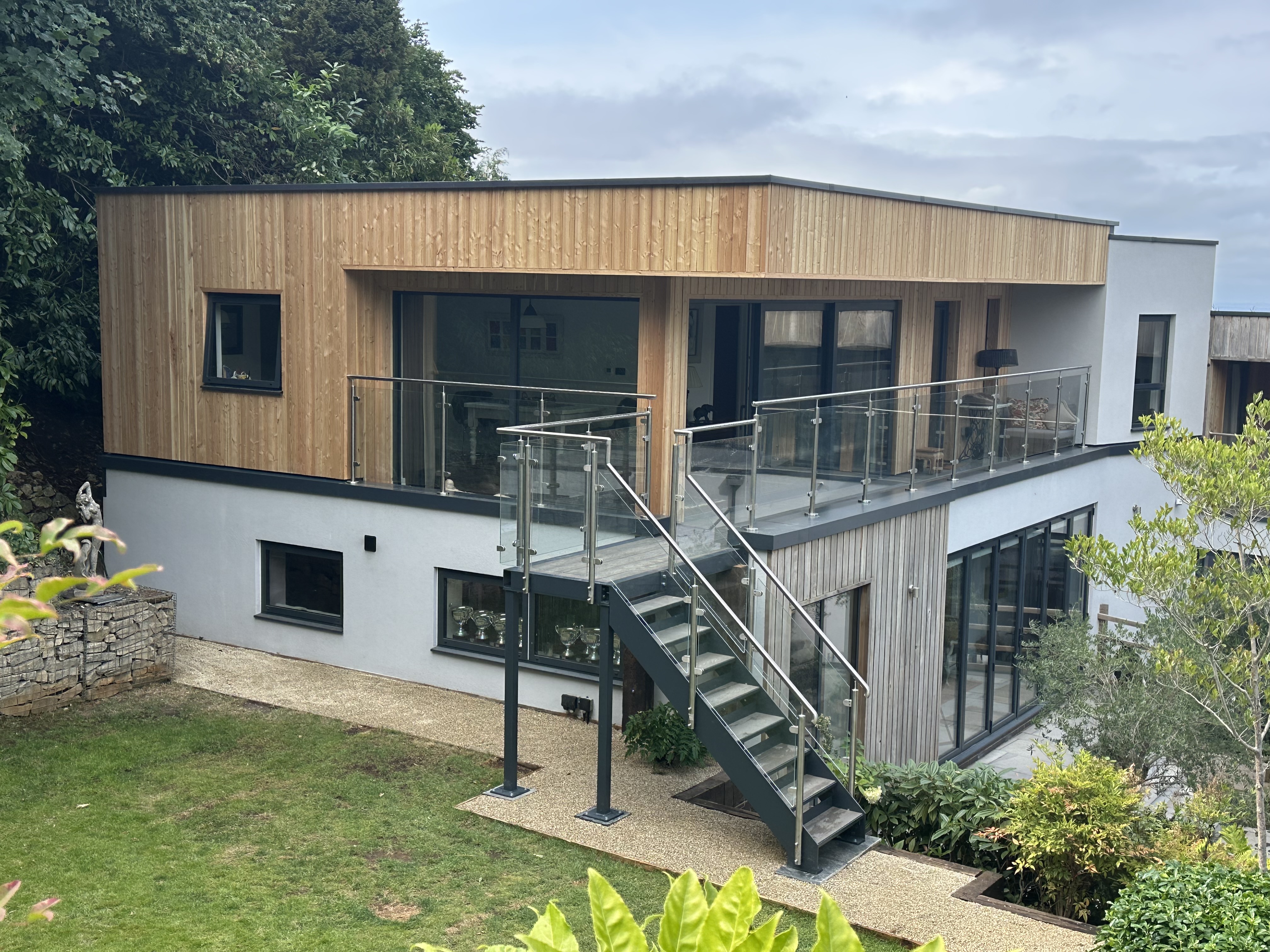
Materials: external staircases must be constructed from durable, weather-resistant materials. Steel staircases are typically galvanised (hot-dip galvanized to BS EN ISO 1461) and can also be powder coated for additional protection and colour choice.
Drainage: open treads or perforated treads are common on external stairs to prevent water pooling and reduce slip risk.
Dio-Met's external staircases are manufactured from galvanised steel as standard, with powder coating available in any RAL colour.
Steps that form the approach to a house: Approved Document M
This is the part most people miss. If the steps are how people get to the front door, building regulations treat them as an approach route under Approved Document M rather than as an ordinary staircase, and the dimensions are not the same as the internal figures above.
Which figures apply depends on the category of dwelling. Part M sets one baseline standard that applies to every new home, plus two optional higher standards a planning authority can impose as a condition. The step dimensions are different for each, which is why you will find two different sets of numbers quoted online. Both are correct, for different categories.
Category 1, visitable dwellings, M4(1). This is the baseline that applies to all new dwellings. Approved Document M paragraph 1.8:
- Rise: uniform, between 75mm and 150mm
- Going: 280mm minimum, measured on tapered steps at a point 270mm from the narrow end
- Clear flight width: 900mm minimum
- Landings: 900mm minimum length, top and bottom and intermediate where needed
- Maximum rise between landings: 1,800mm
- Handrail: any flight of three or more risers needs a grippable handrail to at least one side, 850mm to 1,000mm above the pitch line, extending at least 300mm beyond the top and bottom nosings
- Nosings: steps must have suitable tread nosings
Categories 2 and 3, accessible and adaptable dwellings M4(2) and wheelchair user dwellings M4(3). Where the planning authority has applied either of these as a condition, paragraphs 2.11 and 3.11 tighten the steps to a rise of 150mm to 170mm and a going of 280mm to 425mm. Everything else, the widths, landings and handrail, stays as above.
Two things worth knowing about that M4(1) range. The 75mm at the bottom is a minimum, not a target: nobody builds a 75mm riser by choice, it is there so a very shallow flight on a gentle slope is not accidentally non-compliant. And the whole range sits lower than the 150mm to 220mm allowed for a private stair inside the house under Part K, because an approach route has to work for someone who is unsteady on their feet.
If you are working on a new-build plot, find out which category the planning consent requires before anyone sets out a single step. The two ranges only overlap at 150mm.
The riser height that works everywhere is 150mm. It is the top of the M4(1) range, the bottom of the M4(2) and M4(3) range, and the bottom of the 150mm to 220mm allowed for a private stair under Part K. Pair it with a going of 280mm to 300mm and that satisfies all three as well, since Part M wants 280mm as a minimum and Part K allows up to 300mm.
So if the category has not been pinned down yet and something has to be set out, 150mm rise on a 280mm to 300mm going is the combination that cannot be wrong.
A stepped approach is only acceptable in the first place where step-free access to the entrance cannot be achieved, for example on a steeply sloping plot.
External stairs that are not the approach route
A staircase down to a garden, up to a raised deck or balcony, or a fire escape from an upper floor is not an approach route. Those follow Part K, using the same limits as an internal private stair: 150mm to 220mm rise, 220mm to 300mm going, 42 degrees maximum pitch. The difference outdoors is the guarding. Guarding is required wherever there is a drop of more than 600mm, and externally it must be at least 1,100mm high rather than the 900mm used inside.
Do external steps need planning permission or building control approval?
Planning permission is not normally needed for steps in a garden. It can be needed where the steps form part of something larger, such as a raised deck attached to the front of the house, and the rules are different again in a conservation area or on a listed building.
Building control approval is not normally needed for external steps either, unless they form part of the access to the building. Where they do, you cannot leave the access worse than you found it. A staircase serving an upper floor, or one sitting close to a boundary, is a different question and worth a call to your local authority before you commit to anything.
Steel fire escape stairs regulations
If your project involves a fire escape staircase (most commonly on commercial or multi-occupancy residential buildings), additional regulations apply under Approved Document B (Fire Safety):
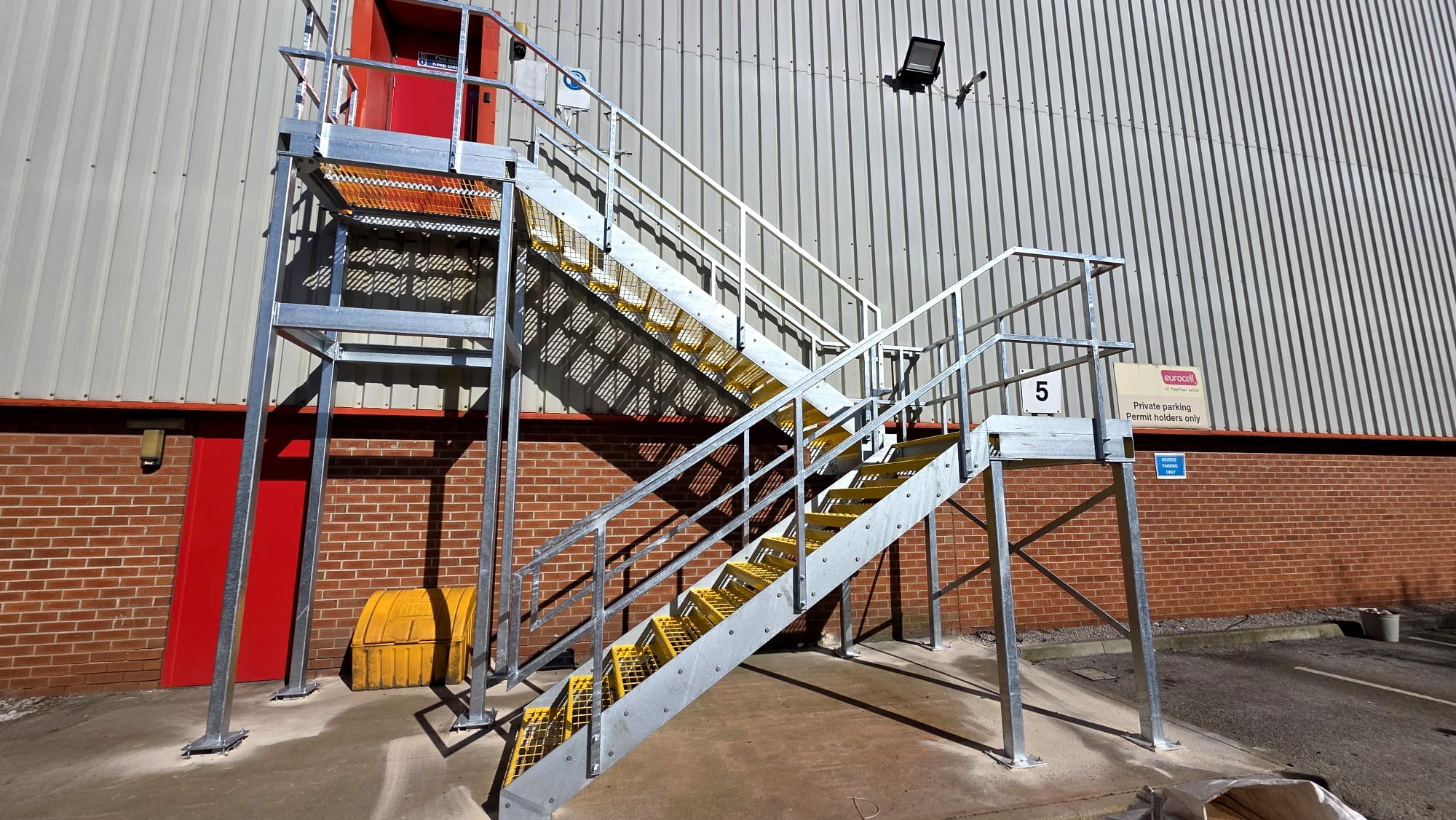
- Fire escape stairs must be constructed from non-combustible materials (steel or concrete)
- The building envelope within 1,800mm above and horizontally from the flights and landings must be fire-resisting construction (minimum RE30 rating)
- Doors leading to fire escape stairs must be fire-resistant (minimum E30) and fitted with self-closing devices
- Fire escapes should be inspected structurally at intervals of no more than 5 years (BS 8210)
Fire escape design requires input from a fire engineer or building control at an early stage. Dio-Met manufactures UKCA-certified fire escape staircases for commercial and residential projects across the UK.
Commercial staircase regulations UK
The regulations above focus on private domestic stairs. Commercial buildings, shared communal areas and multi-occupancy residential properties are classified differently, and the numbers change with them: wider minimum widths, a maximum number of risers per flight, contrasting nosings, different balustrade specifications (key clamp systems are common in industrial settings), higher loading requirements, and accessibility provisions under Part M. Where Part M and Part K conflict, Part M takes precedence.
All of that is set out in full, category by category, in our staircase classification guide, covering private, utility and general access stairs. If your project is commercial or multi-occupancy, get in touch and we will tell you what we can build and what will fit. Dio-Met manufactures staircases for both domestic and commercial projects from our Sheffield factory.
Do you need planning permission for a staircase?
For an internal staircase, planning permission is not normally required. You're altering the interior of your home, which is usually permitted development.
For an external staircase, the situation depends on the property and location:
- A new external staircase may require planning permission if it significantly changes the appearance of the building
- Listed buildings and properties in conservation areas will almost certainly need planning consent
- Permitted development rights may cover some external alterations, but check with your local planning authority first
Regardless of planning permission, building control approval is required for any new staircase (internal or external).
What If My Staircase Can't Meet the Standard Dimensions?
Sometimes a fully compliant staircase simply won't fit the available space, particularly in older properties, loft conversions, or buildings with unusual layouts. In these situations, building control can consider dispensations on a case-by-case basis for designs that might not otherwise comply with the standard requirements.
This isn't guaranteed, and it depends entirely on the circumstances of the project and the judgement of your building control officer. If you think your project might need a dispensation, it's worth having that conversation with building control early on, ideally before you commit to a design. Dio-Met can work with you and your building control officer to find a solution that balances what's achievable in the space with what's safe and approvable.
Do staircases need building control approval?
Yes. Any new staircase installation requires building control approval. This applies whether it's a simple replacement, a new staircase in an extension, a loft conversion stair, or an external access stair.
Building control will want to see that the staircase meets Approved Document K requirements (dimensions, handrails, guarding) and will typically require a UKCA Declaration of Performance certificate for the structural steelwork.
Some local authorities may also request project-specific structural calculations, though this is increasingly rare where UKCA certification is provided.
Dio-Met supplies UKCA Declaration of Performance certificates as standard with all our staircases. If your building control officer requires additional documentation such as project-specific structural calculations, we can provide these on request.
Which Dio-Met Staircases Meet Building Regulations?
Every staircase we manufacture at our Sheffield factory is designed to comply with Approved Document K and BS EN 1090-2 unless a client specifically instructs otherwise. Our range covers:
- Internal straight-flight staircases in steel with options for glass, timber, or metal treads and balustrades
- Spiral staircases in steel, manufactured to suit your specific dimensions and building regulation category
- External access staircases in galvanised steel, with or without powder coating
- Fire escape staircases for commercial and multi-occupancy residential buildings
A caveat on compliance, and on our photographs
Compliance is what we design to, but it is not always what a client wants built. Occasionally someone asks us to supply something that would not pass building control. Leaving the infill bars out of an internal flight so the stair looks lighter is the common one. Dropping a handrail where one ought to be fitted is another.
Where that happens the client is making an informed decision on their own knowledge and at their own risk, and we tell them so at the time. It does mean that some of the finished work you will find in our photographs, on this site and elsewhere online, was built to a client's instruction rather than to Approved Document K. Please do not treat a photograph as a specification.
If your project has to satisfy building control, say so at enquiry stage and we will design to it and tell you where a look you have seen elsewhere would not comply.
Every staircase is individually designed and manufactured to your specific dimensions and requirements. If you're not sure what you need, get in touch and we can advise based on your project.
Frequently Asked Questions
What are the maximum and minimum step dimensions for a domestic staircase?
Maximum rise (step height) is 220mm and minimum going (tread depth) is 220mm, with a maximum pitch of 42 degrees. The comfort formula 2R + G should fall between 550mm and 700mm. All steps in a single flight must be consistent.
Does a steel staircase need UKCA marking?
Yes. A steel staircase is structural steelwork and must be manufactured by a company certified to BS EN 1090-2 and carry the UKCA mark. This is a legal requirement under the Construction Products Regulation. Dio-Met is fully certified and all our staircases are UKCA marked.
How many steps can I have before I need a landing?
A maximum of 16 risers in a single flight for domestic stairs. After that, a landing is required before the next flight begins.
What is the minimum headroom for a staircase?
2,000mm (2 metres) measured vertically from the pitch line throughout the full length of the flight and at landings. Reduced headroom may be accepted for loft conversions with building control agreement.
Do I need a handrail on both sides of my staircase?
If the staircase is under 1,000mm wide, you need a handrail on at least one side. If it's 1,000mm or wider, handrails are required on both sides. Handrail height must be between 900mm and 1,000mm from the pitch line.
Can I have an open riser steel staircase?
Yes, provided no opening allows a 100mm sphere to pass through. The treads usually need to overlap each other by at least 16mm when viewed from the side. Dio-Met designs open riser treads with a 25mm overlap as standard, comfortably exceeding the minimum.
What building regulations apply to an external staircase?
The same dimensional requirements as internal stairs, but guarding must be at least 1,100mm high (instead of 900mm). External staircases should be constructed from durable materials such as galvanised steel. Fire escapes have additional requirements under Approved Document B.
Can Dio-Met supply the documentation needed for building control?
Yes. We supply UKCA Declaration of Performance certificates as standard with all staircases. If your building control officer requires additional documentation such as project-specific structural calculations, we can provide these on request.
Staircases we have built to these rules
Regulations read better with something to look at. Every one of these was surveyed, made in our Sheffield factory and installed by our own fitters, and every one is marked to BS EN 1090-2.
- External steel staircase and landing system, Cheltenham
- Brand-integrated spiral staircase, Barnsley
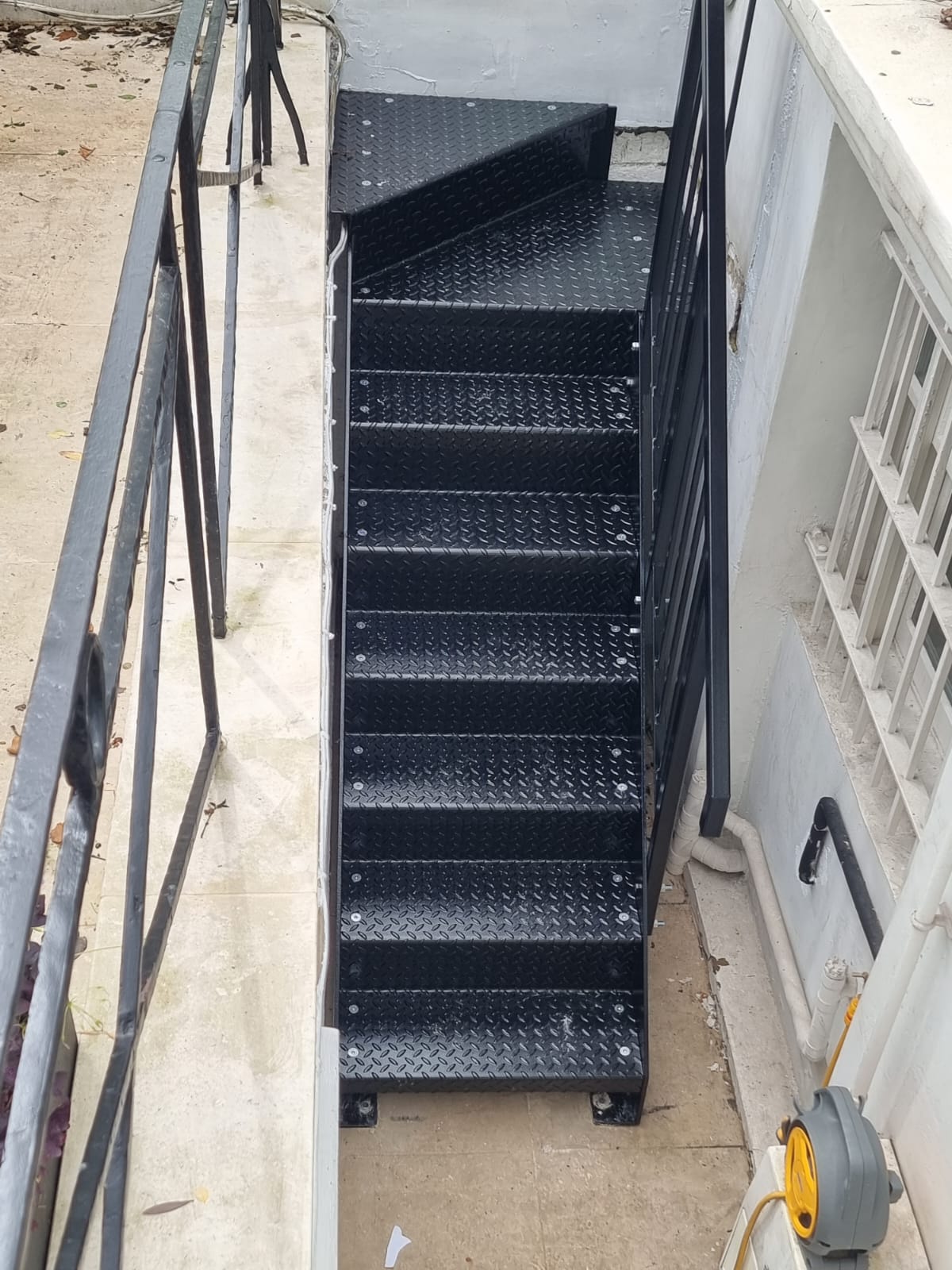
- Kite winder basement access staircase, London
- Galvanised fire escape staircases, Eurocell, Alfreton
- Oak and glass spine staircase, Southport
- Walkout balcony with a spiral staircase, Woodford Green
- All bespoke projects
Related Products
- Metal Staircases and Fire Escape Stairs: our full range of bespoke steel staircases
- Metal and Glass Balustrades: balustrade systems for staircases, landings, and balconies
- Metal Handrails: stair handrails and handrails on posts
- Glass Balustrade Building Regulations Guide: our companion guide covering glass specifications, loading, and UKCA requirements for balustrades
- View all our bespoke projects
Need Advice on Your Project?
Not sure what type of staircase meets regulations for your specific situation? We've been manufacturing bespoke steel staircases in our Sheffield factory for over 30 years. Call us on 0114 243 9009 or email sales@diometonline.co.uk, or request a quote online.
Disclaimer
The information on this page is provided by Dio-Met Fabrications Ltd for general guidance purposes only. It does not constitute professional, structural, engineering, or legal advice. While we make every effort to keep this information accurate and up to date, building regulations, British Standards, and their interpretation by local authorities can change and may vary by project and location. Dio-Met Fabrications Ltd makes no representations or warranties of any kind, express or implied, about the completeness, accuracy, or reliability of the information provided. You should always seek advice from a qualified structural engineer, architect, or your local building control authority before proceeding with any installation. Dio-Met Fabrications Ltd accepts no liability for any loss, damage, or consequence arising from reliance on the content of this page. This guide relates to England and Wales only; regulations in Scotland and Northern Ireland may differ.
Choosing rather than checking? Our steel staircase buying guide covers the decisions — straight, spiral, kite winder or curved, spine or twin stringer, tread and balustrade options, finishes, and what actually drives the cost.
Tags: staircase building regulations, staircase building regs UK, Approved Document K stairs, steel staircase regulations, spiral staircase building regulations, open riser staircase regulations, fire escape staircase regulations, UKCA staircase, domestic staircase requirements