Glass Floor Building Regulations UK: What You Need to Know
If you're considering a glass floor, glass well cover, or wine cellar glass hatch, there are building regulations and British Standards that apply to your project. Glass floors are structural elements that people walk on, so the requirements around loading, glass specification, and safety are understandably thorough.
This guide covers the key UK building regulations for glass floors in domestic properties, including fixed walk-on glass panels, glass well covers, and hinged wine cellar glass hatches. There is some crossover with our glass balustrade building regulations guide and balcony building regulations guide where glass is used as a walking surface on balconies. Where the topics overlap, we've kept things brief here and linked across.
All of Dio-Met's glass floor steelwork is designed and fabricated in our Sheffield factory, and our glass is sourced to meet or exceed these standards.
Please note: this guide is provided for general information only and should not be treated as professional, structural, or legal advice. Building regulations can vary depending on your specific project, location, and local authority interpretation. Always consult a qualified structural engineer and/or your local building control department before making decisions based on this information. Dio-Met Fabrications Ltd accepts no liability for any actions taken or not taken based on the content of this page.
Types of Glass Floor
Before getting into the regulations, it's worth clarifying what we mean by "glass floor" because the term covers several different products, and the requirements can vary between them.
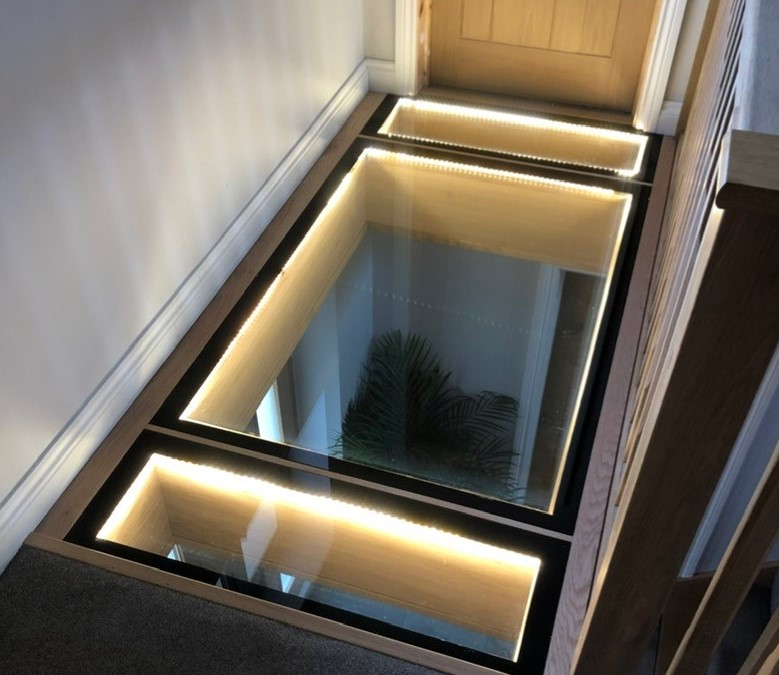
Fixed walk-on glass panels are glass panels set into a floor structure that you walk over. They're typically used to bring natural light down through a building, for example from a ground floor into a basement, or from an upper floor into the room below. The glass is fixed in place and is not designed to be opened. These are available as glass-only panels or as complete glass and steel framework systems.
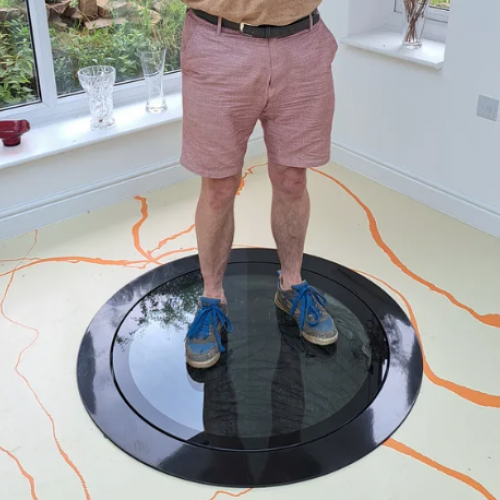
Glass well covers are glass panels that sit over a void or opening in the floor, such as a stairwell, lightwell, or service void. They serve the same structural purpose as a fixed glass floor but are specifically designed to span an opening. Dio-Met supplies glass well covers in rectangular and circular formats.
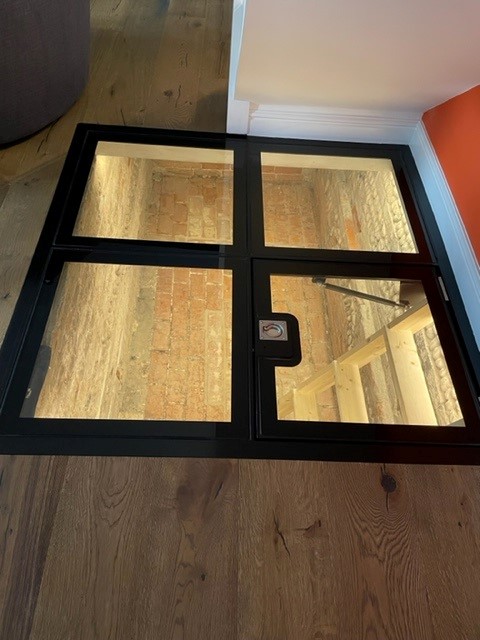
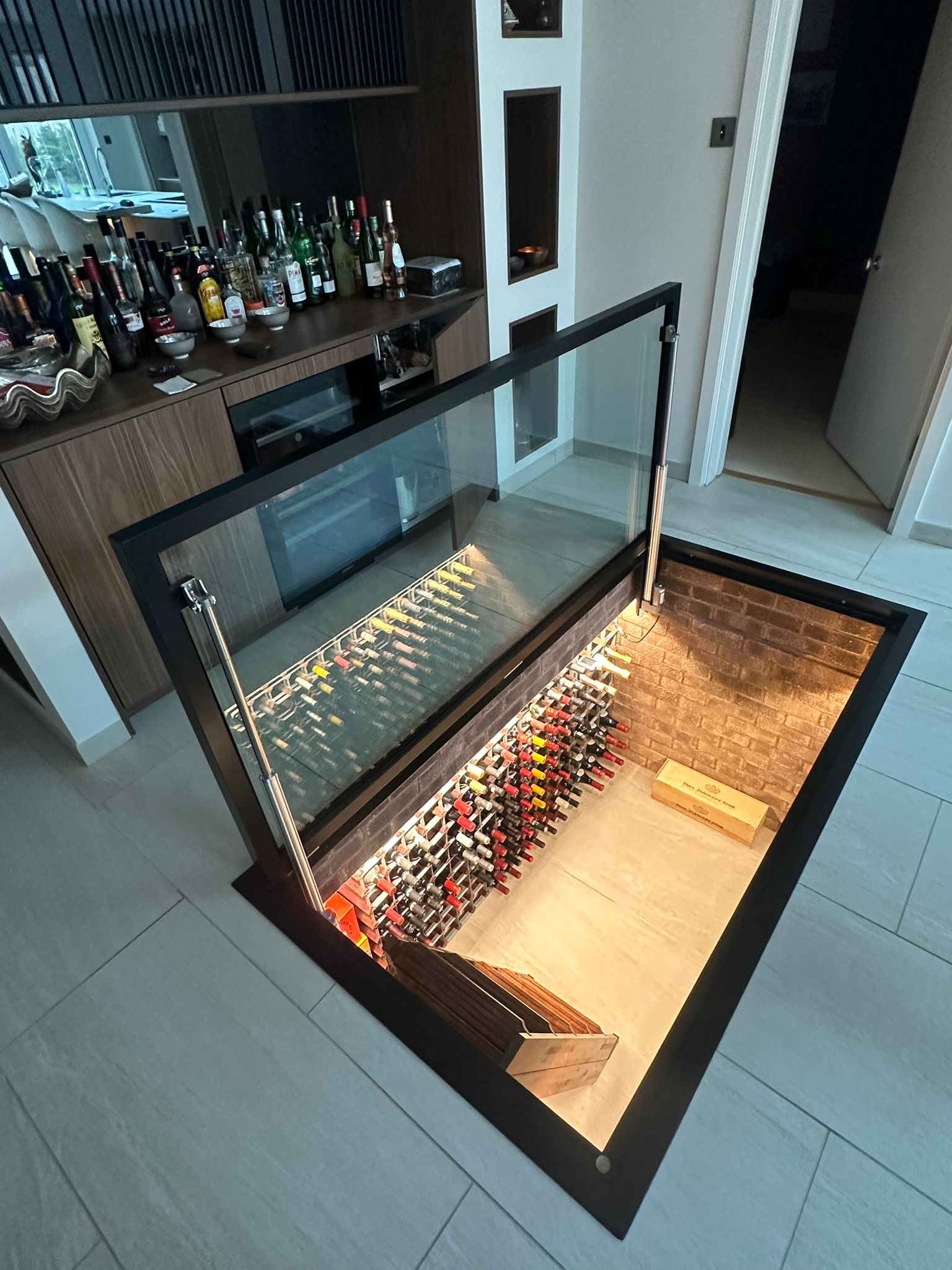
Wine cellar glass hatches are hinged glass floor panels that open to provide access to a cellar or basement below. These need to function both as a loadbearing floor when closed and as a safe, operable access point when open. They're more complex than fixed panels because they involve hinges, gas struts or electric actuators, and locking mechanisms. Wine cellar hatches also sit in a slightly different position in terms of building regulations, which we cover in detail below. See our wine cellar glass doors range. For how they are actually built, and how to choose between gas strut and electric opening, see our guide to hinged glass floors.
All three types must comply with the same core structural and safety requirements, though wine cellar hatches have additional considerations that are worth understanding before you order.
Glass floor loading requirements
Glass floors in domestic properties must be designed to carry the loads set out in BS EN 1991-1-1 (Eurocode 1) with the UK National Annex.
For internal domestic floors (Category A1):
The figures below are the imposed loads given in the UK National Annex to BS EN 1991-1-1 for the building uses we are most often asked about. On a glass floor it is almost always the concentrated load, not the spread load, that decides the glass thickness, because a small hard contact area is far harder on glass than the same weight spread over a square metre. Get the concentrated figure wrong and the specification is wrong. A worked example is our hinged glass wine cellar door in a converted coal store, where it is the 2.0 kN point load over a 50mm square, not the 1.5 kN/m² spread, that sets the 25.5mm glass make up.
| Use | Spread load (UDL) | Concentrated load |
|---|---|---|
| Domestic | 1.5 kN/m² | 2.0 kN |
| Office | 2.5 kN/m² | 2.7 kN |
| Restaurant / bar | 2.0 kN/m² | 3.0 kN |
| Retail | 4.0 kN/m² | 3.6 kN |
| Museum / assembly | 4.0 kN/m² | 4.5 kN |
A balcony is uprated again: 2.5 kN/m² for a balcony in a single family dwelling, against 1.5 kN/m² for the room it opens off.
- Minimum uniformly distributed load (UDL): 1.5 kN/m²
- Concentrated load: 2.0 kN applied over a 50mm square area
When a drop counts as dangerous
Industry guidance treats a drop of more than 380mm below the glass as dangerous, and that is the point at which the design has to account for what happens if a pane is ever broken, not just whether it carries the load. It is a lower threshold than most people assume: a raised floor over a shallow void can cross it. Below that, breakage is a nuisance. Above it, it is a fall.
These are the same loading requirements as any other domestic floor. The glass panel, its supporting frame, and the connections to the surrounding structure all need to be designed to carry these loads with appropriate safety factors.
If the glass floor is external (such as a balcony deck or external walkway), the loading requirement increases to 2.5 kN/m² (Category A5). Our balcony building regulations guide covers external balcony loading in more detail.
The concentrated load of 2.0 kN is important for glass floors because it represents the worst-case point load, such as a stiletto heel or a heavy piece of furniture on a small foot. The glass must resist this without cracking or deflecting excessively, even though the overall distributed load is lower.
Glass floor glass specification and thickness
This is the area where glass floors differ most from other structural glass applications. The glass needs to do three things simultaneously: carry the full design load, survive impact, and remain safe if it does break.
Laminated Construction
Glass floors must be laminated, meaning two or more plies of glass bonded together with a PVB or ionoplast interlayer. Single-ply toughened glass is not acceptable for floors, regardless of thickness, because if it breaks it would leave an open hole in the floor.
The laminated construction provides redundancy. If one ply breaks, the remaining ply (or plies) must be capable of carrying the full design load on its own until the panel is replaced. This is a fundamental safety requirement, and it's the reason glass floor panels use thicker, heavier glass constructions than you might expect.
Typical Glass Specifications
For domestic glass floors, the common glass build-ups are:
Redundant and sacrificial plies
Two ideas worth knowing, because they are what separates a properly specified glass floor from a sheet of thick glass.
A redundant ply is an extra layer in the laminate whose job is to carry the floor on its own if another ply breaks. It is why a laminated floor stays walkable and stays in place after damage rather than dropping through, and it is the reason laminated construction is not optional over a drop.
A sacrificial ply is a top layer that is expected to take the scratches. Glass floors get walked on with grit underfoot, and over years the top surface dulls. With a sacrificial layer, that top pane is replaced rather than the whole unit. On a heavily used floor, in a shop or a hallway, it is worth specifying from the start.
Contact with hard objects, metal, stone or other glass, should be avoided throughout. That is what the cushioning in the frame is for.
- 2 x 12mm toughened laminated (25.5mm total including interlayer): suitable for panels up to approximately 1,000mm x 3,000mm with 4-edge support
- 2 x 15mm toughened laminated (31.5mm total): suitable for larger panels, typically up to around 2,000mm x 1,500mm
- 3 x 10mm toughened laminated (33mm total): a three-ply option providing additional redundancy
The maximum panel size depends on the glass thickness, the support conditions, and the specific loading. All glass floor panels must be supported on all four edges. Two-edge or three-edge support is not acceptable for walk-on glass because the unsupported edges create unacceptable stress concentrations.
There's also a practical handling limit. Glass is heavy, around 25kg per square metre per 10mm of thickness. A large panel of 31.5mm laminated glass can easily exceed 250kg, which is about the limit for safe manual handling on site. Panel sizes need to account for this.
Impact Resistance
All glass in floors must meet BS EN 12600 for impact resistance, with a minimum classification of 1B1 (the highest category). This means the glass has been tested to resist the impact of a 50kg pendulum body dropped from the maximum test height and has either not broken or has broken safely.
The individual plies must be toughened to BS EN 12150 and the laminated assembly must comply with BS EN 14449.
Glass floor support and framing
Glass floor panels need a properly designed support frame around all four edges. The frame serves two purposes: it carries the load from the glass into the surrounding structure, and it holds the glass securely in position.
Frame Design
The support frame must provide a bearing surface at least equal to the thickness of the glass on all four edges, with a minimum 3mm clearance between the glass edge and the frame on each side to allow for thermal movement and installation tolerances. The glass sits on neoprene or EPDM rubber setting blocks and gasket strips that distribute the load evenly and prevent glass-to-metal contact.
Dio-Met's walk-on glass and steel framework systems are designed specifically for this. The steel frame is fabricated to suit the glass size and the floor build-up, with the correct bearing, clearance, and gasket details built in.
Deflection Limits
How the glass sits in the frame
Traditional glass flooring is supported continuously around its perimeter and never at a mid-point. The frame has to carry the design load and the weight of the glass without deflecting noticeably, which is a stiffness problem as much as a strength one: a floor can be perfectly safe and still unnerve people because it moves underfoot.
The glass is never in direct contact with the frame. It sits on a cushioning strip, typically 3mm and around Shore A 60, with a minimum 3mm clearance to the frame and to any adjacent pane, and the joint is pointed to finish flush. Modern structural interlayers have made point-supported and minimally supported designs possible, but they are an engineered exception rather than the default.
The supporting structure (beams, joists, or the frame itself) must not deflect excessively under load. Excessive deflection can cause stress concentrations in the glass, particularly at the edges and corners. The typical deflection limit for glass floor supports is span/360 or span/500 depending on the application and the engineer's assessment.
UKCA Marking and Structural Steelwork (BS EN 1090)
Any steel frame, beam, or support structure that carries a glass floor panel is structural steelwork, and it must be manufactured by a company certified to BS EN 1090-2 and carry the UKCA mark. This is a legal requirement for structural steel products placed on the UK market.
This is worth highlighting because it's an area where many suppliers fall short. Glass floor frames and support steelwork are safety-critical components. They carry the full design load of the glass and everything on it, and if the steelwork hasn't been manufactured under a certified quality management system, building control can reject it. There can also be liability issues if something goes wrong down the line.
BS EN 1090 covers the welding procedures, materials, quality control, and traceability of structural steel during manufacture. UKCA marking is the legal confirmation that the finished product meets these requirements. Without both, the steelwork does not comply.
Dio-Met is fully certified to BS EN 1090-2 and all our structural steelwork, including glass floor frames, carries the UKCA mark. We supply UKCA Declaration of Performance certificates as standard with every order.
What to check if you're buying elsewhere: ask your supplier whether their steelwork is manufactured under BS EN 1090 certification and whether it comes with UKCA marking. If they can't confirm both, that's a red flag. This applies to any steel frame that supports walk-on glass, not just balustrades and balcony structures.
Glass floor slip resistance
Glass is smooth, and smooth surfaces can be slippery, particularly when wet. Slip resistance is a genuine consideration for glass floors and one that building control may ask about.
Testing Standards
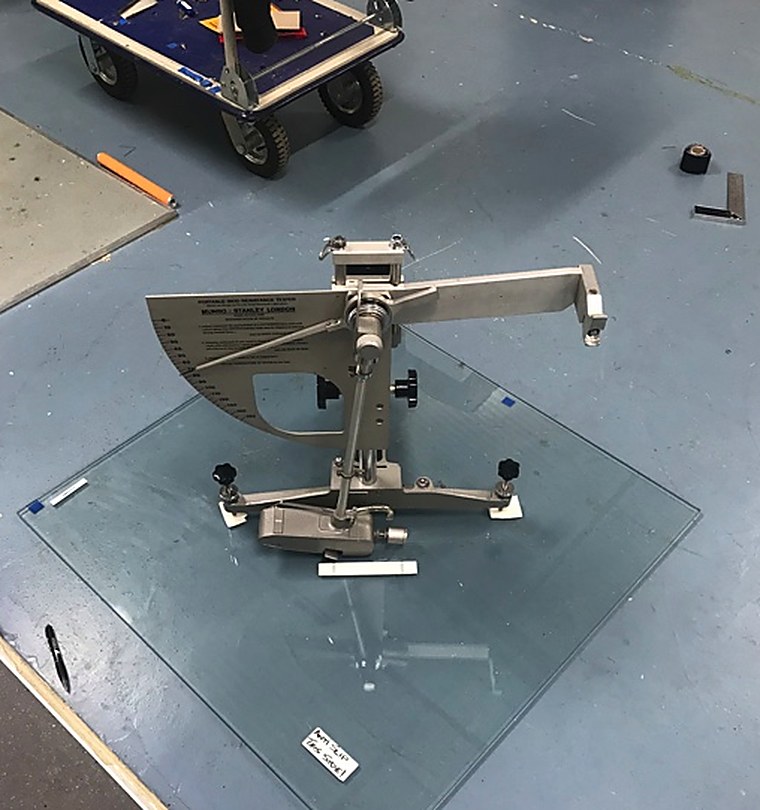
Slip resistance for floor surfaces is assessed using the HSE pendulum test (formerly known as the "Munro" pendulum test), which measures the Pendulum Test Value (PTV) of the surface. The results are classified as:
Our pendulum test results
Independent pendulum testing to the HSE 2012 methodology, carried out in three directions across the walking surface, returned these median values on our anti-slip treated walk-on floor glass:
| Test direction | Median PTV | Classification |
|---|---|---|
| A (dry) | 68 | Low slip potential |
| B (dry) | 70 | Low slip potential |
| C (dry) | 71 | Low slip potential |
| Wet | 19 to 23 | High slip potential |
The dry figures are roughly double the PTV 36 threshold generally taken as low slip potential. We publish the wet figures alongside them deliberately: wet glass is slippery whatever it has been treated with, which is why external walk-on floors and balconies need that designing around rather than glossing over. The treatment is an invisible chemical one, so the glass stays fully transparent, and it wants reapplying at about five years.
- PTV 36 and above: Low slip potential
- PTV 25 to 35: Moderate slip potential
- PTV 0 to 24: High slip potential
Dio-Met's Invisible Anti-Slip Treatment
This is something most glass floor suppliers can't offer. Dio-Met supplies glass floor panels with an invisible chemical anti-slip treatment that provides outstanding grip without changing the appearance of the glass. The treatment is completely transparent, so you get the full visual effect of a clear glass floor with the slip resistance of a treated surface.
Independent HSE pendulum testing (carried out by Surface Performance Ltd to the HSE 2012 methodology, tested in three directions) returned median PTV values of 68 to 71 in dry conditions, classified as low slip potential. That's nearly double the PTV 36 threshold. To put it another way, the treated glass significantly outperforms many conventional floor finishes.
In wet conditions, the same treated glass returned PTV values of 19 to 23, which falls into the high slip potential category. This is important for external applications or areas where the glass might get wet (near swimming pools, bathrooms, entrance areas). For wet environments, additional measures such as sandblasting or ceramic frit may be needed on top of the chemical treatment.
The key advantage of this treatment is that it's invisible. Sandblasting and ceramic frit patterns both work well for grip, but they change the appearance of the glass, making it frosted or textured. If you want a clear glass floor that you can see straight through, with confidence that the surface is safe to walk on, this invisible treatment is the way to achieve it. Ask us about it when you get in touch.
Other Anti-Slip Options
Where the invisible treatment isn't sufficient (wet areas, external applications) or where a frosted appearance is actually preferred, there are other options:
Sandblasting provides a textured surface that significantly improves grip, both wet and dry. It also gives the glass a frosted, translucent appearance, which can be a benefit where modesty is a consideration (more on that below).
Raised ceramic dots or frit patterns are screen-printed onto the glass surface before toughening. These provide localised grip points across the surface. The pattern can be designed to be subtle or decorative.
For external glass floors, such as glass balcony decking, consider the slip resistance requirements carefully based on the use case, exposure, and proximity to handrails or walls. The glass should also be protected from wheeled traffic (trolleys, wheelchairs, heavy furniture on castors) which can cause concentrated point loads and surface damage.
Glass floor privacy and modesty
If the glass floor is transparent, people below can see up through it. This is sometimes the whole point (a wine cellar viewing panel, for example), but in other situations it creates a modesty issue, particularly in domestic settings where the glass floor might be above a living area or hallway.
There are two main approaches:
Translucent interlayer: The PVB interlayer between the glass plies can be specified as translucent (frosted) rather than clear. This lets light through while obscuring the view. It's a permanent solution built into the glass at manufacture.
Sandblasted surface: As mentioned under slip resistance, sandblasting the top surface gives the glass a frosted appearance. This provides both slip resistance and modesty in one treatment. The degree of obscurity depends on the grit and depth of the sandblasting.
Both options still allow natural light to pass through the floor, which is typically the main reason for installing glass in the first place.
Lighting under the glass, and thermal stress
Worth flagging because it comes up constantly on wine cellars and lightwells: if you are lighting the space beneath a glass floor, the heat from those fittings has to be considered at design stage. Uneven heating puts thermal stress into the pane. The same applies to an external floor in direct sun. It is a specification question, not an afterthought once the electrician has been.
Glass floor fire safety
This is an area where it's important to be upfront: standard glass floor panels are not fire rated. Toughened laminated glass used in floors does not achieve a fire resistance rating, and it should not be relied upon as a fire barrier.
What This Means in Practice
In most domestic situations (houses, not flats), a glass floor panel in an internal floor does not need to be fire rated provided that other fire safety measures are in place. Building control will look at the overall fire strategy for the building, not just the glass panel in isolation.
Typical mitigations that building control may accept in lieu of a fire-rated floor panel include:
- Fire doors to the rooms above and below the glass floor
- A domestic sprinkler system
- Smoke detectors and a fire alarm system linked to the glass floor area
- An alternative escape route that does not rely on passing over or under the glass floor
The key principle is that the glass floor should not compromise the means of escape or allow fire to spread unchecked between floors. If the building's fire strategy can demonstrate this through other measures, the glass floor itself does not need to be fire rated.
Flats and Multi-Occupancy Buildings
For flats, HMOs, or any multi-occupancy building, the fire safety requirements are more stringent and a glass floor between separate dwellings is unlikely to be acceptable without significant additional fire protection measures. Consult your building control officer and fire safety engineer early if this applies to your project.
Lighting Below Glass Floors
One practical fire-related note: if you're planning to install lighting below a glass floor (common for wine cellar hatches and display areas), use LED or other cold light sources. High-temperature lighting such as halogen spots positioned close to the underside of a glass panel can cause thermal stress in the glass, particularly in annealed or laminated glass. LED lighting avoids this issue entirely and is standard practice for modern installations.
Heat-soak testing for toughened glass floors
Toughened glass carries a very small risk of spontaneous breakage caused by microscopic impurities known as nickel sulphide (NiS) inclusions. The risk is statistically very low, but it exists in all toughened glass regardless of manufacturer or quality.
Heat-soak testing (to BS EN 14179-1:2016) is a factory process designed to reduce this risk by heating the glass to trigger any NiS inclusions before the panel leaves the factory. It reduces the likelihood of spontaneous breakage but does not eliminate it entirely, and it adds to both cost and lead time. For this reason, heat-soak testing is not standard on most glass floor products, including ours, but it can be specified as an option if required.
The laminated construction of glass floor panels provides the primary safety net here. Even if one ply were to fail, the remaining ply (or plies) continues to carry the full design load until the panel is replaced.
Do glass floors need building control approval?
Glass floors in domestic properties will typically require building control approval as part of any building work that involves altering the floor structure. This applies whether you're cutting a new opening for a glass panel or replacing an existing floor section with glass.
What Building Control May Ask For
In practice, building control often simply require confirmation that the glass floor can carry the relevant design loads and that any structural steelwork carries UKCA certification to BS EN 1090-2. Beyond that, they may also ask for the glass specification and certification (BS EN 12150, BS EN 14449, BS EN 12600), the support frame design and connection details, and the fire safety strategy if the glass floor penetrates a fire-separating floor.
For wine cellar glass hatches, they may also ask about the opening mechanism, edge protection when the hatch is open, and the locking mechanism.
Working with Building Control
Every local authority interprets the regulations slightly differently, particularly around fire safety for glass floors. Our advice is to contact your building control department early, ideally before ordering, to discuss the proposed installation and confirm what they will require.
Dio-Met can provide glass specifications, structural data, and technical drawings for our systems to support your building control application. If project-specific structural calculations are needed, we can provide these on request or work with your appointed structural engineer.
Wine Cellar Glass Hatches and Building Regulations
Wine cellar glass hatches deserve their own mention because they sit in a slightly unusual position when it comes to building regulations.
Often Outside the Scope of Building Regulations
A wine cellar glass hatch typically provides access to a non-habitable cellar or storage space, not a primary living area. Because the cellar is not classified as a habitable room, the access to it often falls outside the scope of the Building Regulations that apply to staircases and access routes serving habitable spaces. In practice, this means building control may not impose the same staircase and access requirements that would apply to, say, a staircase serving a basement bedroom or living room.
That said, the glass panel itself still needs to perform as a structural floor element when closed, so the loading, glass specification, and support requirements covered earlier in this guide still apply.
Handrail Compliance
Under normal building regulations, a staircase requires a continuous handrail. By their nature, wine cellar glass hatches cannot provide this. The hatch opens through the floor, and a handrail cannot flow continuously through a glass panel that hinges upward. This is another reason these installations often fall outside the standard building regulation requirements for staircase access, but it's worth being aware of if your building control officer does take an interest.
Managing the Open Hatch
When a wine cellar glass hatch is open, there is an unprotected opening in the floor. The responsibility for managing this risk sits with the homeowner. Considerations include fitting a balustrade or temporary barrier around the opening when the hatch is in use, ensuring children and visitors are aware of the opening, and never leaving the hatch open unattended.
The Practical Position
Most wine cellar glass hatches are installed without significant building control involvement, particularly where the cellar is used for storage or as a wine cellar rather than as a habitable room. However, if your cellar has been or is being converted into a habitable space (a home cinema, gym, bedroom, or similar), the access requirements become more stringent and building control will almost certainly want to review the full design. In that situation, a glass hatch alone may not be sufficient as the sole means of access.
If you're unsure where your project sits, a conversation with your local building control office before ordering will clarify things.
External glass floor regulations
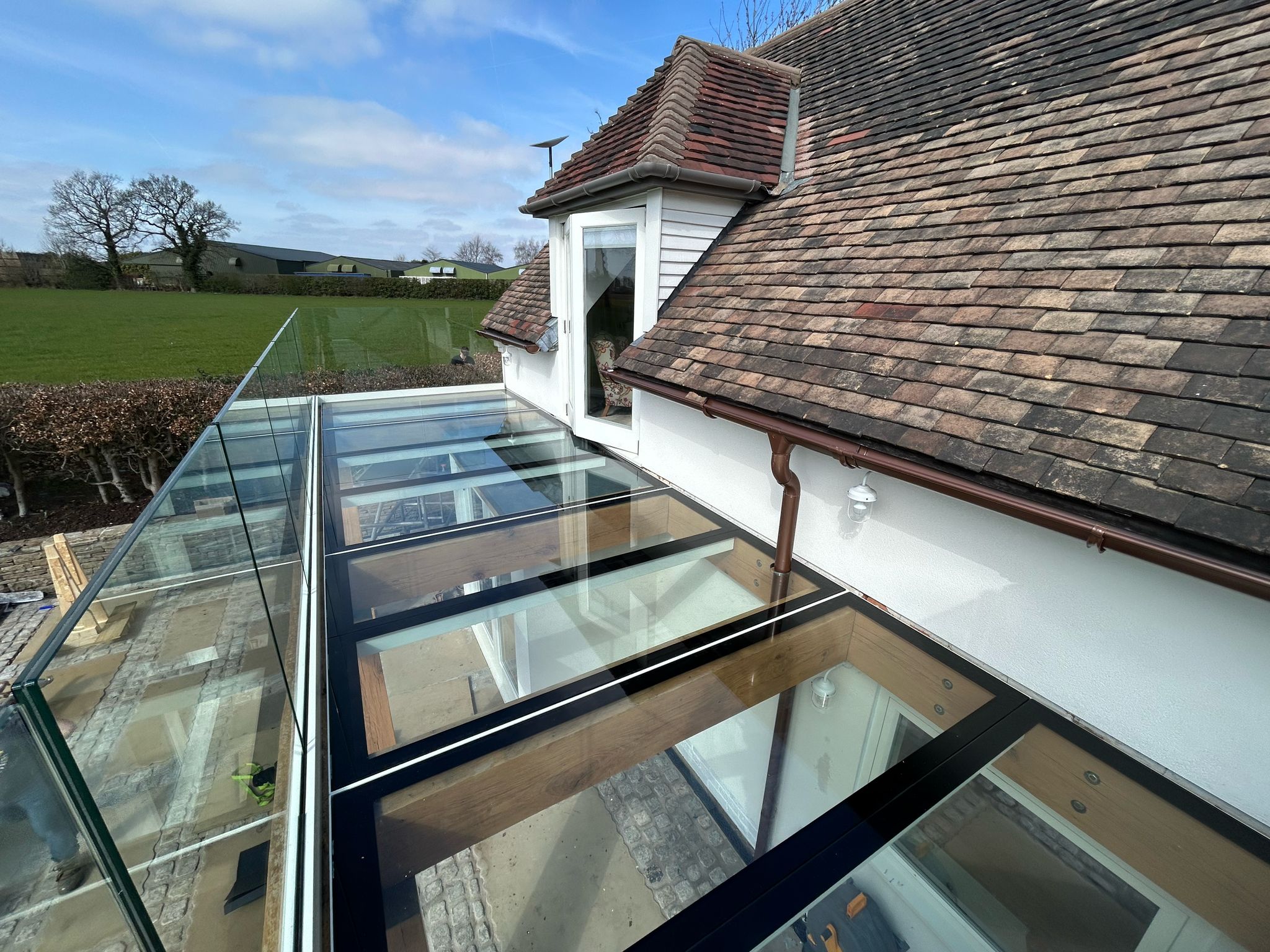
Glass floors used externally (balcony decking, external walkways, roof lights walked on from above) have additional considerations beyond the higher loading requirement of 2.5 kN/m².
Slip resistance is worth thinking carefully about. External glass will get wet, and wet glass is slippery. Whether you need anti-slip treatment (sandblasting, ceramic frit, or our invisible chemical treatment) depends on the use case, how frequently the surface will be walked on, and its proximity to walls, handrails, or other support. A glass panel that's stepped on occasionally to access a roof light is a different proposition to a balcony deck that's used daily. If the glass is in an exposed area with no handrails nearby, anti-slip treatment is strongly recommended. In some cases, installing handrails adjacent to the glass can also help manage the risk.
Wheeled traffic should be avoided or specifically designed for. Wheelchairs, trolleys, and furniture on castors create concentrated rolling loads that standard glass floor panels may not be designed for. If wheeled traffic is expected, this needs to be factored into the glass specification.
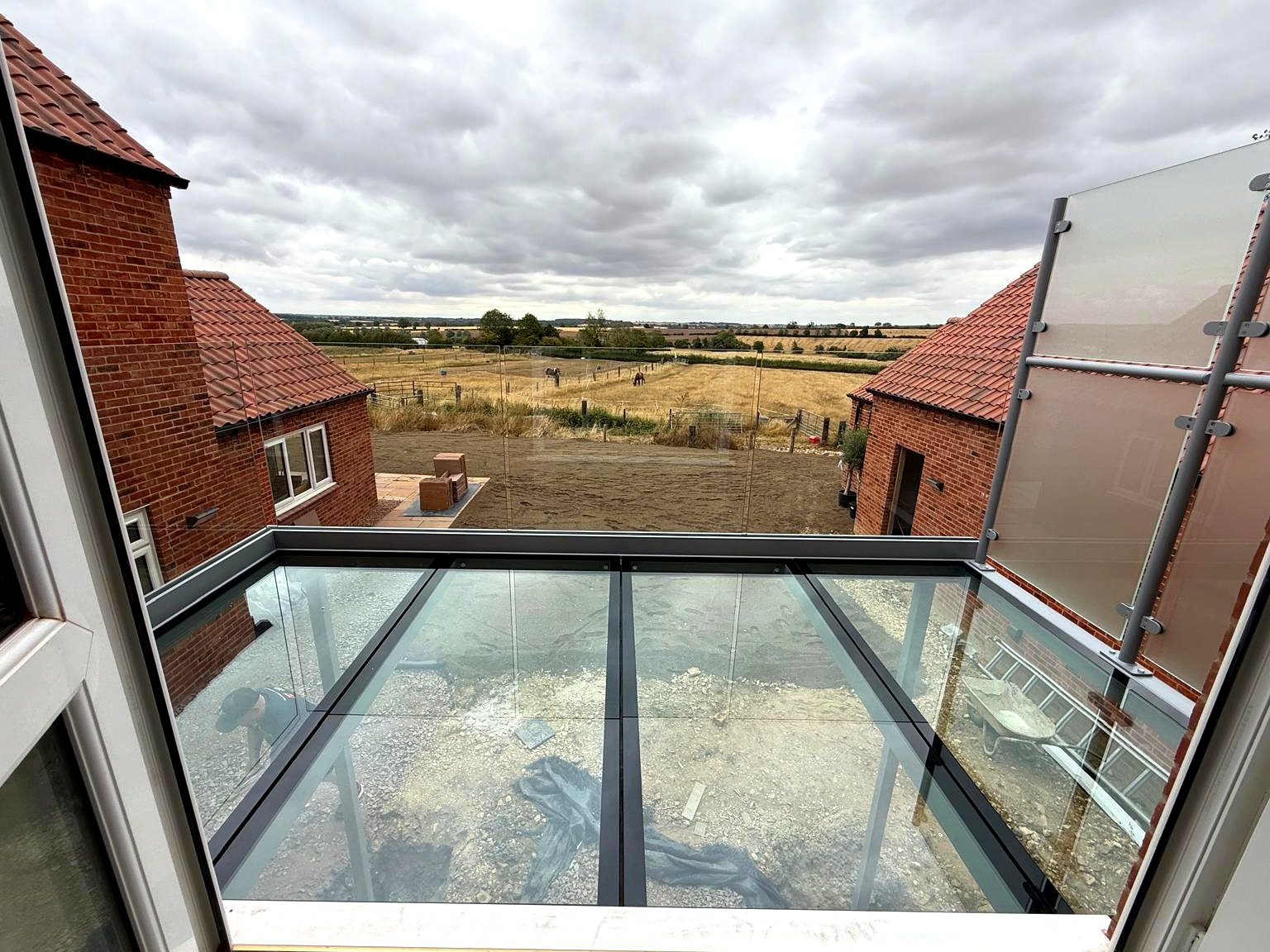
Thermal movement is greater in external applications due to temperature variation. The frame design must accommodate this with adequate clearances and flexible gaskets.
UV exposure can affect the interlayer over time. For external glass floors, specify an interlayer with UV resistance to prevent yellowing or delamination.
Ponding on external floors
Glass deflects under load, and on a large external panel that deflection can be enough to hold standing water in the middle. Ponding looks poor, it collects dirt, and on glass that is already high slip potential when wet it is not what you want underfoot. Falls and panel sizing both need designing for it rather than assuming the water runs off.
Thermal insulation is required wherever a glass floor separates an internal heated space from the outside. Under Approved Document L, any element of the building envelope must achieve adequate thermal performance, and a single laminated glass panel on its own does not meet the required U-values. Dio-Met does not supply insulated glass floor units as a single product, but many customers resolve this by installing an additional insulated glass panel beneath the structural walk-on panel. This creates a sealed cavity that brings the overall U-value in line with Part L requirements. Your building control officer can confirm the target U-value for your specific situation.
For more detail on glass used as external balcony decking, see our balcony building regulations guide.
Which Dio-Met Systems Are Suitable?
Walk-on glass panels: we supply toughened and laminated walk-on floor glass in a range of thicknesses from 25.5mm to 39mm, available as glass-only panels or as complete glass and steel framework systems ready to drop into an opening.
Glass well covers: our glass well covers are available in rectangular and circular formats, designed to span voids, stairwells, and lightwells.
Wine cellar glass hatches: our wine cellar glass doors range includes gas-strut and electric motorised hinged glass floor systems. The steel frames are fabricated bespoke to suit each opening, with toughened laminated glass and your choice of handle style.
Bespoke glass floors: for non-standard sizes, shapes, or applications, we fabricate bespoke steel framework systems to order from our Sheffield factory and source the glass to match. Contact us with your requirements and we'll advise on the best specification.
All our steelwork is fabricated in Sheffield, and we supply and deliver nationwide.
Frequently Asked Questions
Do I need building control approval for a glass floor?
Yes, in most cases. If you're cutting a new opening in an existing floor or installing glass as part of a new build, building control will want to review the structural design and fire safety implications. Contact your local building control department early to confirm their requirements for your specific project.
What loading does a domestic glass floor need to support?
A glass floor in a domestic property must carry a minimum uniformly distributed load of 1.5 kN/m² and a concentrated load of 2.0 kN (Category A1 under BS EN 1991-1-1 with the UK National Annex). External glass floors, such as balcony decking, require 2.5 kN/m².
Is glass floor slippery?
It depends on the surface treatment and whether the glass is wet or dry. Dio-Met offers an invisible chemical anti-slip treatment that achieves PTV values of 68 to 71 in independent HSE pendulum testing, nearly double the low slip potential threshold, while keeping the glass completely transparent. In wet conditions, additional treatments such as sandblasting or ceramic frit may be needed. Ask us about our invisible anti-slip treatment when you get in touch.
Are glass floors fire rated?
No. Standard toughened laminated glass used in floors is not fire rated. However, in most domestic situations building control will accept a glass floor where other fire safety measures are in place, such as fire doors, sprinkler systems, or smoke detectors. Discuss the fire strategy with your building control officer before proceeding.
How thick does glass floor glass need to be?
This depends on the panel size and support conditions. Common specifications for domestic glass floors are 2 x 12mm toughened laminated (25.5mm total) for panels up to around 1,000mm x 3,000mm, or 2 x 15mm toughened laminated (31.5mm total) for larger panels. All glass floor panels must be supported on all four edges.
Can I see through a glass floor?
Clear glass floors are fully transparent. If modesty or privacy is a concern, you can specify a translucent interlayer or sandblasted surface that lets light through while obscuring the view. Sandblasting also improves slip resistance.
Glass floors we have built to these rules
Real installations, all surveyed, made in Sheffield and installed by our own fitters, with the steelwork marked to BS EN 1090-2.
- Electric hinged walk-on glass floor over a wine cellar, Swindon
- Bespoke hinged glass floor, Burwash, East Sussex
- Walk-on floor glass over kitchen pipework, Newcastle
- Glass floor and pond hatch, Chiswick, London
- Circular glass well cover, Bath
- Supply-only glass well cover kit, Kent
- Glass floor balcony, Alderley Edge, Cheshire
- External walk-on glass floor to a walkout balcony, Rutland
- Walk-on glass floor over a wine cellar, exported to Norway
- Circular electric wine cellar door, Scottish Highlands
- All bespoke projects
Related Products
- Walk-on Floor Glass: toughened and laminated glass panels and steel framework systems
- Glass Well Covers: rectangular and circular glass well covers
- Wine Cellar Glass Doors: hinged glass floor hatches with gas-strut and electric options
- Glass Balustrade Building Regulations Guide: companion guide for glass balustrade regulations
- Balcony Building Regulations Guide: companion guide including glass balcony decking
- View all our bespoke projects
Need Advice on Your Project?
Whether it's a simple glass well cover or a bespoke wine cellar hatch with electric opening, we deal with glass floor installations and their regulations every week. Call us on 0114 243 9009 or email sales@diometonline.co.uk, or request a quote online.
Disclaimer
The information on this page is provided by Dio-Met Fabrications Ltd for general guidance purposes only. It does not constitute professional, structural, engineering, or legal advice. While we make every effort to keep this information accurate and up to date, building regulations, British Standards, and their interpretation by local authorities can change and may vary by project and location.
Dio-Met Fabrications Ltd makes no representations or warranties of any kind, express or implied, about the completeness, accuracy, or reliability of the information provided. You should always seek advice from a qualified structural engineer, architect, or your local building control authority before proceeding with any installation.
Dio-Met Fabrications Ltd accepts no liability for any loss, damage, or consequence arising from reliance on the content of this page.
This guide relates to England and Wales only; regulations in Scotland and Northern Ireland may differ.
Tags: glass floor building regulations, walk on glass regulations, glass floor loading requirements, glass well cover regulations, wine cellar glass floor, glass floor slip resistance, glass floor fire rating, laminated glass floor, BS EN 1991 glass floor, glass floor building control