
Glass Balustrades, Stainless Handrails and Brise Soleil — Sharrow School, Sheffield
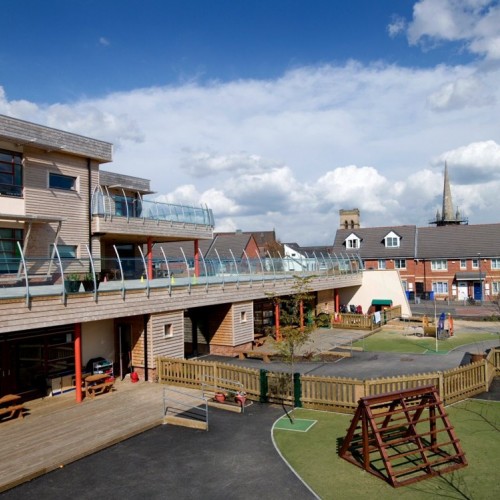
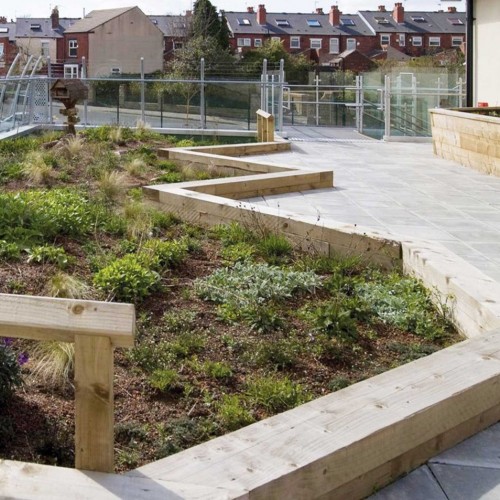
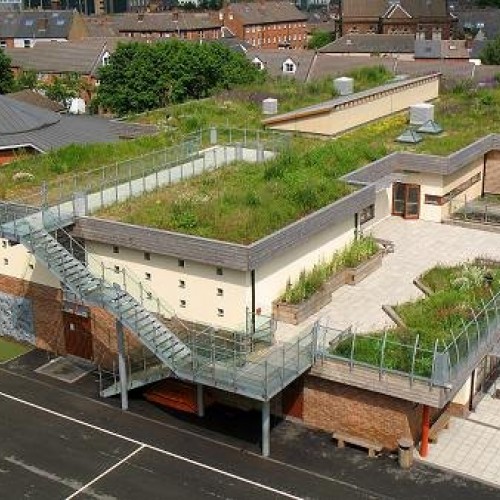
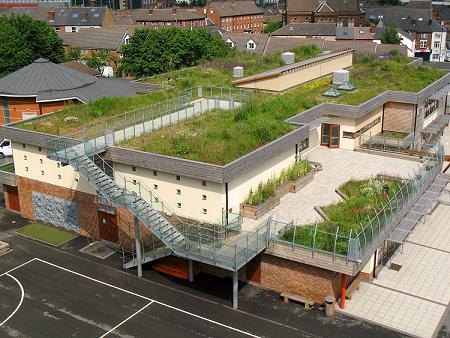
Sharrow School has a nature reserve on its roof. It was the first Local Nature Reserve in the country to sit on top of a building, and it is the reason the school has won the awards it has.
A nature reserve on a roof is only a view until you can safely let a class of primary school children onto it. That is the part we were there for: over 100 metres of external glass balustrade on curved galvanised posts with stainless wire ropes above, plus the internal balustrades and handrails, the external staircase, the ramp handrails, the gates and the brise soleil. Main contractor was Kier Sheffield, working to Sheffield City Council’s own architects.
Project Overview
- Client type: Education, new build primary school
- Main contractor: Kier Sheffield
- Architect: Sheffield City Council
- Location: Sharrow, Sheffield
- External balustrade: Over 100 metres to roof terraces and balconies
- Baluster posts: 60mm diameter curved tubular steel, hot dip galvanised
- Infill: Toughened glass panels with stainless steel wire ropes at high level
- Internal balustrade: 304 grade brushed stainless steel with 10mm toughened glass, to staircases and mezzanines
- Handrails: Twin height stainless steel, returned at every end
- External staircase: Galvanised steel stair with stainless handrails and glass balustrade, serving the green roof and first floor terraces
- Also supplied: Ramp handrails, gates and the brise soleil screens to the outer face of the building
- Scope: Design development, fabrication, supply and installation
- Awards: RIBA White Rose Silver Award for Architecture, and a Sustainable Futures Award
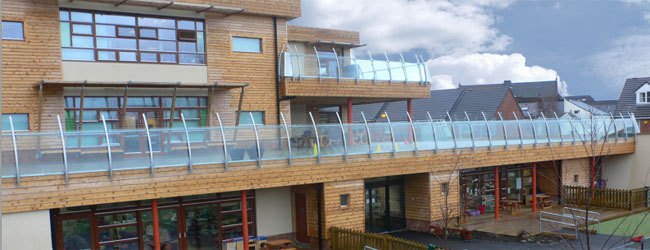
Why the posts are curved, and what that costs you
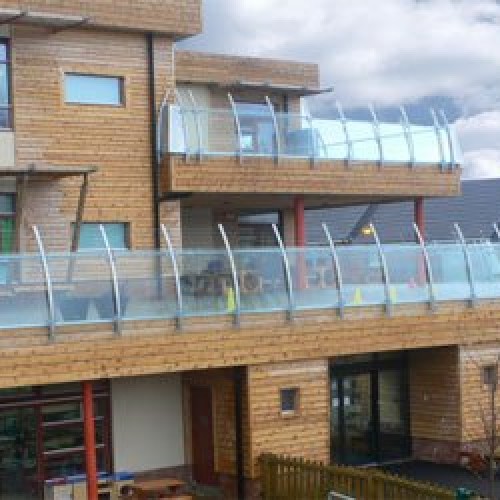
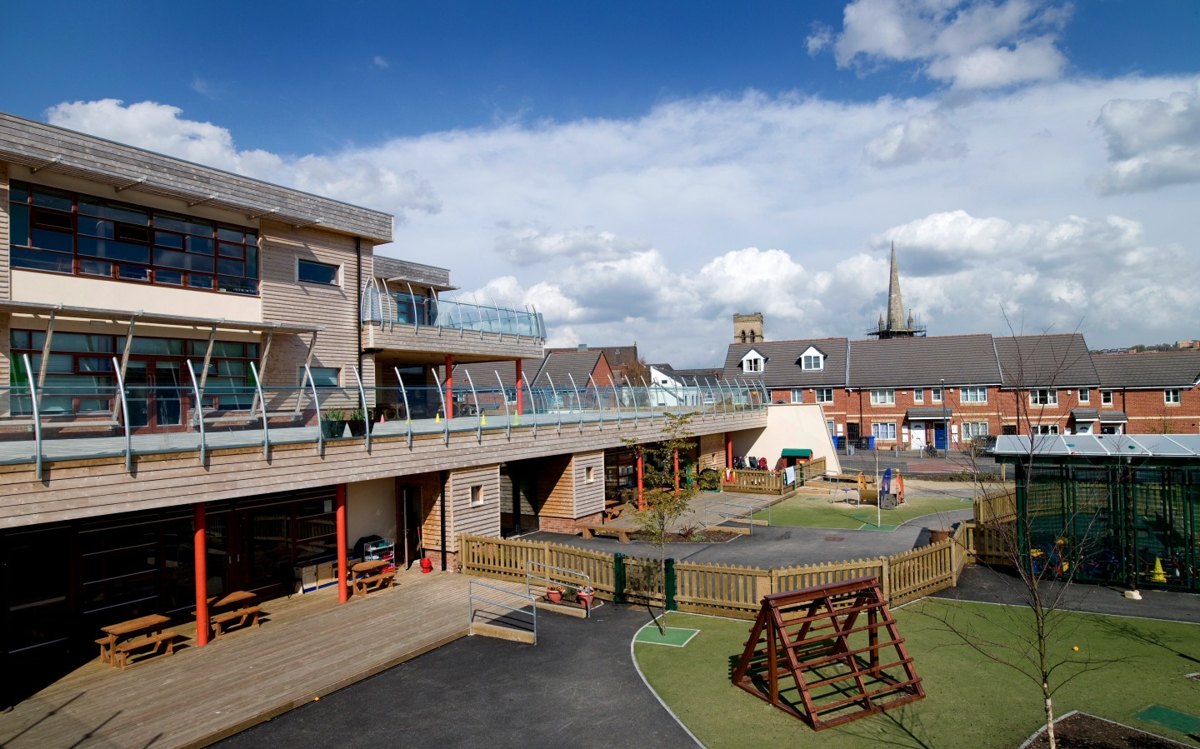
The signature of this building is the baluster. Every post is a 60mm diameter tube, hot dip galvanised, rolled to a curve so it leans out over the drop rather than standing straight up. Along a hundred metres of terrace they read as a rhythm rather than as a fence, and from the playground below they are the thing you notice.
A straight post is a length of tube cut to size. A curved one is a rolled section, and rolling introduces every problem a straight post does not have. The radius has to be identical on every post or the run looks wrong long before anyone can measure why. The glass fixings no longer sit on a vertical line, so each bracket meets the tube at a slightly different point around the curve. The wire rope holes have to be drilled on the arc, not up a straight edge. And the whole assembly still has to end up with the panel gaps even and the top line true.
None of that is difficult in the sense of being clever. It is difficult in the sense of being unforgiving and repetitive, and it is where a job like this is won or lost. It is worth saying plainly that curved balusters cost meaningfully more than straight ones. On a building where the balustrade is the architecture, that is money well spent. On a rear garden terrace, it usually is not, and we will say so.
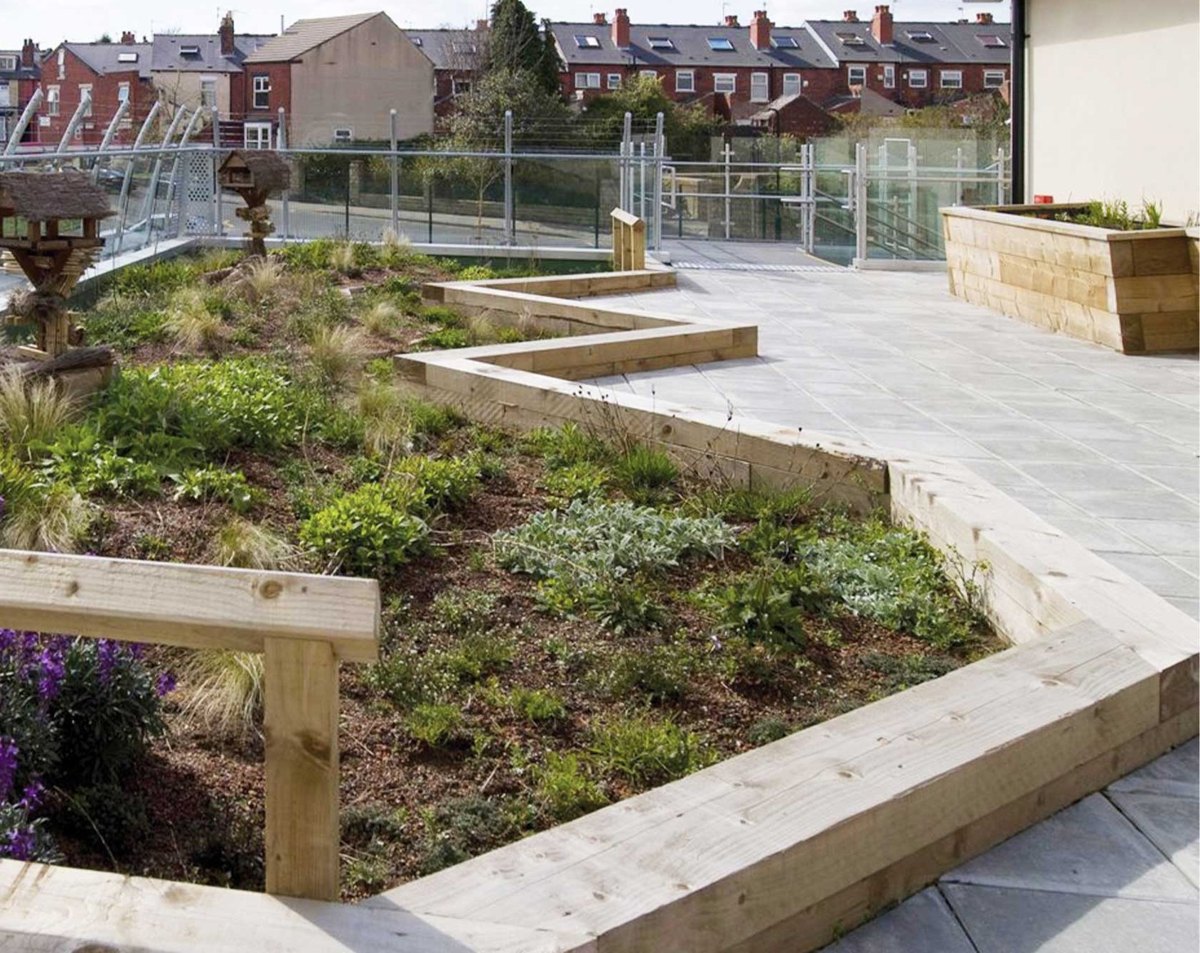
Glass at the bottom, wire ropes at the top. That order matters.
The external guarding is two things stacked. A toughened glass panel from the deck upwards, then stainless steel wire ropes running horizontally above it between the curved posts.
Put that the other way round and you would have a serious problem. Horizontal wires are a ladder to a determined seven year old, and a roof terrace on a primary school is exactly where you do not want a foothold. With the solid panel occupying the lower part of the guarding, there is nothing to get a foot on, and the ropes only start at a height where a small child cannot reach or use them. The arrangement gives you the extra guarding height a roof terrace needs without turning it into something to climb, and without building a wall that would have blocked the view the terrace exists for.
It also keeps the loads sensible. Solid glass all the way up to full height would have been heavier, would have carried more wind, and would have needed bigger posts and heavier fixings into the structure. Ropes above the glass do the same job for a fraction of the wind load.
The other thing worth knowing about a school is that the guarding is designed to a much higher horizontal load than a house. A domestic external balcony is designed to 0.74 kN per metre. A school, where a corridor or a terrace can fill with people, is designed to several times that. Same glass, same look, considerably more steel and more substantial fixings behind it.
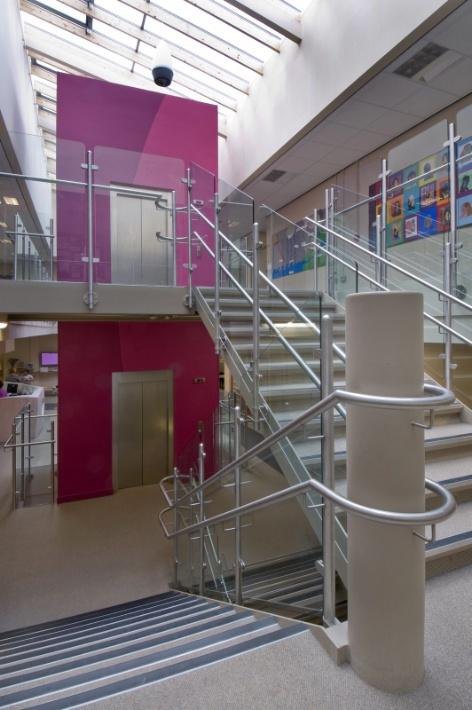
Two handrails, because the users are four feet tall
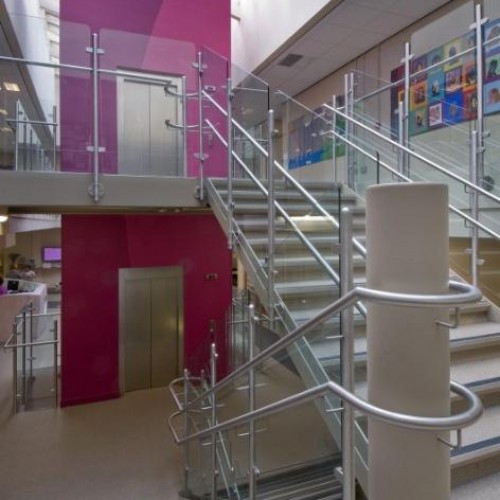
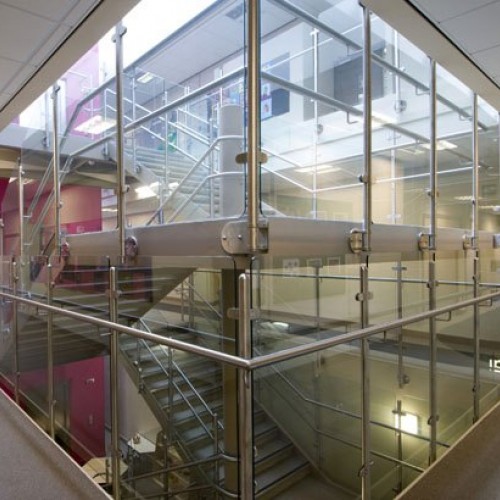
The internal staircases have a handrail at adult height and a second one below it, and that is not a decorative flourish. A rail set for an adult is above the shoulder of an infant school child, which makes it useless exactly when it is most needed. So the stair gets two, one for staff and visitors and one a small child can actually hold.
Look at where they finish. Both rails wrap around the concrete column and return into it. A handrail that stops in mid air is a hook, and a hook at the top of a flight of stairs in a school will eventually catch a coat toggle or a bag strap. Returning the rail costs a bend and a bracket and removes the problem permanently, which is why it is in the guidance and why we do it whether or not anyone asks.
Inside, everything is 304 grade brushed stainless with 10mm toughened glass. Internally that is the right choice: it does not need painting, it survives being grabbed by several hundred children a day, and marks wipe off it.
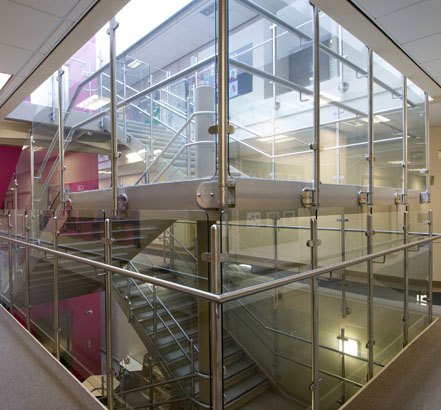
Galvanised outside, stainless inside
The external steelwork is galvanised and the internal steelwork is stainless, and that split is deliberate rather than a budget compromise.
Outside, on a hundred metres of exposed terrace in a Sheffield winter, hot dip galvanising is the finish that keeps working. It is a sacrificial coating bonded into the steel, so a knock from a trolley or a ladder does not start a rust bloom the way a chip in paint does. Over the life of a school building that matters more than the initial appearance.
Inside there is no weather, so the argument changes to how it looks and how it survives being touched. 304 grade brushed stainless is the answer to both, and it is the wrong answer outdoors on a budget of this kind because the quantity involved would have cost a great deal more for no functional gain.
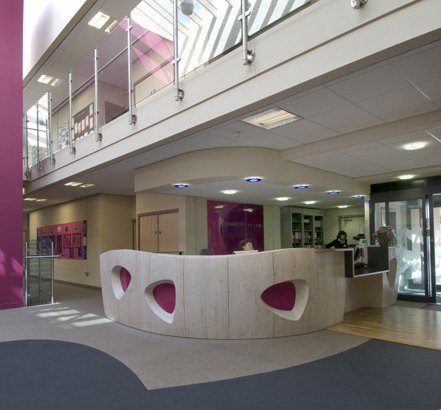
One subcontractor, a lot of separate packages
Listed out, our scope on this building was external terrace balustrades, ramp handrails, gates, an external steel staircase with its own glass balustrade, internal stainless and glass balustrades to staircases and mezzanines, twin handrails throughout, and the brise soleil screens on the outer face.
On a lot of schemes those arrive from four or five different suppliers, which means four or five sets of drawings that were never checked against each other, four different interpretations of the same detail, and a main contractor spending their time being a referee at the interfaces. The internal stainless meeting the external galvanised at a doorway is exactly the sort of junction that gets missed when two firms own the two halves.
Doing the lot ourselves means the interfaces are our problem before they are anyone else’s. For a main contractor like Kier that is worth more than a marginally cheaper quote for one package, because the cost of a missed interface lands on their programme, not on the supplier who caused it.
Frequently asked questions
Do you work as a subcontractor for main contractors?
Yes, and a good part of our work arrives that way. We supply and install to main contractors and principal contractors on education, commercial and residential schemes, working to the programme and producing fabrication drawings for approval before anything is cut. We do not take on JCT contract work, and we supply on our own order and terms.
Can baluster posts be curved rather than straight?
Yes. They are rolled to a set radius and the fixings are then set out on the curve. It is a genuine cost increase over straight posts and it is worth it where the balustrade is a visible part of the architecture rather than a safety requirement to be hidden. Tell us the effect you are after and we will quote both so you can see the difference.
Are glass and wire rope balustrades allowed in a school?
The combination is fine, and the arrangement is what makes it work. Guarding must not allow a 100mm sphere through any opening, and in buildings used by young children it should not be readily climbable. Solid glass in the lower part and ropes above it satisfies both, where horizontal ropes taken all the way down would not.
What heights are the two handrails on a school staircase?
The upper rail is set at normal adult height and a second rail is added lower for children. The exact heights come from the guidance in Approved Document K and BS 8300 and from the age range of the school, so they are set at design stage rather than assumed. What is not optional is that both rails return at their ends so nothing can catch on them.
Should external balustrades be galvanised or stainless?
Galvanised, then powder coated if you want a colour, is the sensible default for external steelwork in quantity. Stainless is the better material in the abstract and is what we use internally and on smaller external features, but across a hundred metres of terrace the cost difference is large and the performance difference outdoors is not. We will price both if it is a close call.
Do you make brise soleil screens?
Yes, as part of a wider metalwork package. Brise soleil is fabrication and fixing rather than anything exotic, and the sensible time to talk about it is while the balustrades and the staircase are being priced, because it is the same steelwork, the same drawings and the same visit to site.
Explore more
Related products
Similar projects
- Stainless steel arches and water rills for an RHS show garden
- Our original case study on this school
- Mesh security screens, terrace guarding and twin handrails at a Sheffield youth centre
- View all our bespoke projects
Working on a school or a commercial scheme?
Send us the drawings and the balustrade schedule. We will come back with a price, fabrication drawings for approval, and an honest view on where the specification is costing you money it does not need to. Email sales@diometonline.co.uk or call 0114 243 9009.
Tags: under stairs glass doors, under stairs wine store, raked glass, wine racking, Delamere, Cheshire